


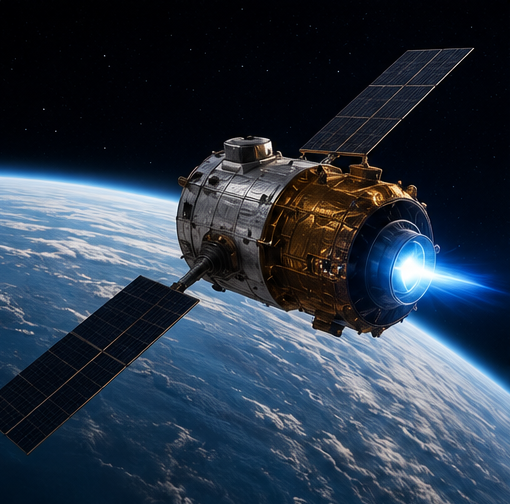
Space industry news across three fronts this week reveals how quickly the orbital economy is diversifying — beyond launches and beyond Starlink. Impulse Space, founded by SpaceX‘s first employee, raised $500 million to build the “last-mile” infrastructure of space — moving satellites efficiently once they are already in orbit. Blue Origin CEO Dave Limp declared the company will fly its New Glenn rocket again before the end of 2026 — six days after it exploded on the launch pad. And the Federal Aviation Administration cleared SpaceX to begin test flights of Starfall — a cargo return capsule designed to retrieve goods manufactured in orbit. Together, the stories define the space economy’s next chapter. Getting to orbit is increasingly routine. What you do once you are there is the new race.
What’s Happening & Why It Matters
Impulse Space: $500M to Solve the Last-Mile Problem
Impulse Space closed a Series D round of $500 million on 2 June, co-led by 137 Ventures and BANNER VC, with participation from Founders Fund, Lux Capital, and Linse Capital. The round values the company at $4.26 billion (€3.93 billion) and brings total capital raised to over $1 billion. Impulse Space was founded by Tom Mueller — the first employee Elon Musk ever hired at SpaceX and the propulsion engineer behind the Merlin engines that made Falcon 9 the world’s dominant launch vehicle.
Mueller described the problem his company solves with precision. “Launch has pretty much been solved. The challenge is getting everywhere else beyond low Earth orbit.” He is right. A satellite launched on a Falcon 9 reaches low Earth orbit. From there, it must maneuver itself — often spending months slowly drifting to its final operational position. For geostationary orbit — the slot used by most communications satellites — that drift can take a year or more. Impulse Space operates spacecraft that pick up that satellite and deliver it rapidly to its destination.
Mira, Helios, and the Caravan Program
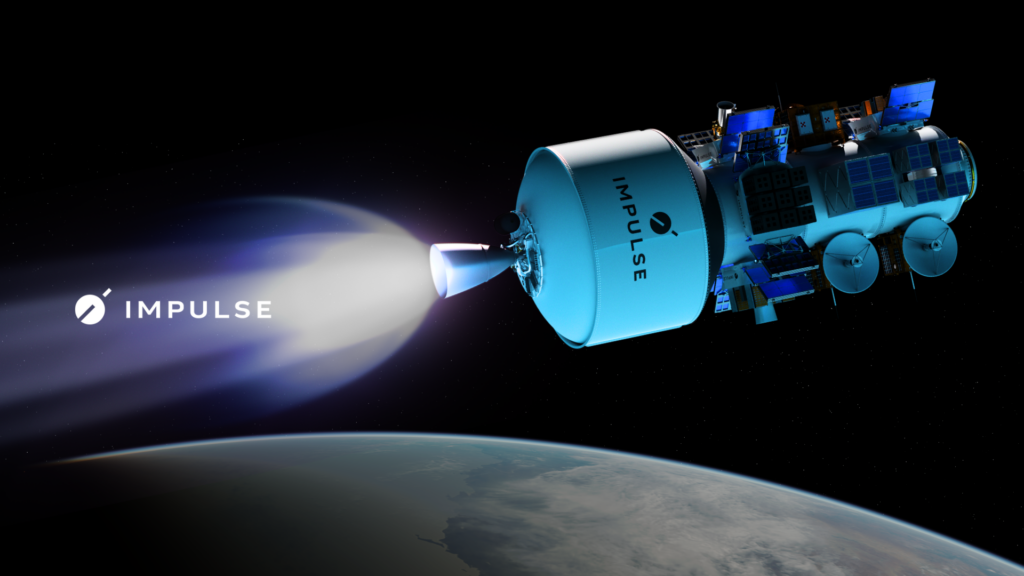
Impulse Space operates two primary vehicles. Mira is a flight-proven precision maneuvering spacecraft that has completed three orbital missions. It deploys satellites, hosts payloads, and repositions spacecraft in orbit. Helios is the company’s larger, higher-energy kick stage — powered by the proprietary Deneb engine — scheduled for its first flight in 2027. Helios is designed to move payloads from low Earth orbit to geostationary orbit rapidly. That speed matters commercially. Every month a geostationary communications satellite spends spiralling slowly to its operating slot is a month of lost revenue for its operator.
The Caravan rideshare programme provides scheduled group transport to geostationary orbit starting in 2027. Multiple satellite operators book slots on a shared Helios stage — dramatically reducing the cost of reaching GEO compared to dedicated upper stage services. The national security dimension is also significant. The Pentagon selected Impulse Space and Anduril Industries to develop prototypes of space-based interceptors. Space Force budgets are growing. Dynamic space operations — frequent maneuvering rather than fixed orbital positions — require exactly the mobility infrastructure Impulse is building.
Beyond Satellites: Moon, Mars, and Off-Earth Manufacturing
The Series D funds three priorities. First, production scaling — Impulse plans to hire more than 200 people across Redondo Beach, Colorado, and Washington, DC. Second, manufacturing capacity expansion across its multi-state facilities. Third, capability development for missions beyond Earth orbit. The Helios kick stage is compatible with SpaceX Falcon 9, Falcon Heavy, and Starship. It is capable of reaching lunar orbit. As TF covered in its NASA moon base article, the lunar economy represents a massive new demand driver for in-space transport. Impulse is also building a robotic lunar lander — potentially as early as 2028. Mueller’s vision is explicit. “We’re building more than spacecraft; we’re building the economic and technical engine that will power humanity’s expansion into space.”
Blue Origin: “We Will Fly Again Before the End of This Year”
As TF covered in its Blue Origin explosion article, New Glenn exploded on Launch Complex 36 at Cape Canaveral during a static fire test on 28 May 2026. Six days later, Blue Origin CEO Dave Limp posted a damage assessment on X — and ended it with a commitment. “We will fly again before the end of this year.” He signed off with the company motto: “Gradatim Ferociter” — Latin for “Step by Step, Ferociously.”
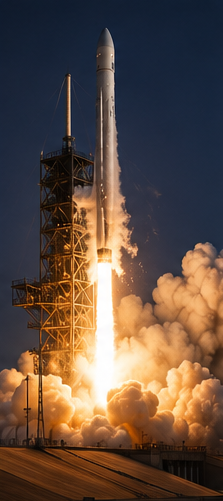
The damage assessment was more optimistic than industry observers had expected. The propellant farm, oxygen, liquid hydrogen, and LNG tanks at LC-36A are all intact and in good condition. The rocket booster already on site for a future mission also survived. Three upper stages stored nearby look good. The main support tower — the transporter-erector — was destroyed. By contrast, Blue Origin has been developing an alternative vertical concept of operations that eliminates the need for a traditional transporter-erector entirely. The explosion accelerated the switch to that design.
The Rebuild Plan — and the Rocket Variant Chosen
Blue Origin‘s recovery plan centres on a specific vehicle decision. Rather than rebuilding LC-36A for the more powerful 9×4 variant of New Glenn — which would take longer and require a larger pad — the company chose to rebuild for the 7×2 variant. That choice is explicitly designed for speed over capability. The 7×2 version is smaller. It returns to flight faster. The six-month timeline Limp referenced puts a return-to-flight as early as Q4 2026 — which aligns with NASA’s Artemis planning horizon.
The stakes could not be higher. NASA is depending on New Glenn to launch the Blue Moon Mark 1 lander to the lunar south pole this autumn. The VIPER rover delivery to the lunar surface in 2027 uses New Glenn. A crewed Blue Moon Mark 2 lander for Artemis requires New Glenn’s demonstrated reliability. And NASA awarded Blue Origin a $468 million contract this month for lunar terrain vehicles targeting 2028 delivery. All of that depends on New Glenn flying again.
SpaceX Starfall: Factories in Orbit — the FAA Clears the Way
The third story this week is the furthest from commercial deployment — and perhaps the most consequential in the long run. On 29 May 2026, the FAA issued an environmental assessment and a Record of Decision approving test flights for SpaceX‘s Starfall — an uncrewed cargo return capsule designed to retrieve goods manufactured in orbit. The approval covers two reentry tests into the Pacific Ocean approximately 1,300 km (808 miles) off California’s coast. The capsules can launch on either Falcon 9 or Starship.
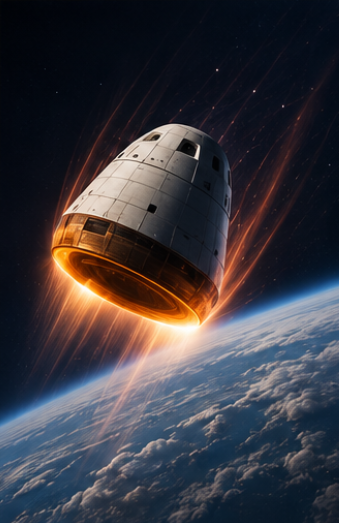
Starfall’s physical specifications are compact. Each capsule measures 3.1 metres (10.2 feet) in diameter and 0.75 metres (2.5 feet) in height. Total vehicle mass is 2,100 kg (4,630 lbs). Payload capacity reaches 1,000 kg (2,205 lbs) within a volume of 2.5 × 1.5 × 0.5 metres. Descent uses drogue, pilot, and main parachutes combined with cold-gas thrusters for attitude control. SpaceX maritime teams recover the capsule after ocean splashdown.
What Starfall Is Actually For — and Its Impact
The FAA Record of Decision is unusually specific about Starfall‘s intended purpose. SpaceX envisions it as an orbital manufacturing logistics backbone — a system that “offers access to microgravity and vacuum, loiter on orbit, and safe return from orbit as a service at scale.” The applications that specific environment enables are commercially significant. In microgravity, crystals grow with a perfection impossible on Earth. Fibre-optic cables produced in orbit carry significantly more data per strand. Pharmaceutical compounds of extraordinary purity are achievable. Semiconductor wafers grown in vacuum exhibit fewer defects. None of those products can be replicated at the same quality in Earth’s gravity.
SpaceX is entering a market pioneered by Varda Space Industries — which has already successfully returned capsules containing orbit-manufactured materials. By contrast, Varda operates as a customer. SpaceX‘s entry positions it as the infrastructure provider — launching, loitering, and returning as a service. That vertical integration is the commercial model SpaceX has applied to launch and internet services. Starfall applies it to manufacturing. The US military has also expressed interest — specifically in Starfall’s potential for rapid point-to-point cargo delivery using suborbital trajectories.
TF Summary: What’s Next
Impulse Space‘s $500 million scales production of Mira and Helios toward Caravan’s 2027 commercial launch. Hiring of more than 200 staff begins immediately across three states. Blue Origin begins LC-36A rebuild immediately — targeting return to flight in Q4 2026 with the 7×2 New Glenn variant. No launch dates for Starfall tests have been confirmed. The FAA clearance covers two test reentries — actual launch scheduling follows SpaceX‘s internal timeline.
MY FORECAST: Space industry news from this week traces three converging lines that define the next decade of orbital commerce. Impulse Space‘s valuation at $4.26 billion will prove conservative by 2028. The in-space mobility market is growing faster than any sector of the launch industry.
Helios‘ first flight in 2027 will be the moment the market recognises that Mueller has built the second essential infrastructure layer of the space economy — after launch. Blue Origin will fly New Glenn in Q4 2026 as Limp promised — but it will be the 7×2 variant on a rebuilt pad, not the more capable vehicle that would have made the company commercially competitive with SpaceX. The one-year delay in that capability upgrade is commercially significant.
Meanwhile, Starfall will complete its two test reentries without incident — and the orbital manufacturing market will accelerate faster than almost anyone currently models. By 2030, manufacturing in orbit and returning products to Earth will be as commercially routine as launching a satellite.
The physics that make it possible have not changed. What is changing is the infrastructure that makes it economical.