



€15.6 billion. More than double the original estimate. 348 satellites instead of 282. And a defence layer nobody asked for two years ago, added because one American president’s phone call with Ukraine changed how Europe thinks about who controls its connectivity.
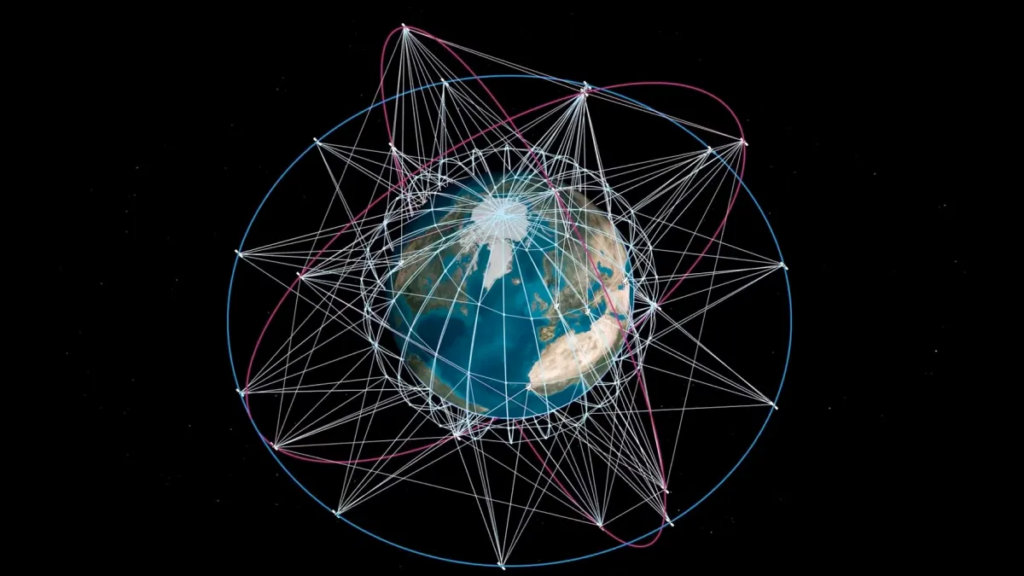
The European Commission finalised its implementation agreement with the SpaceRISE consortium on August 6-7, moving IRIS² — the EU’s sovereign satellite network — from planning into full-scale deployment. The total bill is at €15.6 billion, more than double the €6 billion figure cited when the project was first announced back in 2022. IRIS² stands for Infrastructure for Resilience, Interconnectivity and Security by Satellite. The constellation grew during negotiation too. Manufacturers agreed to build 66 more satellites than planned. This takes the total to 348 — 330 in low Earth orbit, 18 in medium Earth orbit.
What’s Happening & Why It Matters
Beyond Competing With Starlink
Despite the constant comparisons, IRIS² and Starlink aren’t built for the same job. Starlink runs more than 10,000 active satellites, chasing consumer and commercial broadband at massive scale. IRIS² isn’t designed to match that count or that market. Instead, it’s built to give European governments, defence forces, and emergency services connectivity they control end-to-end. They will not depend on decisions made in Washington or Texas.
That distinction has a specific origin. Commissioner Kubilius traced the strategic logic to a moment in February 2025: the meeting between President Trump and Ukrainian President Zelensky, followed by the suspension of US military aid, which raised a question European officials hadn’t asked before. How long could allied forces assume Starlink access would stay available? “Without secure connectivity there is no defence,” Kubilius said at the European Space Conference in January. As a result, IRIS² is the institutional answer to that question.
66 New Satellites, All for Defence
The expansion from 282 to 348 satellites isn’t padding. Those extra 66 satellites form a dedicated quantum-secured defence and security layer, confirmed as part of the week’s Rendezvous 1 agreement. That’s a meaningful architectural choice — Europe isn’t just building broadband redundancy. Instead, it’s building a military communications system it owns.
Spain is putting real money behind that layer. Hispasat will lead the ground segment and the low-LEO portion of the network. Spain announced additional investments between €1.6 and €2 billion tied to the project. Norway and Iceland have already joined as non-EU contributors. They are adding roughly €40 million and €3 million for the 2026-2027 period.
The Three-Year Gap
Here’s the part that gets buried in most of the coverage: first launches aren’t happening until 2029, with full operational capability targeted for 2030. That leaves a gap. European governments don’t have a sovereign satellite system that can compete with Starlink on latency or coverage. They won’t have one for at least three more years.
The bridge is called GOVSATCOM, which became operational back in January. It pools capacity from existing geostationary satellites contributed by France, Spain, Italy, Greece, and Luxembourg through a shared ground-hub architecture. It’s not a full substitute. It’s a stopgap, built to cover the years IRIS² needs to get satellites into orbit.
Germany’s Going Its Own Way
Not every EU member is bought into the shared approach. Germany’s military is building a national €10 billion satellite constellation of its own. That development has already created friction within the IRIS² coalition. “Of course we need to look at how we integrate new developments of sovereign constellations,” Kubilius acknowledged following the signing. This is a careful way of saying Europe hasn’t agreed on whether “sovereign” means one shared system or several national ones running in parallel.
TF Summary: What’s Next
First IRIS² launches are targeted for 2029, with full operational capability by 2030. GOVSATCOM continues serving as the interim bridge through that gap. Spain’s additional €1.6-2 billion investment and Hispasat’s ground-segment leadership role are in active development. Germany’s separate national constellation proceeds, with integration questions still unresolved.
MY FORECAST: Expect the €15.6 billion figure to spike before first launch in 2029 — European infrastructure megaprojects have a consistent pattern of cost growth between implementation agreement and actual deployment. IRIS² has already more than doubled its original estimate once. The Germany question is the one worth watching. If Berlin’s national constellation and IRIS² end up running as separate systems rather than integrated ones, that fragments the “sovereign” advantage the whole project was built to deliver. Watch for additional non-EU countries to follow Norway and Iceland’s lead and buy into the network over the next 18 months. This is likely given how the defence layer’s expansion signals Europe treating satellite communications as a security asset, not just a broadband alternative.
Related Stories
- SpaceX Slides on 12M Subscribers, AI Spending and Mobile Plans
- AST SpaceMobile Delays Service to 2027, Eyes Acquisitions
- NASA Commits $590 Million to Four New Lunar Missions