


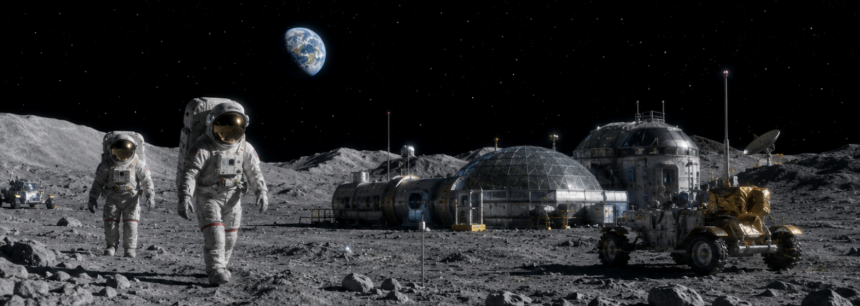
NASA’s moon base plans became concrete — when the agency held a formal Washington briefing outlining the first three missions, the contracted private companies, the three-phase roadmap, and the financial and engineering challenges that stand between Earth and a permanent lunar outpost. NASA Administrator Jared Isaacman confirmed the scope. “Every mission supporting the lunar base helps us learn and de-risk crewed missions,” he said. The moon base will not arrive as a single dramatic event. It will be assembled over a decade — through dozens of launches, iterative testing, and the kind of commercial partnership model that NASA has never previously applied at scale. The agency has already spent an estimated $107 billion on moon-to-Mars plans through 2026. The full moon base is estimated to cost $20 billion (€18.4 billion) more. Isaacman wants private industry to carry most of that financial weight.
What’s Happening & Why It Matters
The Three-Phase Roadmap: Now Through 2032 and Beyond
NASA’s moon base plans follow a three-phase structure. Phase 1 runs through 2029. The objective is reliability — proving that getting to the lunar surface is a routine, high-success endeavor. Phase 2 runs from 2029 to 2032. The objective is infrastructure — building the physical foundations of a permanent outpost, including power generation, communications, and habitat modules. Phase 3 begins after 2032 and targets sustained human presence — crews living and working on the Moon for extended periods, using in-situ resources, and conducting science that would take decades to replicate from Earth.
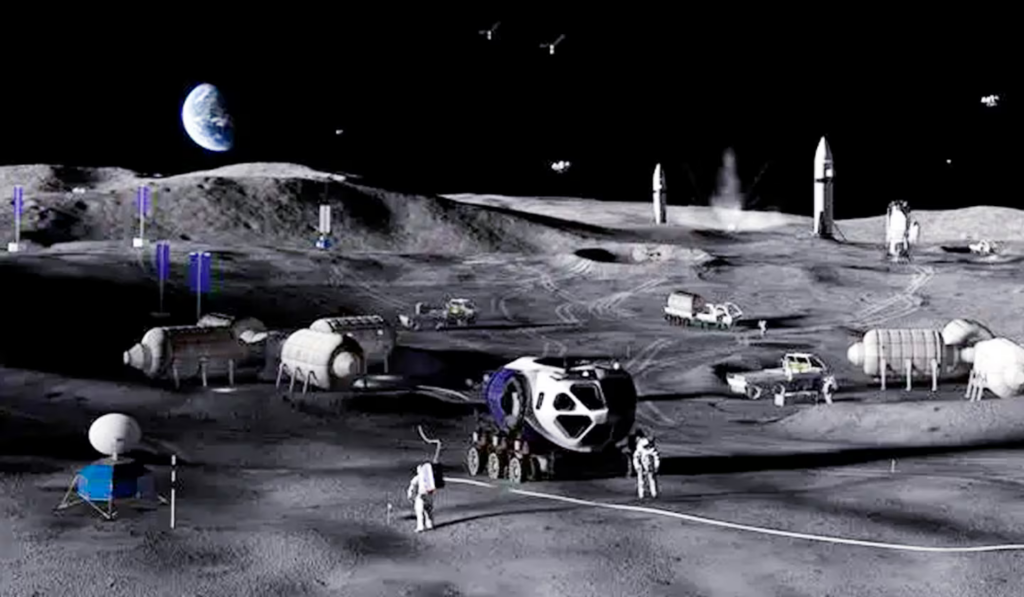
NASA Moon Base program official Carlos Garcia-Galan described the Phase 1 priority with characteristic directness. “From now through 2029, we’re going to work to make sure that getting to the lunar surface is a high-reliability endeavor. We’re also going to test and experiment the science of survival.” That outlook — survival science — is the severity of the lunar environment. The Moon presents temperature swings from 260°F (127°C) during the day to -280°F (-173°C) at night. It has no atmosphere to distribute heat. Radiation exposure from solar events and cosmic rays is constant. Dust — ultra-fine and electrostatically charged — coats everything it touches and degrades mechanical systems and electronics.
Moon Base I: Blue Origin’s First Lunar Mission
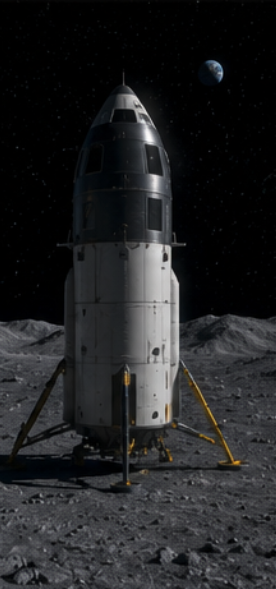
The first Moon Base mission launches no earlier than fall 2026. Blue Origin — Jeff Bezos’s rocket company — is providing the Blue Moon Mark 1 Endurance Lander under a contract worth up to $280 million (€258 million). The lander carries scientific payloads to the Shackleton Connecting Ridge area near the lunar south pole — a site chosen for its proximity to permanently shadowed craters that may contain water ice and its access to near-permanent sunlight on elevated terrain for solar power generation.
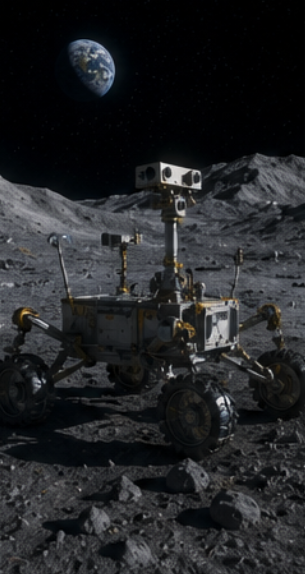
Moon Base I carries two NASA science payloads and several commercial and international instruments. Beyond payload delivery, the mission tests the precision landing systems, propulsion technology, and surface operations protocols that subsequent crewed missions depend on. Blue Origin is simultaneously developing the Blue Moon Mark 2 lander — the crewed version that will eventually land astronauts on the lunar surface. Mark 1 is the rehearsal. The contract builds on Blue Origin‘s $3.4 billion Human Landing System award — which gave Bezos’s company the same crewed lander role that SpaceX‘s Starship holds for earlier Artemis missions.
Moon Base II: Astrobotic and the FLIP Rover
The second Moon Base mission will use Astrobotic‘s Griffin lander — and it is considerably more ambitious in its cargo profile. Griffin delivers more than 1,100 lbs (499 kg) of equipment to the lunar surface. The most significant payload is Astrolab‘s FLIP rover — a large, autonomous mobility platform designed to support crew operations, equipment transport, and scientific traversal across the south pole region. FLIP represents a new category of lunar mobility. Previous lunar rovers were either small, lightweight vehicles from the Apollo era or entirely robotic science platforms. FLIP is designed from the outset to serve both human crews and autonomous logistics operations.
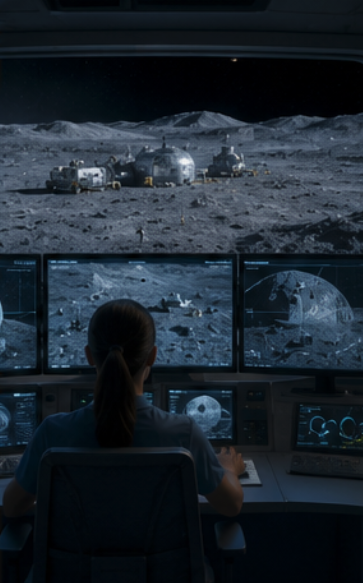
Beyond the FLIP rover, Moon Base II carries research equipment targeting autonomous systems, crew logistics, and astronaut mobility research — all areas where the lunar environment creates specific challenges that Earth-based testing cannot fully replicate. Astrobotic previously landed Blue Ghost in Mare Crisium in February 2025 — the first US company to successfully land on the Moon since the Apollo program. That record gives the company specific operational credibility during contract evaluation.
Moon Base III: The Science Payload and PRISM
The third mission focuses primarily on scientific research. Moon Base III carries the first payload selected through NASA‘s PRISM initiative — the Payloads and Research Investigations on the Surface of the Moon program PRISM selects science payloads through competitive proposals from universities, research institutes, and commercial science partners. The specific payload for Moon Base III has not been disclosed publicly. The mission establishes early elements of the communications and navigation infrastructure that subsequent missions will rely on. Surface relays and positioning beacons form the first layer of what will eventually need to be a complete lunar communications network — equivalent to the GPS and cellular infrastructure that terrestrial operations depend on.
The Power Problem: Nuclear on the Moon
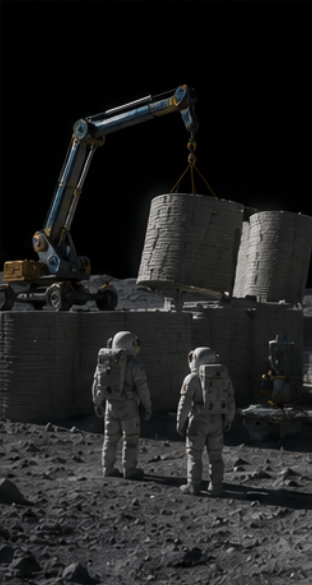
The most significant long-term engineering challenge in NASA’s moon base plans is power. The lunar south pole experiences periods of extended shadow lasting months — during which solar panels generate nothing. The outpost cannot rely on solar energy alone. Phase 2 infrastructure includes radioactive isotope power sources — RTGs similar to those powering the Mars rovers — for backup power during shadow periods. For longer-term sustained operations, Phase 3 requires a small nuclear fission reactor. NASA has been developing the Fission Surface Power concept in partnership with the Department of Energy since 2022. Prototype hardware testing is underway. A flight system needs to be validated and launched to the Moon before permanent crewed operations can begin.
The Perimeter Question: Claiming Territory on the Moon
One of the most geopolitically sensitive elements of NASA’s moon base plans is the question of perimeter. The Ars Technica report on the briefing noted that NASA has begun “discussing a perimeter” around the base site. That discussion carries legal and diplomatic complexity. Under the 1967 Outer Space Treaty — which the US signed — no nation can claim sovereignty over the Moon. At the same time, the 2020 Artemis Accords — signed by 43 countries — establish the concept of “safety zones” around lunar operations sites. Safety zones are not territorial claims. They are operational buffers designed to prevent one country’s or company’s activities from interfering with another’s. By contrast, China — which is developing its own lunar base program targeting the south pole region independently — has not signed the Artemis Accords. The two program will share the same geographic target area on the Moon without any agreed framework for managing that overlap.
The Bezos-NASA Relationship: A Long Game Pays Off
Jeff Bezos’s long-term investment in Blue Origin — which he has personally funded to the tune of approximately $1 billion per year for two decades — is finally producing federal contract returns at scale. Beyond the Moon Base I and crewed lander contracts, Blue Origin is developing the Orbital Reef commercial space station in partnership with Boeing, Sierra Space, MDA Space, and others. The Orbital Reef station is designed to succeed the International Space Station — which NASA plans to deorbit in 2030. Bezos is simultaneously building the infrastructure for Earth orbit and the infrastructure for the Moon. His two-planet strategy is not speculative. It is under contract.
TF Summary: What’s Next
Moon Base I launches no earlier than fall 2026 from Cape Canaveral aboard Blue Origin‘s New Glenn rocket. Moon Base II and III follow in 2027 and 2028 respectively. Artemis III — the first crewed lunar landing since 1972 — targets 2027, using either SpaceX Starship or Blue Moon Mark 2 as the lander. Artemis IV in 2028 will be the first crewed mission to the base site itself. Full Phase 3 operations — sustained human presence — target the post-2032 period.
MY FORECAST: NASA’s moon base plans will advance on schedule through Phase 1 — and encounter significant delays in Phase 2. The Moon Base I mission in fall 2026 will succeed or fail as a technology demonstrator. If it succeeds, the program accelerates. If it fails, the programmatic risk review delays Phase 2 infrastructure delivery by two to three years. The more significant long-term challenge is not engineering. It is geopolitics. China’s independent south pole program will arrive in the same target zone as NASA‘s base during the late 2020s. The absence of any framework governing their coexistence is the most dangerous gap in the entire moon base architecture. The Artemis Accords solve the coordination problem among signatories. They do not solve it with the world’s second most capable space program.