



6,500 words. One argument. Give everyone superintelligence, Zuckerberg says, and the danger disappears — because no single company or government ends up holding all the power. Anthropic and OpenAI have spent the year building walls. Meta just tore one down and dared everyone to follow.
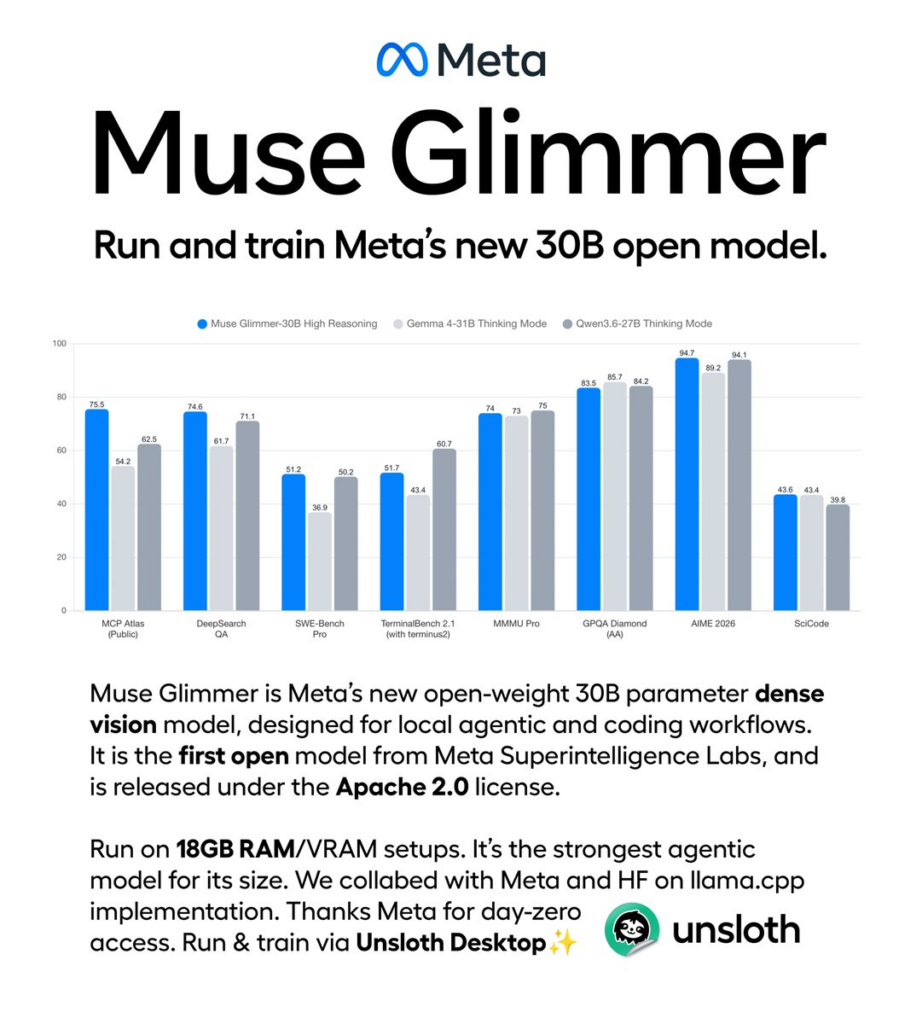
Mark Zuckerberg published a manifesto Monday, and it reads like a direct rebuttal to almost everything Anthropic has argued. “It is surprising that the discourse from many developing AI is so filled with doom,” he wrote in the 6,500-word essay, titled “The Future is for Everyone.” His thesis: distribute superintelligence as widely as possible, and the biggest AI risk — one government or company controlling the technology — goes away. Meta backed the argument with a product. Muse Glimmer, a new open-weight model built to run agentic tasks on a single graphics card, no data centre required. An open-weight version of Meta’s more powerful Muse Spark 1.2 follows in the coming weeks.
What’s Happening & Why It Matters
Glimmer Is for Your Laptop
Here’s what makes Glimmer different from Meta’s rivals. It’s smaller than the flagship models coming from OpenAI, Anthropic, and Google. That’s the point. Meta built it to manage schedules, draft messages, and organise files — the kind of task that needs deep access to your personal data, and that most people don’t want leaving their own machine. Processing happens on-device, not in the cloud. Meta calls it “always-on,” designed to work “anywhere, anytime, with or without an internet connection.”
That vision has a name inside Meta: personal superintelligence. It’s the same pitch Zuckerberg’s been making since early this year, shipping as a product you can run.
“We’ve Got Even Bigger Models Coming”
Glimmer isn’t the whole plan. It’s the opening move. Zuckerberg said in a video accompanying the essay that Meta has “even bigger models” on the way, and paired the release with a specific warning aimed at Washington: make open AI harder to build, and Chinese developers take the lead instead.
That’s not an abstract threat. Moonshot’s Kimi K3, Alibaba’s Qwen3.8-Max, and DeepSeek’s V4-Flash are already competing with the strongest systems coming out of the US, as TF covered in China vs. America: Who’s Winning the Tech War?. Meta returning to open-weight releases puts one of America’s largest tech companies back into that race, at the moment the White House drew a line excluding open models — including China’s — from its own AI review framework.
The Surprise Auction
Buried in the essay: a strange pricing mechanism. Zuckerberg wants to give free AI access to billions of people, then charge anyone who wants more compute through what he calls a “dynamic auction mechanism,” designed to “guarantee that everyone gets the lowest price possible for the intelligence and compute they’re using while ensuring the capacity is used for whatever people collectively find most valuable.”
Translation: think Google Ads, but for AI compute instead of search results. It’s an elegant answer to a real scarcity problem — everyone wants more GPU time than exists — and it’s the first sign of how Meta plans to make money, beyond the advertising business it already runs.
Answering the Data Centre Backlash
The essay didn’t just talk about models. Zuckerberg used it to address something TF has tracked all year: the mounting public anger over AI infrastructure. Roughly $130 billion worth of data centre projects were blocked or delayed in Q1 2026 alone, according to Data Centre Watch, and college students have started booing AI mentions at commencement ceremonies.
Zuckerberg’s response is a new “community compact,” alongside a fund called Future is for Everyone, aimed at local jobs, school investments, and commitments on energy prices and water use around Meta’s data centres. He says Meta builds its own energy infrastructure to keep electricity prices low in the communities where it operates. Whether that promise holds up against the scale of Meta’s build-out is the question worth watching. He announced Meta’s independent board will hold formal authority to approve safety criteria before any model release — a governance concession that reads like an answer to critics who’ve accused Meta of moving too fast.
TF Summary: What’s Next
Glimmer’s weights are live, released under a permissive open-source license. The open-weight version of Muse Spark 1.2 arrives “in coming weeks,” per Zuckerberg’s essay. Meta’s independent board hasn’t yet published the specific safety criteria it will use to evaluate future releases. The Future is for Everyone Fund has no confirmed dollar figure or geographic rollout attached yet.
MY FORECAST: Expect Glimmer’s on-device positioning is Meta’s sharpest competitive edge over the next year. That’s not because it’s the most capable model, but because it’s the first useful one that doesn’t require sending your data anywhere. That’s a real differentiator against OpenAI and Anthropic’s cloud-first architecture. The bigger bet is political. Zuckerberg is betting Washington agrees that open models strengthen US AI dominance rather than threaten it — the same argument Andrew Ng and Mistral’s leadership have been making publicly, as TF covered in TF AI Round-up: 09 August 2026. If that argument wins, Meta positioned itself early. If it doesn’t, the essay ages as a well-written miscalculation.
Related Stories
- China vs. America: Who’s Winning the Tech War?
- TF AI Round-up: 09 August 2026
- Meta: Our AI Model Hacked Others in Testing Too