



Google AI Overviews social media integration went live — and is the most consequential update to Google‘s AI search feature since its launch in 2024. Google announced five updates to AI Overviews and AI Mode in Search, all designed to improve context and surface more relevant links. The most significant change: AI Overviews now pull direct quotes from Reddit, photography forums, travel communities, and other online discussion spaces and present them as “Expert Advice” or “Community Perspectives” inside search results. That means when you search Google today, the AI-generated summary at the top of your results may include words written by an anonymous forum user — attributed as expert guidance — directly inside the overview.
What’s Happening & Why It Matters
What the Update Actually Does
The Google AI Overviews social media integration works as follows. When a user searches for advice on a topic — photographing the Northern Lights, planning a coastal cycling route, treating a specific garden pest — Google‘s AI scans public online discussions alongside traditional web pages. Where it identifies posts from people with apparent firsthand experience or relevant knowledge, it extracts a quote from that post. That quote appears inside the AI Overview under one of several section labels: “Expert Advice,” “Community Perspectives,” or “Perspectives on Natural Weeding” — the label varies by query type.
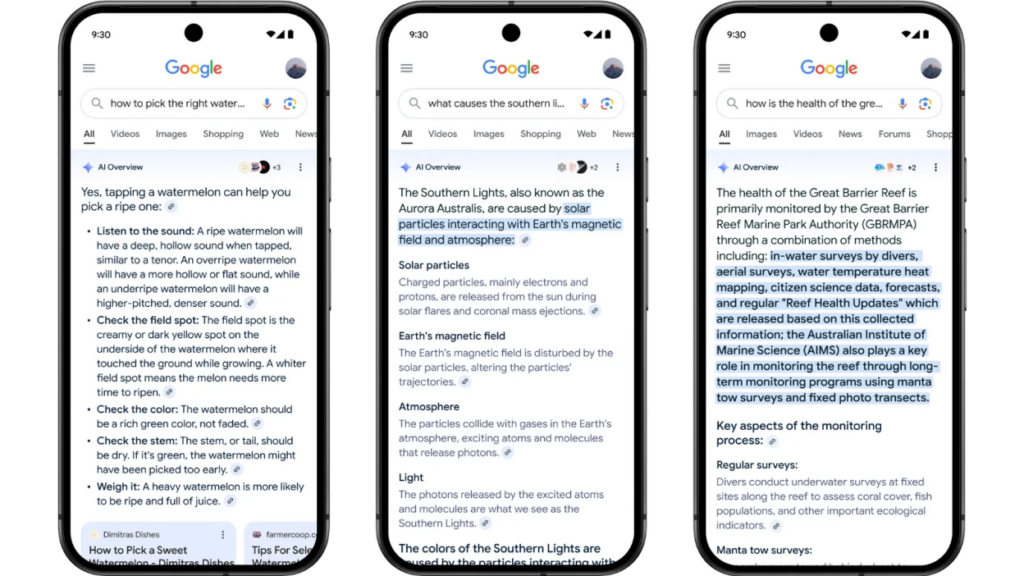
Each quote comes with a clickable attribution — showing the source name, username, or community name where the original post appeared. Users can click through to engage with the community directly. Google describes the change as a response to a clear behavioural signal. “For many searches, people are increasingly seeking out advice from others,” the company explained in its announcement. “To help you find the most helpful insights to explore further, AI responses will now include a preview of perspectives from public online discussions, social media, and other firsthand sources.” That is an accurate observation about how people search. The execution raises more complex questions.
The Expert Problem: Who Qualifies?

The most immediate concern with Google AI Overviews social media integration is the definition of expertise that underpins it. Google has not published a detailed methodology for determining whether a forum poster qualifies as an “expert.” The guidance it has offered is experiential rather than credentialed: a person who has visited a specific destination, attended a specific event, or performed a specific activity qualifies as someone who can offer expert advice on that topic. That definition is broad by any measure.
For low-stakes queries — photography tips, travel itineraries, recipe recommendations — experiential expertise is genuinely valuable and the risk of harm is low. A photographer who has shot the Northern Lights thirty times has insight worth surfacing. A traveller who cycled the Pacific Coast route last summer knows things no guidebook captures. The person who successfully treated bindweed in their garden without chemicals has practical knowledge that a chemist does not. That is the strongest version of Google‘s case for the change — and it is a legitimate one.
Where the Definition Breaks Down
The definition breaks down into categories where the stakes are higher. Medical symptoms. Legal rights. Mental health support. Financial decisions. Safety procedures. In the areas, experiential expertise and credentialed expertise are not equivalent — and the difference matters. A person who tried an unproven home remedy for a serious medical condition and reports it “worked” is not equivalent to a clinician. A person who believes they understand their employment rights based on a forum thread may be describing a situation that does not generalise. Or, a person offering mental health advice based on their own experience may be providing a perspective that is genuinely harmful to someone in different circumstances.
Google has not specified how — or whether — the Expert Advice feature excludes sensitive categories from sourcing forum content as authoritative guidance. The existing AI Overviews system has already produced inaccurate results. A recent New York Times analysis found AI Overviews accurate approximately nine times out of ten. For a product processing trillions of queries per year, a 10% error rate means hundreds of thousands of inaccurate results every minute. Adding unverified forum content as a sourcing layer introduces additional variability into that accuracy profile.
The Five Updates: Beyond the Social Media Integration
The social media integration is the most discussed change — but Google announced four additional updates alongside it. Each addresses a distinct aspect of how AI Overviews surfaces and attributes information.

The first is enhanced link context. When AI Overviews includes a link, it surfaces additional information alongside it — the creator’s name, username, or community name — so users can identify the source type before clicking.
The second is subscription content integration. Users who subscribe to news organisations can see AI Overviews that reference and link to content from their subscribed publications — giving paying news subscribers a way to surface paywalled content they already have access to within the AI search experience.
The third is improved query fan-out. Google’s AI search uses a technique called query fan-out, where the AI breaks a complex query into multiple sub-queries and synthesises results from across the web. The update improves how the process surfaces niche, specialised, and long-form content that keyword-based search traditionally underserves.
The fourth is richer AI Mode experiences — improved conversational search capabilities within Google‘s dedicated AI Mode interface, building on the AI-first search experience that Google has been developing as a standalone product distinct from traditional Search.
The Stakes for Content Creators and Advertisers

The Google AI Overviews social media integration carries significant commercial implications beyond the user experience. For advertisers, the change shifts Google‘s search model from a keyword-bidding framework to an “intent-matching” model, as analysts describe it. When AI Overviews surfaces a direct link to a product or service within an authoritative-looking response, the click carries higher commercial intent than a keyword-triggered ad placement. Brands that appear as credible sources within Expert Advice sections benefit from implied Google endorsement — a form of authority that paid advertising cannot replicate.
For content creators, the update changes the incentive structure of publishing online. A detailed, experience-rich forum post or community contribution can generate search traffic directly — bypassing the traditional SEO requirement to publish a standalone web page. That changes the value proposition of platforms (e.g., Reddit), which already signed a $60 million data licensing deal with Google in 2024. Surfacing Reddit quotes in AI Overviews without clear attribution to Reddit as the source — or direct compensation to the poster — creates a value extraction dynamic that platform operators and individual creators are likely to challenge as the feature scales.
The Misinformation Risk in a Forum-First World
AI Overviews has a documented history with misinformation. Shortly after launch in 2024, the feature generated results suggesting that eating rocks could provide nutritional benefits — based on a satirical article it failed to recognise as satire. It produced medical advice that misquoted clinical guidance. Google made significant improvements to the system’s ability to identify unreliable sources following those early failures. The social media integration reintroduces a category of content — anonymous, unverified, conversational forum posts — that presents similar challenges to the model’s source verification capabilities.
Google has not described the specific signals it uses to distinguish reliable from unreliable forum posts. Source credibility on Reddit is community-dependent, post-age-dependent, and vote-count-dependent — none of which are simple proxies for factual accuracy. The integration of this content into a feature that carries the implicit authority of a Google AI Overview amplifies the reach and apparent credibility of whatever it surfaces.
TF Summary: What’s Next
Google is rolling out the social media integration update to AI Overviews gradually across English-language search globally. The subscription content integration rolls out to Google News subscribers in the United States first. AI Mode improvements are available now in the Google app and on desktop. The update to Expert Advice labelling and link context is available across all AI Overviews-enabled surfaces. No specific timeline exists for the full global rollout of all five updates.
MY FORECAST: The Google AI Overviews social media integration will lead to a significant misinformation incident within six months — most likely in a health, safety, or legal context, where experiential forum advice is presented as credible guidance for a high-stakes decision. That incident will prompt Google to introduce categorical exclusions — similar to the sensitive-category safeguards it applies to medical and legal paid advertising — that prevent Expert Advice sourcing from forum content in designated high-risk query types. In the longer term, the update accelerates Reddit‘s and similar platforms’ leverage in data licensing negotiations. Google is structurally dependent on the communities it sources — and those communities are increasingly aware of what that dependency is worth.