


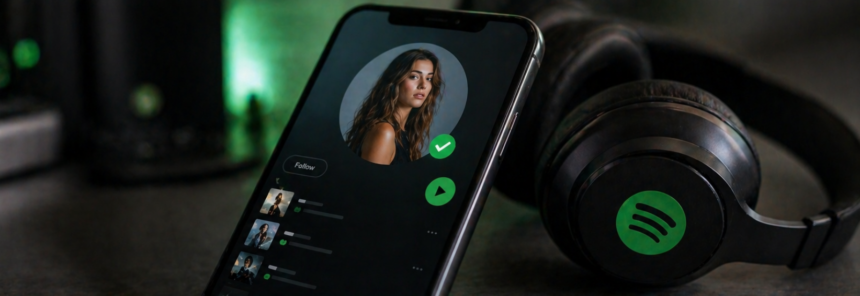
Approximately 75,000 AI-generated tracks are released on streaming platforms every day. Spotify just drew a green line between real artists and everything else.
On 30 April 2026, Spotify launched Verified by Spotify — a new green checkmark badge that identifies real, human artists on the platform. The badge appears on artist profiles and next to artist names in search results. It carries a single, deliberate message: there is a person behind this music. Profiles primarily representing AI-generated music or AI-created personas are not eligible for the badge at launch.
The Verified by Spotify badge arrives as AI-generated music floods streaming platforms at an industrial scale. Rival platform Deezer reported that AI-generated tracks make up 44% of all new music uploaded daily across the streaming industry. An estimated 75,000 AI-generated tracks are on platforms like Spotify every single day. Sony Music requested the removal of more than 135,000 AI-generated songs impersonating its artists across streaming services last month. Against that backdrop, the green badge is not a cosmetic feature. It is a platform taking a structural position on authenticity.
What’s Happening & Why It Matters
What the Badge Is and What It Signals
The Verified by Spotify badge is a light green checkmark icon. It appears visibly on artist profiles and alongside artist names in search results. Spotify described its purpose directly in the announcement blog post. “In the AI era, it’s more important than ever to be able to trust the authenticity of the music you listen to. Our focus is on providing you with more context about artists and their music so that you can build more meaningful connections with them.”

The badge is not a follower count. It is not a paid feature. It does not reward virality or algorithmic success. At launch, Spotify says more than 99% of the artists listeners actively search for will carry the badge — representing hundreds of thousands of musicians. The majority are independent artists, spanning genres, career stages, and geographies. The system is not designed to privilege major-label superstars. It is designed to surface the working musicians that fans genuinely seek out.
The Three Criteria for Verification
Earning the Verified by Spotify badge requires three things. First, artists must demonstrate consistent listener activity and engagement over time. Spotify prioritises profiles that listeners actively seek out over a sustained period — not profiles that experienced a single algorithmic spike and disappeared. Second, artists must maintain good standing with Spotify’s platform policies. Accounts flagged for fraud, artificial streaming, or policy violations do not qualify. Third, artists must show signals of a real-world presence both on and off the platform. That means concert dates, merchandise, and linked social media accounts connected to the artist profile.
Spotify explicitly stated it will pair these criteria with “human review and judgment” — not purely algorithmic filtering. The goal, as the company described it, is to identify real artists behaving in good faith, not simply to filter out bad actors. That distinction is meaningful. AI-persona accounts designed to generate passive listening revenue may not contain obviously fraudulent content. The human review layer is what separates those accounts from genuine artists who have not yet been verified.
What Is Not Eligible — and Why That Line Is Complicated
Profiles that primarily represent AI-generated music or AI-persona artists are not eligible for verification at launch. That is a firm position. At the same time, Spotify acknowledged in its announcement that “the concept of artist authenticity is complex and quickly evolving” — signalling that the eligibility criteria will develop over time.
The complexity is real. Many human artists use AI tools in their production workflow. Spotify already added AI Credits to Song Credits earlier in April 2026 — a transparency feature showing listeners where artificial intelligence contributed to a track. The Verified by Spotify badge addresses the artist identity question separately. An artist who uses AI tools in production can still qualify for verification as long as they meet the three criteria above. The badge signals the presence of a real human artist — not the absence of any AI involvement in the creative process.
What Gets Built Alongside the Badge
The Verified by Spotify badge launches alongside a second new feature: a dedicated artist details section appearing in beta across all artist profiles — whether or not the artist holds verified status. The section highlights career milestones, release activity, and touring history. Spotify compared it to nutritional labelling on food packaging — a quick, reliable snapshot of what is actually inside. That analogy is apt. A listener encountering an unfamiliar artist can view their profile to see how long they have been active, how consistently they have released music, and whether they tour. That context is genuinely useful when deciding whether an artist is worth investing time in.
The details section and the verification badge together form a coherent listener-facing transparency strategy. Spotify built related features throughout early 2026 — including Artist Profile Protection, which lets artists review and approve releases before they go live on their profiles, SongDNA, and the About the Song feature. The Verified by Spotify badge is the most publicly visible element of that architecture. It is the one ordinary listeners will notice immediately.
What Spotify Reversed — and Why It Had To

The new Verified by Spotify badge replaces a system Spotify retired in January 2026. The old “Verified Artist” blue checkmark — which confirmed that an artist had claimed their profile — was dropped because, as the company acknowledged at the time, “the term ‘verified’ came to suggest more than the checkmark was designed to represent.” The blue checkmark meant nothing about authenticity or genuine human presence. It meant only that someone had submitted a form.
The new green badge reclaims the word “verified” under a different, more demanding standard. It requires sustained engagement, real-world presence, and human review. That is a materially higher bar than claiming a profile. The change in colour — from the blue that social media platforms have used for years to a distinctive light green — also signals intentional differentiation. Spotify does not want this badge associated with the contested, often-mocked blue-checkmark economy of social media. The green checkmark is designed to mean something specific, reliable, and music-industry-relevant.
The Context: AI Music Is Not Slowing Down
The scale of the AI music challenge makes this launch urgent. Deezer‘s patent-pending AI music detection tool intercepts and removes up to 99% of AI-generated tracks before they reach the platform. Deezer took the deletion approach. Spotify is taking the verification approach. Both strategies respond to the same underlying problem: the economics of streaming reward upload volume, and AI tools have made high-volume music generation trivially easy and cheap.
Spotify Q1 2026 earnings — reported the same week as the badge launch — showed 293 million paying subscribers, a record for the platform. The company has an enormous commercial incentive to protect the experience of those 293 million listeners. If AI-generated content degrades the quality, trust, and emotional resonance of music discovery, subscribers leave. The green badge is partly an ethical position on human artistry. It is also a product decision rooted in business survival.
What the Badge Means for Independent Artists
The most important line in Spotify‘s announcement may be the least dramatic. The majority of the hundreds of thousands of artists verified at launch are independent. That is significant. The Verified by Spotify badge is not gatekeeping music behind major-label infrastructure. It is rewarding the actual behaviour of working independent musicians — touring, releasing consistently, maintaining a real social presence, and building genuine fan engagement over time.
For independent artists, the badge provides a sign that costs nothing to earn beyond doing the work they were already doing. It distinguishes them from accounts that upload algorithmically optimised background music — what Spotify calls “functional music” — designed for passive listening rather than active fandom. Functional music and genuine artistry have coexisted on Spotify for years. The green badge does not remove functional music. It simply identifies, visibly and clearly, which profiles represent something more.
TF Summary: What’s Next

The Verified by Spotify badge rolls out gradually over the coming weeks. Artists who actively search on the platform and meet the three criteria will see the badge appear on their profiles without needing to apply. Spotify confirmed that verification will be ongoing — meaning the absence of a badge today does not indicate permanent ineligibility. The artist details section in beta will continue to expand across all profiles as the system matures.
MY FORECAST: The harder question is what comes next as AI music capabilities accelerate. Today’s criteria — concert dates, merchandise, linked social accounts — assume that real artists have a real-world presence that AI personas cannot easily fabricate. That assumption is more complicated as AI tools improve and as bad actors invest in manufacturing that kind of presence artificially. Spotify acknowledged as much by explicitly stating that the criteria will evolve. The human review layer is the current safeguard against that evolution — and the one most likely to need the most continuous investment. The green badge is a meaningful step. It is not a permanent solution. The AI music wave is not slowing down, and neither is Spotify‘s response to it.