


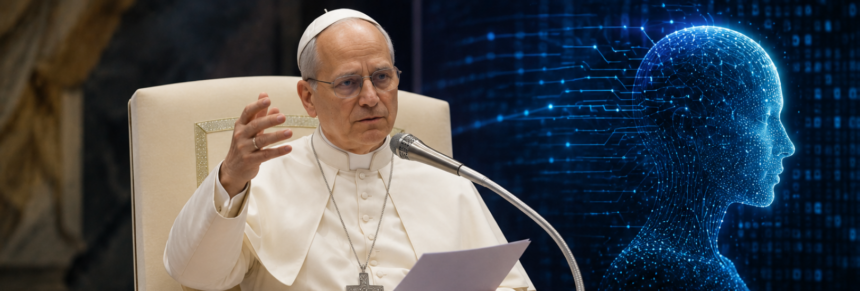
Pope Leo XIV’s AI encyclical — titled Magnifica Humanitas: On Safeguarding the Human Person in the Time of Artificial Intelligence — arrived on 25 May. The document is 235 pages long. It contains 245 numbered paragraphs divided across an introduction and five chapters. Pope Leo XIV signed it on 15 May — the 135th anniversary of Pope Leo XIII’s Rerum Novarum, the foundational Catholic social teaching document that addressed the Industrial Revolution. The timing is deliberate. Magnifica Humanitas positions AI as the defining moral challenge of the 21st century — just as industrialisation was the defining challenge of the 19th. The encyclical was presented at the Vatican‘s Synod Hall alongside Christopher Olah, co-founder of Anthropic. Anthropic is currently in litigation with the Trump administration. The choice of Olah as a launch partner is not symbolic. It is a statement.
What’s Happening & Why It Matters
What the Encyclical Actually Argues
Magnifica Humanitas does not reject artificial intelligence. It does not embrace it uncritically either. Instead, the document places a single question at the centre of every argument it makes. Does this technology serve the human person — or does it serve power? Pope Leo XIV states the stakes plainly in the opening paragraphs. “Humanity, created by God in all its grandeur, is today facing a pivotal choice: either to construct a new Tower of Babel or to build the city in which God and humanity dwell together.” That framing — drawing on the Genesis story of humanity’s catastrophic attempt to reach the heavens through collective effort without moral foundation — runs through the entire document.
The encyclical’s central charge against AI development is specific. “The risk of dehumanisation — of building a future that excludes God and reduces the other to a means — is an ancient and ever-new temptation that today takes on a technical guise,” Leo writes. He warns against what he describes as a “culture of power” driving the AI race. That culture, he argues, does not ask whether AI serves the common good. It asks whether AI serves the competitive advantage of the few individuals and corporations building it.
The Labour Question: A Direct Heir to Rerum Novarum
The most politically pointed section of Magnifica Humanitas addresses the impact of AI on work. Pope Leo XIV draws directly on Pope Leo XIII’s 1891 document, which argued that industrial capitalism had an obligation to treat workers with dignity rather than as economic inputs. Magnifica Humanitas applies that framework to AI displacement. “What is needed is a more active political involvement that is capable of slowing things down when everything is accelerating, and of protecting the opportunities for communities still to be able to participate and ask questions,” Leo writes.
That demand — for governments to actively slow AI deployment when it outpaces society’s ability to respond — is the most direct challenge in the document to the current approach of the Trump administration, the weakening of the EU’s Digital Omnibus, and virtually every other major economy’s AI governance posture in 2026. By contrast, Leo does not call for a halt. He calls for pace. “Without bold decisions, the prospect of greater poverty and inequality looms large.” The encyclical is not anti-technology. It is pro-deliberation.
AI and War: The Most Urgent Warning
Pope Leo XIV’s most urgent language in Magnifica Humanitas concerns AI’s role in warfare. He notes that contemporary conflicts are “hybrid” — fought not only on physical battlefields but “also on the economic, financial and cyber fronts, where disinformation and campaigns that feed people’s fears are used to manipulate public opinion.” He warns that increasing military expenditure is presented as the “only response” to an uncertain world — describing this as “false realism” and an “irresponsible Realpolitik.” The Pope raises the specific concern that some leaders “may consider armed conflict as an effective way of diverting attention from domestic problems.”
At the same time, Leo is explicit about autonomous weapons. He calls for AI to be “disarmed” — specifically targeting the development of AI systems designed to make lethal decisions without human oversight. As TF covered in its Pentagon AI contracts article, the Trump administration designated Anthropic a supply chain risk specifically because the company refused to remove safeguards against the use of autonomous lethal weapons from its military contracts. The encyclical validates that refusal at the highest moral level available.
Power Concentration: The Core Problem
Beyond war, Magnifica Humanitas identifies the concentration of AI capability in the hands of a few as the central structural threat to human dignity. “It is not enough to invoke ethics in the abstract; robust legal frameworks, independent oversight, informed users and a political system that does not abdicate its responsibility are required,” Leo writes. That sentence addresses every government that has treated AI regulation as optional — including the US administration that delayed signing a basic voluntary AI oversight executive order just days before this encyclical’s publication.
The encyclical calls on AI developers to work for the common good rather than profit. It demands that governments “establish adequate regulatory tools capable of upholding justice and curbing the distorting effects of technological power.” It calls out the specific risks to children, vulnerable populations, workers facing displacement, and populations in developing countries who cannot participate in the AI economy on equal terms. Each of those concerns has been documented in TF’s coverage throughout 2026 — from Meta‘s momfluencer campaign to WiseTech‘s engineer displacement to the **AI toy safety crisis.
The Anthropic Presence: Deliberate, Contested, Significant
Christopher Olah‘s presence at the Vatican launch is the story that runs alongside the encyclical’s content. Anthropic is not simply an AI company. It is the AI company that refused military AI contracts, lost its US government business as a result, got its CEO’s meeting with the White House cancelled, and is running on SpaceX‘s Colossus infrastructure. At the same time, Musk privately told Trump to kill the AI oversight order. Olah’s presence at the Vatican signals something specific. Anthropic and the Vatican share a view of AI’s risks that the current US administration explicitly rejects.

Olah welcomed the encyclical’s approach directly. “We need more of the world — religious communities, civil society, scholars, governments — to do what His Holiness has done here: to take this seriously, to look closely, and to send events in a better direction,” he said at the Vatican presentation. The decision to involve Anthropic drew criticism from some observers who described it as a papal endorsement of a specific corporation. A Vatican source pushed back. Anthropic‘s inclusion represents an “enormous corporation that is taking onto itself an enormous risk and responsibility” — not a papal seal of approval for its commercial interests.
Pope Leo XIV and Trump: An American Pope in Open Tension
The context of Magnifica Humanitas is the relationship between Pope Leo XIV — born Robert Francis Prevost in Chicago — and US President Donald Trump. Leo is the first American Pope in history. He was elected in May 2025 after the death of Pope Francis. He declared AI “the biggest challenge facing humanity today” in his first address to the College of Cardinals. Trump responded by posting an AI-generated image of himself dressed as a pope on Truth Social days after attending Francis’s funeral. The Vatican did not comment. The implicit message from both sides was clear.
Leo has been publicly critical of the Iran war — which Trump has prosecuted aggressively. He has declined to endorse the administration’s approach to AI regulation. He has published a 235-page document that directly contradicts the administration’s AI governance philosophy — and launched it with the co-founder of the company the administration denylisted. Whether Trump responds to the encyclical publicly is to be seen. The administration’s silence on today’s launch is itself a statement.
Global Response
Magnifica Humanitas addresses the 1.4 billion Catholics worldwide directly through their bishops. It extends its appeal to “all people of goodwill” — a standard encyclical situation that historically reaches far beyond the Catholic community. The document’s philosophical reference points are deliberately open. AP News reported that the encyclical invokes J.R.R. Tolkien, Ludwig van Beethoven, Martin Luther King Jr., and philosopher Hannah Arendt — alongside scripture. That breadth is intentional. The Pope is writing for secular philosophers, artists, civil rights advocates, and religious believers simultaneously.
The document’s impact will be felt across multiple dimensions simultaneously. It gives the global AI safety movement a moral vocabulary that extends beyond the tech policy sphere. The Pontiff provides civil society, unions, and child safety advocates a theological endorsement for their campaigns. The Pope places the Church’s voice directly into the geopolitical conversation about who controls AI and for whose benefit.
TF Summary: What’s Next

Magnifica Humanitas is available in multiple languages through Vatican News. The full text is accessible as a PDF from the Holy See’s website. Translations into all major world languages are being distributed simultaneously through the Church’s global network. Catholic universities, dioceses, and schools will begin studying the document in their curriculum and formation programmes immediately. Several governments — particularly in Latin America and sub-Saharan Africa — are expected to reference the encyclical in their own AI governance discussions. Dario Amodei — Anthropic‘s CEO — has not yet publicly commented on the launch. Olah‘s presence at the Vatican was on Anthropic‘s behalf.
MY FORECAST: Pope Leo XIV’s AI encyclical will produce three concrete outcomes within 12 months. First, it will accelerate the EU’s AI Act implementation — providing European Commission officials with the moral authority of a major world religious institution to resist industry pressure for further delays and weakening. Second, it will generate a formal Vatican-UN dialogue process on AI governance — building on the Church’s existing relationships with multilateral institutions. Third, and most importantly, it will shift the terms of the AI debate in the Global South. The 1.4 billion Catholics in Africa, Latin America, and Southeast Asia are the most economically vulnerable populations to AI displacement. Until today, their governments have had no major institutional ally at the global level articulating their specific risks. Magnifica Humanitas gives its leaders a document to cite — and a moral framework that no amount of Silicon Valley lobbying can easily counter.