


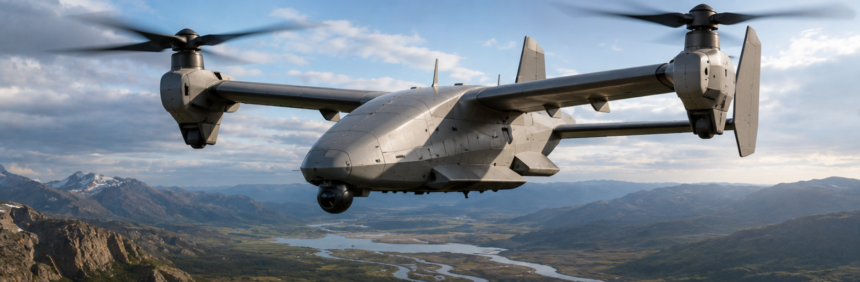
Autonomous and robotic systems news moved across air, space, and manipulation simultaneously this week — and the pace of development across all three categories is accelerating. AIRO Group Holdings unveiled the JX250/JC250 — a full-scale, heavy-lift hybrid-electric VTOL drone capable of carrying 330 lbs (150 kg) for up to 18 hours without a runway. Dassault Aviation and OHB formally proposed VORTEX-S to the European Space Agency — a reusable, runway-landing spaceplane that could end Europe’s dependence on US capsules for orbital cargo return. Chinese firm Xynova released the Flex-2 — a 23-degree-of-freedom robotic hand that combines multiple actuation technologies for human-like manipulation. And Horizon Robotics published HoloMotion-1 — an open-source 4-billion-parameter AI model that drives humanoid robot control at 300 frames per second on edge hardware. Four developments. All in one week. Together, they describe a world where autonomous systems are more capable in every direction.
What’s Happening & Why It Matters
AIRO’s JX250/JC250: The Drone That Doesn’t Need a Runway
AIRO Group Holdings unveiled the JX250/JC250 at AUVSI XPONENTIAL 2026 — the premier unmanned systems trade show in the United States. The aircraft is a full-scale heavy-lift VTOL drone built around AIRO’s patented compound rotor craft design. That design is the aircraft’s defining innovation. Standard rotary-wing drones use a large rotor for both lift and forward flight, which is efficient for hovering but inefficient at cruise. By contrast, the JX250/JC250’s rotor is sized for vertical lift, then slows in forward flight to act as a secondary wing. A pusher propeller and short fixed wings carry the aircraft forward at cruise speed.
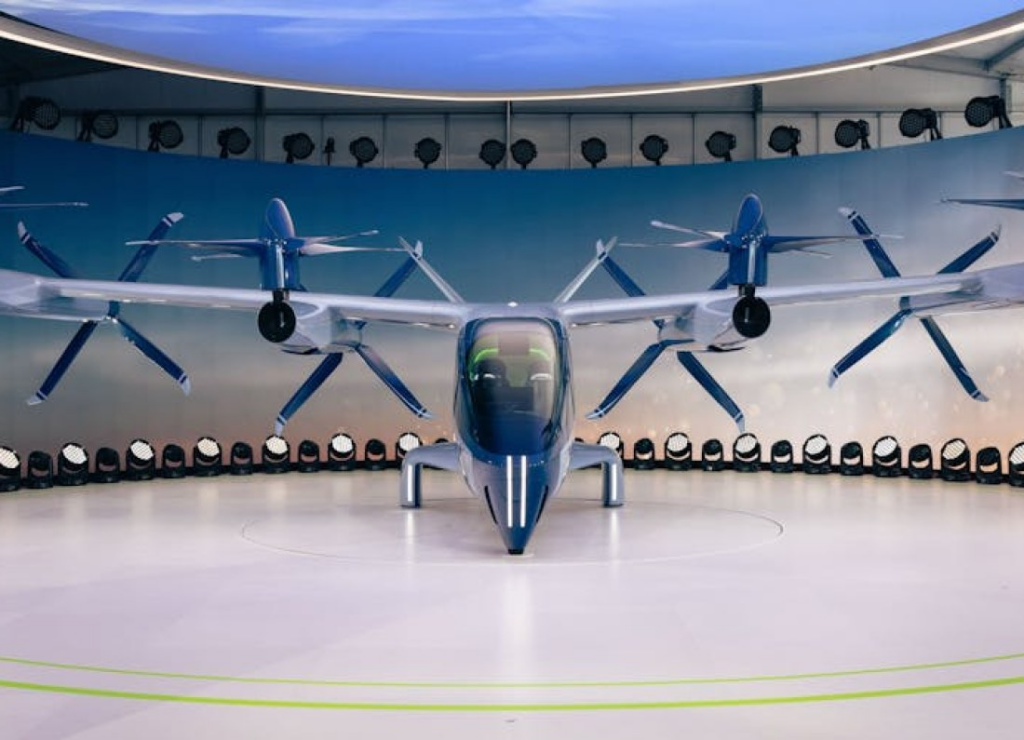
At cruise, the JX250/JC250 reaches 112 mph (180 km/h). Its operational range exceeds 200 miles (320+ km). It carries up to 330 lbs (150 kg) of payload. Its endurance — the detail that sets it apart from comparable platforms — ranges from 15 to 18 hours at loitering speeds. AIRO COO John Uczekaj stated the significance plainly. “There’s not a single aircraft today that can lift vertically and fly 15, 18 hours. It doesn’t exist.”
Dual-Use Design: From Battlefield to Disaster Relief
The JX250/JC250 is available in two variants. The JC250 cargo variant uses a removable belly pod. It targets military cargo resupply, remote humanitarian delivery, middle-mile logistics, and oil and gas remote supply chains. The JX250 ISR variant carries an underslung surveillance camera array for intelligence, surveillance, and reconnaissance missions. Both variants share the same airframe and propulsion architecture.
The hybrid-electric propulsion is itself a strategic asset. AIRO COO Uczekaj described the practical advantage directly. “Hybrid provides us capabilities, not only for range, but also for going to remote areas where there may not be electrical charging available. That provides a lot of flexibility going into rural areas or battlefield conditions.” Traditional electric drones require charging infrastructure. The JX250/JC250 uses a combustion engine, generator, and battery system. It extends its range and endurance without any dependence on ground charging.
The Group 3 Classification and What It Unlocks
The JX250/JC250 falls into the US military’s Group 3 UAS classification — aircraft between 55 and 1,320 lbs with operational ceilings above 3,500 feet (1,067 metres). That classification unlocks a specific set of military procurement channels, foreign military sales routes, and regulatory pathways. At the same time, AIRO is developing the aircraft in Canada — keeping its supply chain within a close US ally framework while targeting NATO and Five Eyes partner markets. The prototype flight is scheduled for late 2026. Commercial and operational deployment follows in 2027. The addressable market AIRO is targeting — combining defence, commercial cargo, and humanitarian applications — exceeds $315 billion by 2030.
Europe’s VORTEX-S: A Space Shuttle by Another Name
On 11 May 2026, Dassault Aviation and OHB formally submitted VORTEX-S to ESA‘s ALADDIN cargo return tender. VORTEX-S stands for Véhicule Orbital Réutilisable de Transport et d’Exploration — Reusable Orbital Transport and Exploration Vehicle. It is a winged spaceplane designed to carry cargo to and from low Earth orbit, landing on a runway rather than splashing into the ocean. Dassault acts as prime architect and systems integrator — the same role it holds for the Rafale fighter and Falcon business jet. OHB develops the service module — the orbital systems that power and maneuver the vehicle once in space.
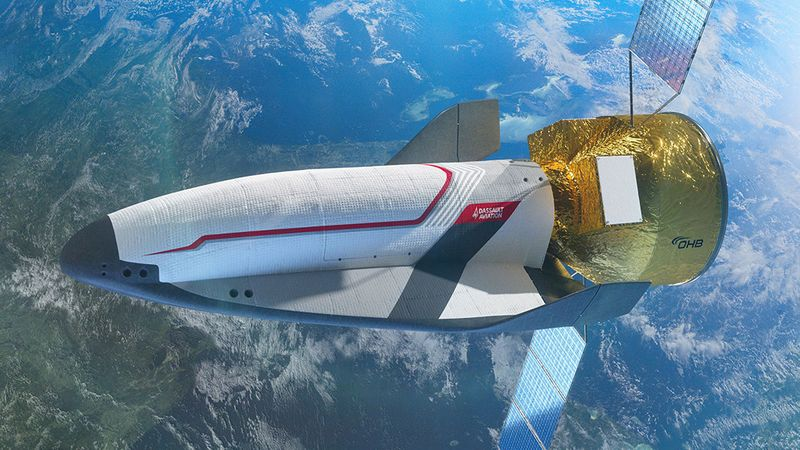
The ALADDIN tender’s Phase 2 evaluation is expected by mid-2026. The Phase 1 contracts — worth €25 million each — went to capsule-based concepts from The Exploration Company and Thales Alenia Space. Critically, Phase 2 is open to all bidders — not just Phase 1 awardees. That opening gives VORTEX-S a legitimate path to an ESA contract even without prior programme funding.
Why Europe Needs Its Own Spaceplane
The geopolitical case for VORTEX-S is compelling. SpaceX currently dominates launch services globally — including European satellite deployment and ISS cargo logistics. China is building its own orbital station and developing independent space logistics. Europe has no runway-landing orbital cargo vehicle of its own. All capsule-based return systems — including Dragon — splash down in the ocean. Ocean recovery limits what can be returned intact. Biological research samples, precision manufacturing outputs, and sensitive payloads all benefit from a controlled runway landing.
VORTEX-S targets precisely that capability gap. Dassault Aviation CEO Éric Trappier described the ambition. “With the Vortex-S proposal to ESA, we aim to strengthen Europe’s space capabilities.” OHB CEO Marco Fuchs emphasized the shared industrial identity. “The joint expertise of our two companies positions us to advance Europe’s autonomous space transportation vision.” France’s DGA defence procurement agency and CNES space agency have already committed €30 million in initial funding for the VORTEX-D demonstrator, announced at the 2025 Paris Air Show. The demonstrator’s first flight is targeted for 2028.
China’s Flex-2 Robotic Hand: 23 Degrees of Freedom
Chinese robotics firm Xynova released its second-generation dexterous robotic hand — the Flex-2 — on 20 May 2026. The Flex-2 combines three distinct actuation mechanisms in a single system: rigid links for structural stability, hydraulic-tendon actuation for force generation, and elastic-tendon actuation for compliance. That three-way combination is the system’s core innovation. Most robotic hands use a single-actuation approach, which forces engineers to trade off among strength, speed, and delicacy. The Flex-2 addresses all three requirements simultaneously by routing different actuation types to different grip zones. The thumb uses hydraulic-tendon actuation for maximum force. The fingertips use elastic actuation for tactile compliance. The palm structure uses rigid linkages for stability.

At 23 degrees of freedom, the Flex-2 closely matches the range of motion of a human hand. The system achieves ±0.1 mm positioning repeatability — equivalent to watchmaking precision. Xynova describes target applications across semiconductor handling, pharmaceutical packaging, surgical instrument manipulation, and food processing — all tasks requiring a combination of delicacy and reliability that existing industrial grippers cannot provide.
HoloMotion-1: A Robot Brain That Thinks at 300 Frames Per Second
Horizon Robotics published HoloMotion-1 — an open-source 4-billion-parameter AI model for whole-body humanoid robot control. The model runs inference at 300 frames per second on edge devices — meaning the robot’s brain processes its entire sensor input and generates control commands within 3.3 milliseconds per cycle. That speed approaches human reaction time for fine motor control. By contrast, previous state-of-the-art humanoid control models ran at significantly lower frequencies — requiring either cloud connectivity for high-fidelity control or accepting reduced responsiveness on edge hardware.
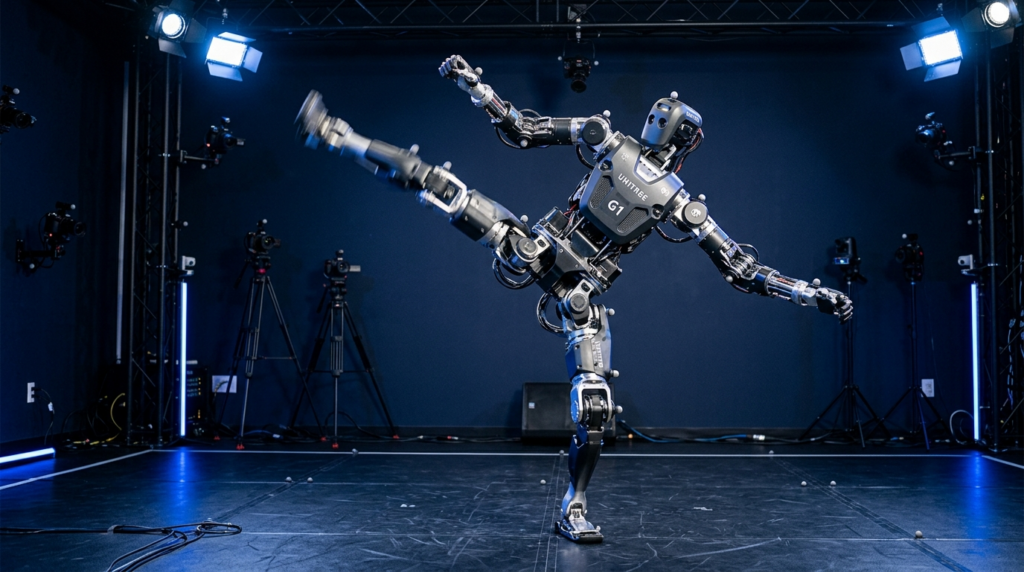
HoloMotion-1 eliminates both constraints. It runs entirely on the robot’s onboard hardware — no cloud dependency, no network latency, no infrastructure requirement. The open-source release is strategically significant. Horizon Robotics is making the model freely available to the research community and commercial developers — accelerating adoption across the Chinese robotics ecosystem while simultaneously positioning the company’s underlying hardware platforms as the preferred inference substrate. The model targets whole-body control — coordinating the robot’s head, torso, arms, and legs as a unified system rather than treating each as a separately controlled segment.
TF Summary: What’s Next
AIRO‘s JX250/JC250 advances through detailed design and engineering toward a first flight in late 2026. Commercial deployment begins in 2027. ESA evaluates ALADDIN Phase 2 bids by mid-2026 — with a contract decision expected before the end of the year. Dassault is simultaneously developing the VORTEX-D subscale demonstrator for a 2028 first flight. Xynova‘s Flex-2 is available for commercial integration. Horizon Robotics has released HoloMotion-1 under an open-source licence — downloadable today.
MY FORECAST: Autonomous and robotic systems news points clearly toward the competitive frontier of 2027. AIRO’s 18-hour endurance figure will generate interest from US military procurement before its first flight — the capability gap it addresses is documented and urgent.
VORTEX-S will win the ALADDIN Phase 2 contract. Its winged, runway-landing design addresses the specific gaps that capsule concepts cannot — and Dassault‘s industrial credibility as the Rafale’s builder is the strongest possible endorsement of programme realism.
China’s robotic hand and AI control model together represent the most commercially important development of the four. The combination of 23-DOF manipulation and 300 fps whole-body control closes the two primary gaps that have prevented humanoid robots from performing real manufacturing tasks at production scale.
By 2028, robots combining Flex-2-class hands and HoloMotion-1-class brains will perform assembly line tasks currently requiring skilled human operators. That combination — more than any single product — is the development that changes the economics of manufacturing.