


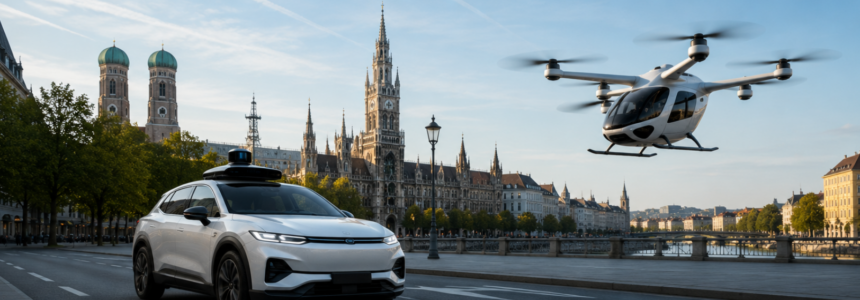
Robotaxi and air taxi developments moved from concept to testing phase on 2 June 2026 — in two very different locations. In Munich, Uber and Israeli AI startup Autobrains Technologies announced a joint program to deploy Level 4 autonomous robotaxis in Germany’s automotive capital, running on NVIDIA’s Drive Hyperion platform. Subject to regulatory approval, Munich will be the first European city where passengers can hail a fully autonomous taxi through the Uber app. Meanwhile, in Alatau City on the outskirts of Almaty, Kazakhstan, the AutoFlight V2000 Prosperity completed Central Asia’s first-ever air taxi demonstration flight — an unmanned 10-minute test in front of a crowd of spectators. Commercial air taxi service between Almaty, Alatau, and Konayev is targeted for 2027. Ground and sky — two separate transport revolutions are happening at once.
What’s Happening & Why It Matters
Uber and Autobrains Choose Munich — Here’s Why
The robotaxi and air taxi development story begins in Munich — not in San Francisco, Phoenix, or Beijing, where robotaxi services are already commercial. Europe is significantly behind those markets. Waymo operates hundreds of robotaxis commercially in the US. Baidu’s Apollo Go runs thousands of driverless rides daily in Chinese cities. Europe has no commercial service yet. Uber and Autobrains are betting that Munich’s specific combination of factors makes it the right launchpad to change that.
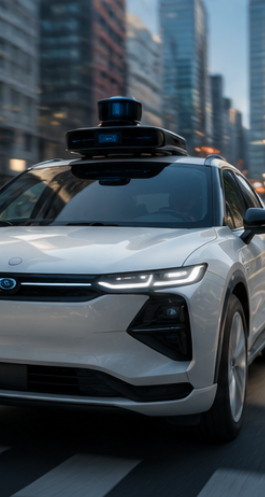
Those factors are specific and defensible. Munich is the headquarters of BMW, a major automotive engineering hub, and home to a technically sophisticated urban population that already accepts high degrees of vehicle automation. Germany passed an Autonomous Driving Act in 2021 that permits Level 4 driverless operation within defined operational design domains — one of the most progressive regulatory frameworks in Europe. Munich’s road network, with a mix of dense city streets and high-speed thoroughfares, creates exactly the testing conditions needed to validate an autonomous system that must handle genuine complexity.
What Level 4 Means — and What Makes Autobrains Different
Level 4 autonomy means the vehicle drives itself entirely within a defined operational area — no human intervention required during operation. A safety driver may be present initially, but the vehicle does not need them to complete its journey. The distinction has weight. Level 3 systems — which require human takeover on demand — have proven commercially unworkable because drivers cannot reliably re-engage safely after extended disengagement. Level 4 eliminates that failure mode by designing a system that never requires re-engagement.
Autobrains‘ approach to achieving Level 4 is architecturally distinctive. Rather than relying on a single large AI model to handle every aspect of driving, the system deploys multiple AI agents that each handle specific tasks — context understanding, risk assessment, and real-time decision-making operating in parallel. Uber‘s global head of autonomous mobility and delivery, Sarfraz Maredia, described the commercial ambition precisely. “The challenge is not just building autonomous vehicles — it’s bringing them into a commercial network where they can reliably serve riders at scale.” That is exactly the gap Waymo has been bridging in the US for three years. Uber is betting it can replicate that trajectory in Europe faster.
The Manufacturer-Agnostic Model That Changes Everything
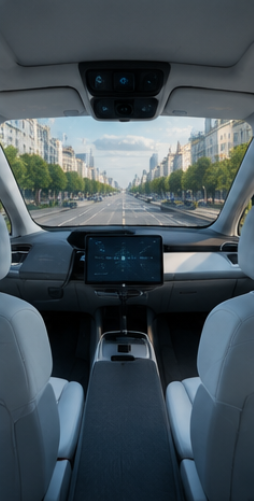
The design philosophy behind the Munich program differs fundamentally from Waymo‘s approach. Waymo uses a highly customized vehicle fleet — modified Jaguar I-PACEs and Chrysler Pacificas with bespoke sensor arrays on the roof. That approach is expensive, operationally complex, and difficult to scale rapidly. By contrast, the Uber–Autobrains Munich program is explicitly “manufacturer-agnostic” — the autonomy stack runs on NVIDIA Drive Hyperion‘s software-defined computing architecture and can integrate into production vehicles from Audi, BMW, Mercedes-Benz, or Volkswagen.
That model has direct implications for scale. Waymo must procure, modify, and maintain every vehicle in its fleet. The Uber–Autobrains approach allows any OEM to bring their existing production vehicle into an autonomous ride-hailing network — dramatically reducing the capital required to expand. Uber CEO Dara Khosrowshahi called Munich “a key piece in shaping the future of autonomous vehicles.” At the same time, the manufacturer-agnostic strategy carries a technical challenge of its own — it must work equally well across different vehicles’ physical characteristics, sensor positions, and actuator responses.
Europe’s Competitive Market: Lyft, Baidu, VW, and Rimac
The Munich announcement is not Uber‘s only European autonomous vehicle play. Separately, Uber and UK-based Wayve Technologies are running public-road trials in London. Lyft and Baidu’s Apollo Go have announced plans to launch autonomous vehicles in Germany and the UK in 2026. Volkswagen is independently developing a robotaxi version of the ID. Buzz — available to book via Uber in the US, and deployed in Hamburg through the separate ALIKE project. Croatian supercar manufacturer Rimac is also developing an autonomous vehicle platform for European deployment.
That competitive density is unprecedented for Europe. Twelve months ago, European robotaxi services existed only on paper. By the end of 2026, multiple programs will be in active testing — across London, Munich, Hamburg, and potentially Berlin and Frankfurt. The regulatory question is the pivotal constraint. German law permits Level 4 autonomy within defined operating areas. The Federal Motor Transport Authority (KBA) must approve each specific operating domain individually. The timeline between technology readiness and commercial launch depends almost entirely on how quickly those approvals move.
Kazakhstan’s Air Taxi: Central Asia’s First eVTOL Demonstration
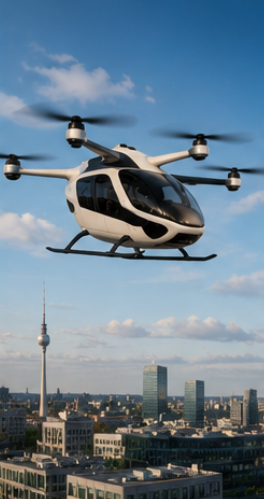
The second robotaxi and air taxi development story travels 4,000 miles east of Munich — to the brand-new planned city of Alatau on the outskirts of Almaty, Kazakhstan. On 19 May 2026, the AutoFlight V2000 Prosperity eVTOL completed Central Asia’s first air taxi demonstration flight. The aircraft lifted off from a purpose-built vertiport in Alatau City, completed a 10-minute uncrewed test flight, and landed without incident. The crowd was substantial. The significance was genuine.
The V2000 Prosperity is a 13-motor electric vertical take-off and landing (eVTOL) aircraft. It reaches speeds of 124 mph (200 km/h). Its range is approximately 124 miles (200 km) on a single charge. The aircraft carries one pilot and up to five passengers — a payload that makes it commercially viable for urban air mobility routes. The Alatau demonstration was unmanned for safety certification purposes. Passenger operations require full regulatory approval from Kazakhstan’s Civil Aviation Committee.
The €260 Million Ecosystem Behind the Flight
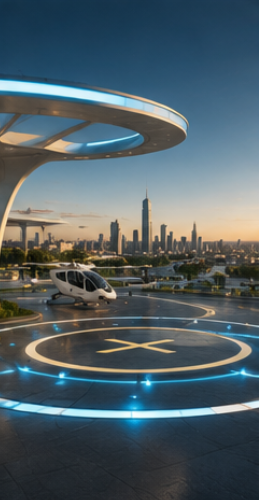
The flight is the visible surface of a €260 million infrastructure investment in Alatau City’s urban air mobility ecosystem. Alatau Advance Air Group (AAAG) — the private Kazakh operator behind the program — is working with partners from the US, South Korea, China, and Italy. The full ecosystem includes not just aircraft but vertiport infrastructure, digital navigation systems, and delivery drone networks. The regulatory frameworks, too, are involved.
Alisher Abdykadyrov, CEO of Alatau City Authority, stated the ambition. “For us, this is more than a demonstration of new technology. It represents a transition toward a new model of urban development, where innovation, digital transformation and advanced mobility solutions are a defining feature.” The targeted commercial route — Almaty International Airport to Alatau City, approximately 31 miles (50 km) — takes roughly 10 minutes by air taxi. By road, the same journey takes between 40 minutes and 90 minutes, depending on traffic. That time advantage is the commercial case. Beyond passenger transport, the emergency response version of the V2000 Prosperity can carry firefighting equipment capable of tackling fires across 800 square meters in a single operation.
The Joby Aviation S-4 Arrives in 2028
Kazakhstan’s air taxi program is not limited to the AutoFlight V2000. Under a $300 million contract signed in November 2025 between Kazakhstan’s AI agency, Joby Aviation, Alatau Advance Air Group, and Kazakhstani businessman Vyacheslav Kim, the country will receive Joby Aviation‘s Model S-4 aircraft beginning in 2028. The S-4 carries four passengers and a pilot, has a range of approximately 150 miles (241 km), and reaches speeds of up to 199 mph (320 km/h). That performance profile makes it significantly faster and more capable than the current V2000. On 8 May 2026, Kazakhstan’s President Kassym-Jomart Tokayev signed a constitutional law granting Alatau City special legal status — including experimental legal regimes and special air zones for urban air mobility. Kazakhstan is not just testing an aircraft. It is building the world’s first experimental legal and regulatory framework designed specifically for urban air mobility at the national level.
TF Summary: What’s Next

Uber and Autobrains await KBA regulatory approval for the Munich programme. No commercial launch date has been confirmed. Safety drivers will accompany vehicles during initial operations before the transition to fully driverless operation. Kazakhstan’s air taxi programme continues full-scale safety and route-verification testing through 2026, targeting a commercial launch in 2027. The Joby S-4 fleet arrives in 2028. Both programmes will generate independent safety data that will influence how regulators across Europe and Central Asia approach autonomous mobility frameworks.
MY FORECAST: Robotaxi and air taxi development in Europe and Central Asia will produce a commercial service before the end of 2027 — but Munich, not Almaty, will be first.
The German regulatory framework, while demanding, moves faster than the process for certifying an entirely new aircraft category for commercial passenger operations. By Q4 2026, Uber and Autobrains will have regulatory approval for a limited operational domain in Munich and will begin commercially carrying passengers with safety drivers. Full driverless operation follows in 2027.
Kazakhstan’s air taxi commercial service is realistic in 2027 — and its legislative infrastructure, specifically Alatau City‘s special legal status and experimental air zones, gives it the fastest path to certification of any new urban air mobility programme in Asia. Joby Aviation’s S-4’s availability in 2028 will accelerate commercial operations in the Almaty region. The cities that build the infrastructure first will attract the talent, capital, and population growth that follow genuinely differentiated transport systems.