


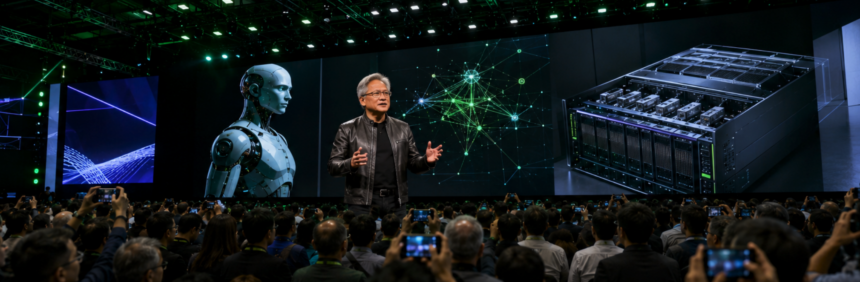
Computex 2026 and Panathēnea AI announcements defined the global technology conversation on 1 June 2026 — from opposite ends of the earth. In Taipei, NVIDIA CEO Jensen Huang took the stage at the Taipei Music Centre for a two-hour keynote that introduced RTX Spark — the company’s first-ever processor built specifically for Windows PCs. Two hours later, Qualcomm CEO Cristiano Amon followed at the COMPUTEX 2026 exhibition hall to announce Qualcomm Dragonfly — the company’s entry into data centre AI processing. Meanwhile, in Athens, the Panathēnea 2026 innovation festival wrapped three days at the Zappeion Hall, where 11,500 founders, investors, and executives from 60 countries came to confront the gap between Europe’s innovation output and its commercial ambitions. Three stages. Two continents. One obsession with AI’s next chapter.
What’s Happening & Why It Matters
NVIDIA RTX Spark: The Apple Silicon Moment for Windows
The Computex 2026 NVIDIA RTX Spark announcement is the most significant consumer computing launch since Apple‘s M1 chip in November 2020. Huang framed it in exactly those terms on stage in Taipei. “Remember, 15, 20 years ago, we used to have an idea called a phone,” he told the audience. “Today, when you think about your phone, the one thing you don’t do with it is make phone calls. You do just about everything else.” Huang was describing what he believes will happen to the PC. The device category is being redefined — from a tool you input commands into to a machine that runs AI agents that work for you.
The RTX Spark is the hardware making that transition possible. It is an ARM-based system-on-chip — NVIDIA‘s first in its history — built in collaboration with MediaTek. The chip combines a 20-core Grace CPU with a Blackwell RTX GPU carrying 6,144 CUDA cores, plus a neural processing unit. All of it runs on a 3nm TSMC process. Up to 128GB of unified LPDDR5X memory at 300 GB/s bandwidth is available. At peak capability, RTX Spark delivers 1 petaFLOP of AI performance — equivalent to the performance of an RTX 5070 laptop GPU — in a chip designed for mobile power envelopes.
What RTX Spark Means for the Windows PC Market

The device profile is immediately competitive. Microsoft Surface Laptop Ultra, Dell XPS 16, and devices from ASUS, HP, Lenovo, and MSI will all feature RTX Spark at launch in fall 2026. NVIDIA claimed that “100% of the PC world” is behind the platform — a claim that pointedly omits Apple, Intel, AMD, and Qualcomm.
By contrast, the platform’s technical specification is genuinely compelling. RTX Spark runs local large language models with up to 120 billion parameters and context windows of up to 1 million tokens. It renders 3D scenes greater than 90GB. It edits 12K 4:2:2 video. The NPU exceeds Microsoft’s 40 TOPS threshold for Copilot+ certification. NVIDIA has worked with Microsoft for several years on this chip, giving it an expected head start on the Prism ARM emulation layer for legacy Windows apps. Huang joins Microsoft CEO Satya Nadella at Build 2026 on 2 June to reveal further integration details.
NVIDIA’s AI Factory Vision at Computex

Beyond the RTX Spark consumer announcement, Huang used the Computex 2026 keynote to lay out NVIDIA‘s complete infrastructure vision. Huang declared plainly: “NVIDIA has really become an infrastructure company.” The enterprise narrative centred on AI factories — massive data centres built to generate business value through AI models and agents rather than to serve conventional cloud workloads.
Two announcements anchored this section. NVIDIA Vera CPUs are now in full production — ARM-based server processors designed from scratch for agentic AI at hyperscale. “AI agents will be the largest users of computing,” Huang said. “Vera is the first CPU designed for that future.” NVIDIA claims Vera CPUs complete tasks 80% faster than x86 equivalents. Oracle Cloud Infrastructure CEO Mahesh Thiagarajan confirmed OCI is scaling AI infrastructure around Vera.
Additionally, NVIDIA Cosmos 3 — the world’s foundation model for physical AI — was announced as the engine powering robotics development and autonomous driving systems. Cosmos 3 is open-source. Its data is open. Huang described it as the architecture that will enable self-driving robotaxis through NVIDIA Drive Hyperion.
Qualcomm Dragonfly: A New Data Centre Competitor Arrives
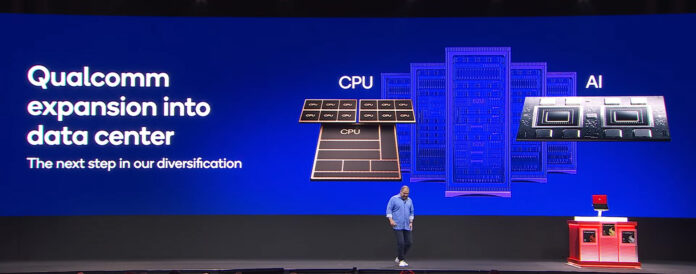
Qualcomm CEO Cristiano Amon took the official Computex 2026 opening keynote stage after Huang’s pre-show event concluded. His headline announcement was Qualcomm Dragonfly — the company’s new brand for data centre products. Dragonfly represents Qualcomm‘s formal entry into the AI inference data centre market. At the same time, Amon framed the company’s broader position around a single insight. Token demand in 2030 will exceed 4,000,000,000,000,000,000 per year — a figure so large that no cloud-only architecture can cost-effectively serve it. The answer, Amon argued, is intelligent distribution between on-device and cloud computing. His demo showed that agentic AI tasks could be completed with 30% fewer tokens and 4x lower cost by mixing on-device and cloud processing.
Separately, Qualcomm announced the Snapdragon C — the company’s first chip targeting the entry-level Windows laptop market. At under $300, the Snapdragon C-powered laptop targets students, families, and small businesses. Acer, HP, and Lenovo are committed launch partners. The timing carries one significant risk. Gartner projects a 17% increase in PC prices in 2026 as DRAM and SSD costs surge. That headwind disproportionately affects the entry-tier devices the Snapdragon C targets.
Panathēnea 2026: Europe’s Innovation Mirror

Meanwhile, 11,500 founders, investors, and executives gathered in Athens on 27–29 May for Panathēnea 2026 — a conference that reimagines the ancient Athenian festival as a contemporary innovation summit. The Zappeion Hall hosted more than 250 world-class speakers. Over 90 side events ran simultaneously across the city. Between 30% and 35% of participants came from outside Greece — making it one of the most internationally diverse European startup events of 2026.
The central message was blunt. Europe produces research and talent. Europe does not — yet — produce global AI companies that rate against OpenAI, Anthropic, or NVIDIA. Markus Villig, founder and CEO of Bolt — the Estonian ride-hailing company operating in dozens of countries — delivered one of the summit’s most-quoted lines from the Zappeion stage. The challenge, Villig said, is no longer producing research. It is “turning those ideas into global businesses.”
Europe’s Structural Innovation Gap — and What Athens Represents
The Panathēnea 2026 roster included speakers from OpenAI, Google, NVIDIA, Sequoia Capital, Index Ventures, and Atomico — alongside European founders. ElevenLabs CEO Mati Staniszewski appeared. Deel CPO Suo Wang spoke. The programme dedicated more than 70 sessions to AI, defence technology, fintech, and robotics. Academy Award-winning director Barry Jenkins represented the summit’s arts pillar — a deliberate signal that Panathēnea intends to position creativity alongside capital and technology.

The event ran under the auspices of the Greek Ministry of Digital Governance and Artificial Intelligence, the Ministry of National Economy and Finance, and the Region of Attica. Microsoft for Startups described Athens as a “connector hub for South Europe, where capital, innovation, and ambition intersect.” As TF covered in its Mistral AI Airbus BMW article, European AI sovereignty is no longer rhetorical. It is generating industrial contracts. Panathēnea is the community building the next wave of companies that will win or lose those contracts.
TF Summary: What’s Next
RTX Spark-powered laptops — including the Microsoft Surface Laptop Ultra and Dell XPS 16 — launch in fall 2026. NVIDIA and Microsoft will reveal more details about their deeper integration at Build 2026 on 2 June. Qualcomm will disclose full specifications and pricing for Dragonfly and Snapdragon C at its Investor Day on 24 June 2026. The full Computex 2026 show floor runs from 2 to 5 June at the Taipei Nangang Exhibition Centre. Panathēnea 2026 concluded on 29 May. Its next edition returns to Athens in 2027.
MY FORECAST: The Computex 2026 NVIDIA RTX Spark announcement will prove more commercially significant than Apple’s M1 launch in one specific dimension — ecosystem breadth. Apple‘s silicon transition was elegant and complete, but it applied only to macOS. RTX Spark enters a Windows market spanning hundreds of OEMs and 1.4 billion active devices. If NVIDIA achieves even modest penetration in the Windows laptop market by the end of 2026, the company’s chip portfolio will become as commercially important as its GPU business. The Panathēnea story will take longer to resolve. Europe will not produce an OpenAI equivalent before 2030. But it will produce five to ten Bolt-scale companies in AI, fintech, and defence tech over that same period — and the founders of those companies are exactly who spent three days in Athens this week. The gap between European ambition and European output is real. It is also closing.