


One team taught Gemini to control a robot’s fingers well enough to tie a knot. Another taught it to hunt a 13-year-old security flaw hiding in Chrome’s own code. Neither job is finished. Both show what happens when the same model gets pointed at different problems.
Google shipped two different Gemini-powered projects, and together they say more about where the company’s AI strategy is heading than either announcement does alone. On the robotics side, DeepMind released Gemini Robotics 2. This is a model that controls an entire robot body — from walking to fine finger manipulation — using one system across multiple hardware types. On the security side, Google detailed how it built an “agent harness” using Gemini to hunt for vulnerabilities across Chrome’s own codebase. Notably, the system uncovered a sandbox escape bug that had survived undetected for 13 years. The same model. Two different applications of what it means to reason about a physical or digital environment.
What’s Happening & Why It Matters
Gemini Robotics 2 — One Brain, Multiple Bodies
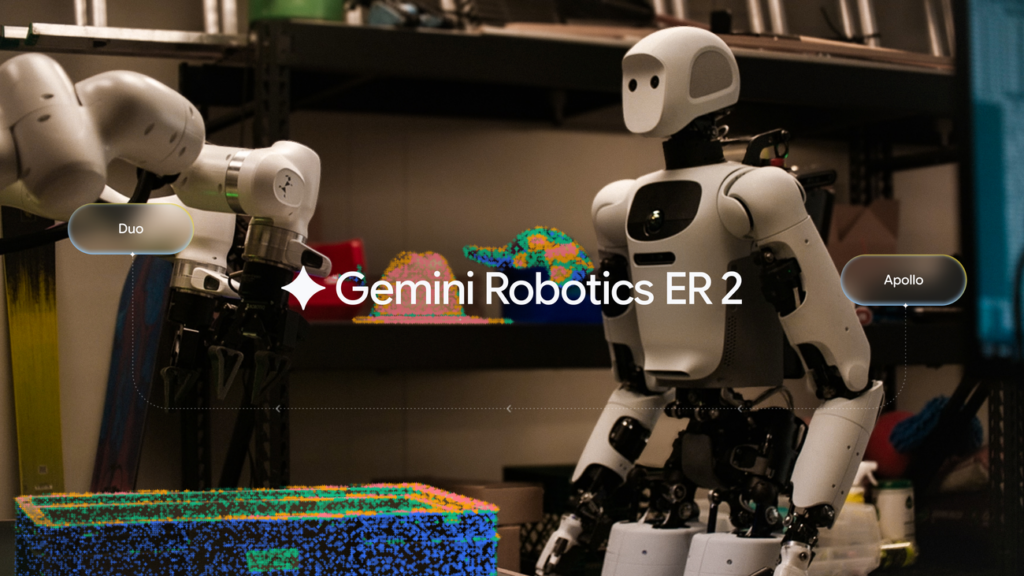
The robotics release includes two models working together. Gemini Robotics 2 is the vision-language-action model that converts what a robot sees and hears into actual motor control. Gemini Robotics ER 2 is the reasoning layer above it, planning multi-step tasks and communicating with humans. The headline claim is generalization: the same model checkpoint controls three different setups. The setups include a humanoid called Apollo 2 fitted with five-fingered SharpaWave hands. Additionally, that same Apollo 2 can be fitted with different Inspire hands instead. The third setup is an industrial Franka Duo arm using a standard two-fingered gripper.
Reported tasks include tying knots, sealing a ziplock bag, and tight packing with the industrial gripper. DeepMind robotics director Kanishka Rao was candid about the limits: true dexterity is “a distant goal,” and robots still learn far less than humans, who adjust after just one or two mistakes. MarkTechPost’s independent analysis backed that caution up with a specific number. Multi-finger dexterity success rates range from 32% to 92%, depending on the task. That’s not reliable dexterity. That’s dexterous at some things, still unreliable at others.

Chrome: Gemini Hunting Bugs
The Chrome story runs on a different track, but the model is doing similar work: reasoning about a complex environment, spotting where something is wrong, and figuring out what to do about it. Google built an agent harness in early 2026 that used Gemini to find vulnerabilities across the Chrome codebase “with higher efficiency and lower false positives.” One bug it caught was a sandbox escape that would let a compromised renderer trick the browser into reading local files. The flaw had survived in Chrome’s code for more than 13 years.
Historically, triaging a single security report took anywhere from 5 to 30 minutes and relied on human expertise. Google’s Gemini-powered system compresses that. Additionally, the team has since expanded it to support both open-weight and proprietary models working together. Plus, there is a knowledge base covering Chrome’s entire Git history to extend the model’s reasoning past what it learned in training.
Addressing the Patch Gap Problem
Finding bugs faster creates a new problem: getting the fix to users fast enough. Google says it takes 1-2 days to triage, fix, test, and release a Chrome patch. But the time users spend before restarting their browser can be a significant contributor to what’s called the patch gap. This is the window where a known vulnerability sits unpatched on a live machine.
Google’s answer is a feature called “dynamic matching,” designed to eliminate the need for a full browser restart in most cases by replacing background processes — the Renderer and GPU — with updated binaries on the fly, using Chrome’s existing multi-process architecture. It’s still in research and development. However, it’s built for a future where Chrome moves to a two-week update cycle later. Patches will need to reach users faster than the current release rhythm allows.
How Gemini Pulls Them Together
Robots and browsers are unrelated problems. They’re not, at least not from Google’s perspective. Both projects lean on the same core capability: a model that can reason about a messy, high-stakes environment — a cluttered room or a 20-year-old codebase — and take a specific, corrective action inside it. The robotics team calls that “whole-body control.” The Chrome team calls it “vulnerability discovery and triage.” It’s the same bet: that Gemini’s reasoning ability generalizes well beyond chat, into physical manipulation on one end and codebase archaeology on the other.
Neither project is finished. The robotics dexterity numbers still swing by task. The Chrome patch-without-restart feature is in active research. But both point at the same strategic direction — Google isn’t just building a better chatbot. It’s building a reasoning engine it can plug into different problems and see what breaks less often.
TF Summary: What’s Next
Gemini Robotics ER 2 is in public preview for developers; the motor-control model stays gated behind DeepMind’s hardware partnerships with Apollo and Franka. The ASIMOV-Agentic safety benchmark DeepMind built alongside the release is available on Hugging Face under an open license. On the Chrome side, the “dynamic matching” restart-free patching feature remains in research. There is no confirmed ship date ahead of Chrome’s planned move to a two-week update cycle.
MY FORECAST: The robotics dexterity gap will close faster than Rao’s cautious outlook suggests — comparable benchmarks have moved quickly elsewhere in the field, and DeepMind’s own multi-embodiment approach gives it more training data to work with than single-robot competitors. The Chrome bug-hunting work is the more consequential story, though it will get less attention. A 13-year-old sandbox escape surviving that long in one of the world’s most scrutinized codebases is a uncomfortable data point for the entire security industry, not just Google. Therefore, expect Microsoft and other major browser and OS vendors to disclose their own AI-assisted vulnerability sweeps within the next two quarters. This will happen once it is clear how much the approach found that years of human review missed.
Related Stories
- New AI Model Gives Humanoid Robots a 90% Success Rate on Complex Tasks
- AI Finding Serious Bugs in Leading Software Titles
- Countering Competitors, Microsoft Unveils AI Security Tools