


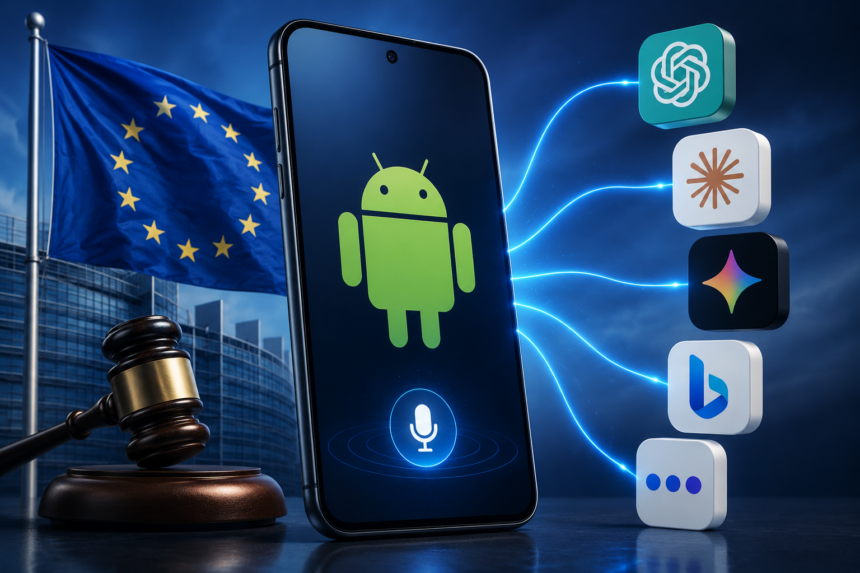
If you download ChatGPT or Claude on an Android phone in the EU, you get an app. Gemini gets an operating system feature — wake word, home button, screen reading, and the ability to act inside other apps. As of 16 July, that gap is illegal.
The EU’s Android AI interoperability order was adopted under the Digital Markets Act — binding specification measures requiring Google to give rival AI assistants the same deep system access currently reserved exclusively for its own Gemini. “Currently, on Android phones, competitors’ AI assistants only have restricted access to key functionalities,” the European Commission said. “Today’s decision will ensure that users can activate their preferred AI assistant.” Henna Virkkunen, the Commission’s Executive Vice-President for Tech Sovereignty, Security and Democracy, named the goal: “We hope to see emerging alternatives to Google Search and Google’s AI services, such as Gemini.” Android carries approximately 60% of European mobile users — meaning the order directly affects the majority of smartphones on the continent.
What’s Happening & Why It Matters
What “System-Level Access” Means
The EU’s Android AI interoperability order covers 11 specific operating system features, with Google permitted to require certification before an app touches five of them, designated as “restricted features.” Those include centralised access to on-device data apps opt into sharing (currently AppSearch), context-aware intelligence powering proactive suggestions like Magic Cue, structured on-device integration through App Actions and App Functions, and screen automation implemented through Computer Control.
By contrast, the practical user experience is what makes the gap so stark today. Under Google‘s current setup, downloading ChatGPT or Claude on an Android phone gets you an app — one you must manually open. Using Gemini gets you an operating system feature, one that can hear a wake word, hold down the home button, read your screen, and take actions inside other apps entirely on your behalf. Google will be required to let users pick a preferred assistant and wake it by voice, exactly as they currently do with Gemini — and those rival assistants must be able to act inside apps, for example booking a taxi or suggesting chat replies.
A Second, Parallel Order — Search Data Access
The EU’s Android AI interoperability order arrived alongside a second, separate specification measure targeting Google Search directly. The Commission is compelling Google to hand anonymised search query, click, and ranking data to rival search engines and to AI chatbots with search features, for a cost-based fee. Alphabet‘s deadlines require it to finalise the dataset by November 2026 and its pricing offer by January 2027.
By contrast, dataset quality and commercial terms will determine whether the measure helps rivals or amounts to little more than a formal right to request data with limited practical value. Neither order is a fine — specification proceedings only establish what a gatekeeper must build; the Commission’s separate power to open a formal non-compliance case, complete with fines, is untouched and available if Google fails to comply adequately.
Google’s Response — A Privacy Threat
The EU’s Android AI interoperability order drew an immediate and pointed rebuttal from Google. President of Global Affairs Kent Walker cast the decision as a threat to users: “Today’s decisions risk undermining vital privacy and security guardrails for millions of Europeans.” Interoperability requirements as a privacy risk rather than a competition remedy — echoes arguments Apple has made in parallel EU proceedings over its own iOS restrictions.
By contrast, the order builds directly on a 2025 investigation into Google’s AI practices, in which the Commission concluded that Google’s control over Android’s entire AI stack — from voice invocation through to on-device models — hindered the emergence of competing AI assistants, constituting a clear violation of the DMA’s interoperability obligations. As TF covered in its Google EU antitrust appeal article, Brussels has demonstrated a sustained, multi-year willingness to pursue Android-related antitrust and interoperability enforcement to its conclusion — the order is the latest instalment in that pattern, not an isolated action.
Apple Faces the Same Pressure — With a Shorter Runway
The EU’s Android AI interoperability order is explicitly named by the Commission as a template extending beyond Google alone. Regulators have separately been probing Apple‘s iOS restrictions and are reportedly examining Microsoft‘s practices around Windows and Bing, though no formal AI-specific action against Microsoft has yet been taken. Notably, Google won a considerably longer compliance runway than Apple, which must make its own Siri AI compliant with equivalent interoperability rules before it can even launch in the bloc at all — as TF covered in its WWDC 2026 article, Siri AI’s EU launch is blocked over exactly the class of concern.
The Trump administration has publicly opposed the DMA, arguing it unfairly targets US technology firms specifically — a political tension that has run through nearly every major DMA enforcement action against American companies throughout 2026, without so far changing the Commission’s enforcement trajectory.
TF Summary: What’s Next
Google must implement Android AI assistant interoperability under the binding specification measures with a compliance timeline the Commission has set, though full technical rollout is not expected before July 2027 according to industry analysts. The parallel search data-sharing order requires Google to finalise its dataset by November 2026 and pricing by January 2027. Non-compliance risks a formal Commission investigation carrying fines of up to 10% of global annual turnover.
MY FORECAST: The EU’s Android AI interoperability order will produce competitive movement in the European AI assistant market within 18 months — the system-level access gap between Gemini and every rival assistant has been the single largest structural barrier preventing OpenAI, Anthropic, and others from meaningfully competing on Android specifically. By contrast, dataset quality on the parallel search-sharing order will be the test of whether the measure produces real competition or merely a compliance formality — Google’s November 2026 dataset submission will reveal whether the Commission’s remedy has real teeth. Expect Apple to face an even more prescriptive equivalent order within 12 months, given the Commission’s explicit signalling that the Android decision previews exactly how Brussels intends to handle Apple’s parallel restrictions.
Related Stories
- Google Loses Its Appeal Against a Record €4.1 Billion EU Fine
- EU Tells Meta: Disable Auto-Play and Infinite Scroll or Face Massive Fines
- WWDC 2026: Siri Gets a Brain, macOS Drops Intel, Tim Cook Takes a Bow