


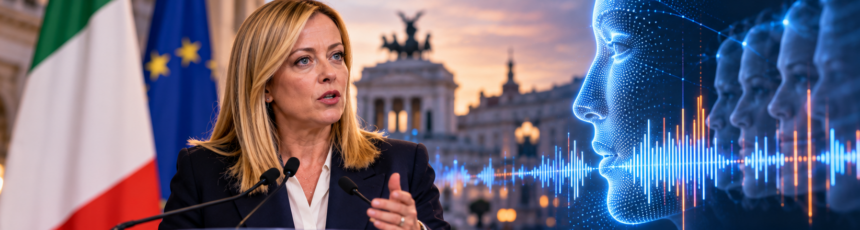
The Italian PM filed a four-second sound clip with the EU trademark office. Italian media say approval won’t stop deepfakes by itself.
This article discusses AI deepfakes, including sexual deepfakes, at a legal level.
Italian Prime Minister Giorgia Meloni applied to trademark her voice with the EU Intellectual Property Office (EUIPO), records showed on 5 October 2026. She wants a new legal tool against AI-generated deepfakes. The application is under examination, so her voice isn’t a registered trademark yet.
Italian media say approval alone wouldn’t stop deepfakes, according to Reuters. It could add legal obstacles for anyone who copies her voice. Meloni has denounced deepfakes as a way to spread falsehoods and target individuals, and she urged users to verify content before sharing it.
What’s Happening & Why It Matters
What She Filed
The filing is a sound trademark built on a four-second recording of Meloni saying “Io sono Giorgia Meloni” (“I am Giorgia Meloni”) twice. A Rome law firm, MpmLegal, handled it through lawyer Marco Mastracci, Yellow reports. The listed goods and services include downloadable multimedia content and political events. La Repubblica reported the filing.

Italian outlets note the phrase echoes a viral speech from October 2019. In that speech, she called herself a woman, a mother, Italian, and Christian.
What a Voice Trademark Does
A registered trademark adds civil claims against copycats. In Italy, counterfeiting a registered trademark is also a crime that can bring fines and, in serious cases, prison. Italian media expect the registration to create extra legal obstacles, not a block on deepfakes.
The tool has limits. Trademark attorney Josh Gerben said of Taylor Swift’s filings that AI can mimic a voice without copying any existing recording. Trademarks may help fill that gap, he said, but courts have not tested registering a spoken voice. The Conversation adds a person’s voice isn’t automatically a trademark. It’s unclear whether trademark law can police a manufactured endorsement.
Pop Stars and Voice Actors Got There First
Italian singer Giusy Ferreri filed earlier this year, described as the first individual to file such a request with the EUIPO, La Repubblica reports. Voice actor Luca Ward followed weeks later. In the US, Taylor Swift’s company filed three applications with the USPTO on 24 April: two audio clips, “Hey, it’s Taylor Swift” and “Hey, it’s Taylor,” plus an image. Reuters notes Matthew McConaughey had similar filings approved.
Italy Already Has a Deepfake Crime
Italy’s Law 132/2025, which Meloni’s government championed, took effect on 10 October 2025. Article 612-quater punishes spreading AI-faked images, videos, or voices without consent when the spread causes unjust harm. The penalty is one to five years in prison. Prosecutions need a complaint from the victim, and the offence targets the person who spreads the fake, not the platform hosting it.
A trademark covers different ground. It adds civil remedies against commercial copying, so the two tools overlap in part. The EU’s AI Act transparency rules for synthetic content have applied since 2 August 2026, as covered in EU Makes AI Labels Mandatory for Realistic Synthetic Content. Labels disclose a fake. They don’t give a person ownership of a voice.
Meloni’s Deepfake Record
In 2024, Meloni launched a civil action against a Sardinian man accused of creating and posting sexual deepfake images using her face. She sought €100,000 ($112,000) in damages. An Italian court is hearing the case. In May, she cited a circulating fake sexualised image as part of an attack on her.
Coverage doesn’t say how a voice trademark would treat satire or news reporting. Both would test the registration if the EUIPO grants it.
TF Summary: What’s Next
The EUIPO is examining the application, and coverage gives no decision date. Meloni’s 2024 civil case against the Sardinian man stays pending before an Italian court. Italy’s AI law reaches its first anniversary on 10 October. The EU’s synthetic-content labelling rules have been in force since 2 August.
MY FORECAST: Expect other European public figures to file for voice protection within months. The EUIPO will examine the sound trademark for distinctiveness, with a decision months away. Expect the first test case to involve a commercial fake, such as a synthetic endorsement. Watch whether Italian prosecutors pair Article 612-quater with the trademark in one case.
Related Stories
- EU Makes AI Labels Mandatory for Realistic Synthetic Content
- ChatGPT’s Images 2.5 Turns Doodles Into Finished Photos
- Users Rebel Against Labs’ AI Watermarking