



In Beijing, robots race for sport. In Ukraine, they race to replace soldiers. Both stories are telling us something important.
Two events happened this week on opposite sides of the world. In Beijing, more than 70 teams of humanoid robots completed an overnight test run across a 21-kilometre (13-mile) course through the city’s E-Town development zone, preparing for the world’s second humanoid robot half-marathon on 19 April 2026. Meanwhile, in eastern Ukraine, ground robots completed over 9,000 battlefield missions in March alone — evacuating wounded soldiers, delivering ammunition, and, in some cases, capturing enemy positions without a single human soldier present.
Thousands of kilometres separate the two stories. However, they share the same technological trajectory. Furthermore, they raise the same uncomfortable question: as robots grow faster, more capable, and more autonomous, what role do humans actually play? The answer is changing. Consequently, the world had better start paying attention.
What’s Happening & Why It Matters
Beijing’s Robot Race: Not Just a Stunt

The 2026 Beijing E-Town Humanoid Robot Half-Marathon is the world’s first recurring robot endurance race. Moreover, it is far more than a spectacle. Participation this year surged nearly fivefold compared to the inaugural 2025 event. Over 100 teams registered, representing enterprises, universities, and four international entries. The official race on 19 April follows a comprehensive overnight test run conducted from the evening of 11 April through to the early hours of 12 April.
The test run covered the full 21.0975-kilometre (13.1-mile) course — the standard half-marathon distance — through urban streets and ecological park terrain in Beijing’s Yizhuang district. Additionally, it simulated route navigation, equipment coordination, emergency response protocols, and multi-device collaboration under race timing conditions. Approximately 40% of competing teams rely entirely on autonomous navigation — meaning their robots complete the course without a human operator guiding each step. Liang Liang of the Chinese Institute of Electronics described autonomous navigation as adding “a significant challenge for the robots.”
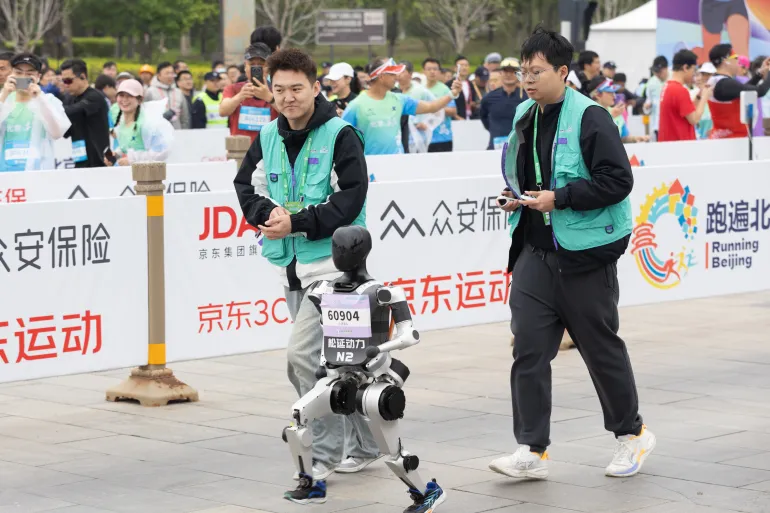
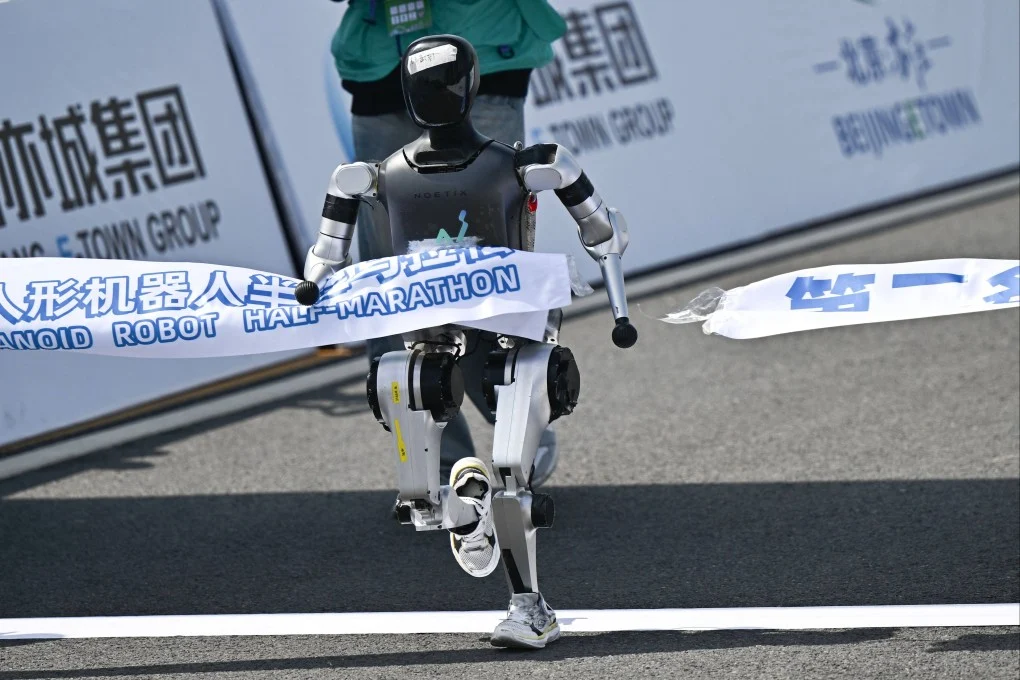
The results from the test run were illuminating. Overheating joints require cooling breaks during battery changes. Draining batteries pushed teams to optimise power algorithms. However, progress was undeniable. Yang Kechang of China Agricultural University said his team was “already satisfied just to finish” — having assembled their robot at 1 PM and entered it into the competition the same day. Furthermore, some teams expect their robots to approach the finishing times of elite human athletes in short distances.
China’s Industrial Ambition Behind the Race
The half-marathon is not simply a celebration of robotics. Rather, it is a pressure test for China’s rapidly expanding humanoid robot industry. The 2026 race, in the words of Chinese experts, serves to “accelerate the transition of humanoid robots from laboratory prototypes to real-world applications.” Furthermore, organisers introduced new endurance awards this year — including prizes for simply completing the course — signalling that real-world durability is valued as highly as peak performance.
The industrial context is striking. A production line in Guangdong Province, run by Leju Robotics, produces over 10,000 robot units per year, with a new unit rolling off the line every 30 minutes. In October 2025, Chinese firm Noetix launched its consumer-grade “Bumi” humanoid robot at 9,998 yuan ($1,376 / £1,082). Additionally, China’s Ministry of Industry and Information Technology (MIIT) released the country’s first top-level standard framework for humanoid robots. It embodied AI on 1 March 2026 — covering the entire industrial chain and lifecycle.
Unitree Robotics CEO Wang Xingxing stated at the 2026 Yabuli Entrepreneurs Forum that humanoid robots could break the 10-second barrier in the 100-metre dash by mid-2026 — potentially surpassing the limits of human sprinters. The race, therefore, is not a parallel universe to the military and industrial applications developing elsewhere. It is the same technology, stress-tested on a public course.
Ukraine’s Battlefield: Robots Replace Soldiers
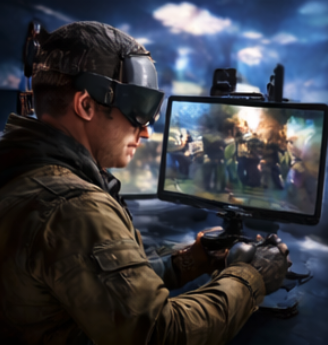
Approximately 8,000 kilometres (5,000 miles) west of Beijing, the relationship between humans and robots in high-stress environments is very different. Ukraine is running out of soldiers. Consequently, it has turned to machines.
In March 2026, Ukraine’s Armed Forces completed over 9,000 missions using Unmanned Ground Vehicles (UGVs) — a sharp jump from roughly 2,900 missions in November 2025 and over 7,000 in January 2026. Since the beginning of 2026, ground robotic systems have completed approximately 32,500 missions. Furthermore, the number of military units deploying ground robots rose from 67 in November 2025 to 167 in March 2026. These are not experimental figures. They represent a fully operational shift in how Ukraine wages war.
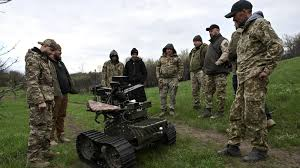
Ukrainian Defence Minister Denys Shmyhal described the strategy plainly: “The development and scaling of ground robotic systems form part of a systematic, human-centric approach focused on protecting personnel.” In practical terms, robots now handle 80% of logistics operations in some Ukrainian units, including the 3rd Assault Brigade. Additionally, robots deliver ammunition to front-line positions, evacuate wounded soldiers from kill zones, and lay and clear mines. In one widely documented case, a Maul UGV retrieved a wounded soldier from 64 kilometres (40 miles) inside Russian-held territory — surviving repeated drone strikes and a mine blast.
The World’s First UGV Battalion
Beyond logistics, Ukraine has crossed a threshold that military historians will study for decades. The K2 Brigade established the world’s first dedicated UGV battalion, commanded by Major Oleksandr Afanasiev. His unit mounts Kalashnikov machine guns on wheeled and tracked platforms and deploys them into positions where, as he put it, “an infantryman would be afraid to turn up.” Furthermore, the battalion uses battery-powered kamikaze UGVs — explosive-laden vehicles that roll silently toward enemy positions and detonate. Unlike aerial drones, they produce no audible warning on approach.

Ukrainian manufacturer Tencore produced over 2,000 UGVs for the Ukrainian army in 2025. Additionally, it expects demand to reach approximately 40,000 units in 2026. Of those, an estimated 10–15% will be armed. Furthermore, Ukrainian President Volodymyr Zelenskyy declared that Ukrainian forces had captured a Russian position using only drones and robots — no infantry involved. Subsequently, Zelenskyy declared: “The future is here.”
Rob Lee, a Eurasia expert at the Foreign Policy Research Institute, confirmed the direction of travel: “The numbers are increasing — and we’re going to see that scale even more in 2026.” Meanwhile, former Ukrainian commander-in-chief Valerii Zaluzhnyi outlined the next phase: AI-powered swarms combining aerial, ground, and maritime drones attacking simultaneously from multiple directions. “In the near future we’ll see dozens and even hundreds of smarter and cheaper drones attack from various directions and heights, from the air, ground and sea at the same time,” he said.
The Ethics Nobody Has Solved
Both stories share a common thread. In Beijing, autonomous navigation robots make real-time decisions about route, speed, and obstacle avoidance without human input. In Ukraine, AI-powered drones assess targets and autonomously fire when Russian radio jamming renders remote control ineffective. Therefore, in both civilian and military contexts, machines are making consequential decisions independently.
Current Pentagon protocols require automated weapons systems to engage only with human authorisation. However, practice and doctrine are already diverging on the Ukrainian front lines. Furthermore, international law is not equipped for what lawyers are calling “algorithmic accountability.” Current negotiations in Geneva are exploring a two-tier framework: a total ban on systems that target people using biometric data, and strict rules on geographic scope, duration, and mandatory human override — so-called “human-on-the-loop” requirements. However, the pace of technological deployment is already outrunning the pace of legal frameworks.
As Dr Patrick Bury, a professor of warfare and counter-terrorism, asked on X after Ukraine’s robot-only capture: “If this starts happening at scale — which is the logical conclusion — would this change the nature, rather than the character, of war?” The answer appears to be yes. Furthermore, it is already happening.
TF Summary: What’s Next
The robots running in Beijing on 19 April 2026 and the robots fighting in eastern Ukraine this week are, technologically speaking, cousins. Both are humanoid or semi-autonomous platforms, and both rely on advances in dynamic motion algorithms, AI decision-making, and battery endurance. Moreover, both are improving at a pace that is outstripping regulation, doctrine, and public understanding simultaneously. China’s half-marathon is a civilian showcase. Ukraine’s battlefield is a live proving ground. Together, they define what the next decade of robotics actually is like.
MY FORECAST: The question ahead is not whether robots will run faster or fight harder — they will. The question is who governs them, who is accountable when they make mistakes, and whether the legal and ethical frameworks being drafted in Geneva and Washington can keep pace with what is already happening in Beijing and on the eastern front. Consequently, the most important decisions about autonomous robots are not being made in races or on battlefields. They are being made — or not made — in parliaments, international bodies, and corporate boardrooms right now. The humans are not dead. However, they are running out of time to decide the rules.
— Text-to-Speech (TTS) provided by gspeech | TechFyle