


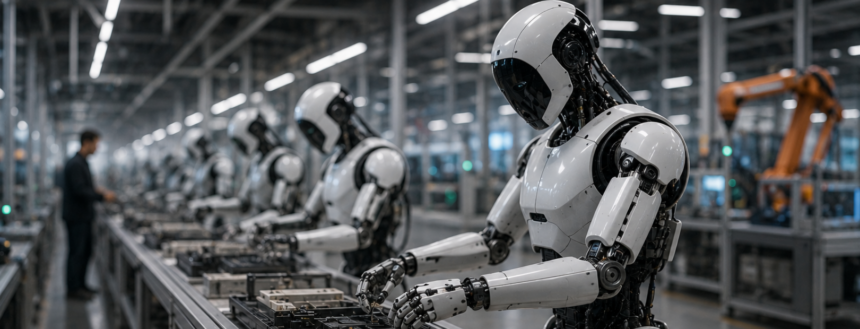
Humanoid and autonomous robot advances are in five examples — and the breadth of progress is startling. Figure AI demonstrated robots completing full eight-hour factory shifts without human intervention, using a unified neural network called Helix-02. Unitree Robotics unveiled the world’s first production-ready manned mecha robot — a 500 kg (1,102 lb) machine that carries a pilot and shifts from two legs to four. Euroatlas confirmed its Greyshark hydrogen-powered autonomous submarine can patrol for 16 weeks without surfacing or needing a support vessel. A Korean hotel launched a camera-on-wrist training programme for next-generation service robots. And a startup demonstrated a humanoid arm capable of handling fragile objects with precision.
“The Humans Are Dead” is a recurring TF series. Edition three covers a world where the machines are working, walking, and patrolling at scales that would have seemed fictional three years ago.
What’s Happening & Why It Matters
Figure AI’s Helix-02: Eight Hours, No Breaks, No Resets
On 13 May 2026, Figure AI CEO Brett Adcock posted an eight-hour live stream on X showing his company’s robots completing a full factory shift. The robots sorted barcoded packages onto a conveyor belt. They worked continuously — no resets — no human intervention. “Watch a team of humanoid robots running a full 8-hr shift at human performance levels,” Adcock wrote. “This is fully autonomous running Helix-02.”
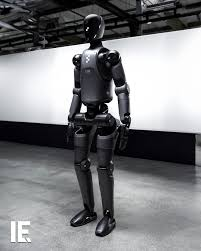
The Helix-02 system is a unified neural network. It merges movement and manipulation into one architecture — replacing the two separate controllers that traditional industrial robots use. The system processes vision data from cameras on the head and palms, tactile input from fingertip sensors, and joint position data across the whole body simultaneously. That integration produces a robot that can react to changing conditions in real time rather than following pre-programmed sequences.
What Helix-02 Can Actually Do
The Helix-02 demonstrations went beyond package sorting. The robot unscrewed bottle caps, extracted pills from an organiser at precise quantities, pushed accurate syringe volumes, and picked metal parts from cluttered bins using tactile sensing alone. Each task required the kind of fine motor control that industrial robots have historically struggled with. A second demonstration showed two robots resetting a bedroom in under two minutes — hanging clothes, making a bed, taking out trash, closing books, repositioning furniture, and coordinating around shared objects without a central controller. That last detail matters. The robots coordinated without instructions from above.
The Helix-02 achievement builds on earlier work. At BMW‘s Spartanburg, South Carolina plant, Figure AI robots previously ran 10-hour shifts daily — moving more than 90,000 parts per day and contributing to production of over 30,000 cars. The eight-hour warehouse demonstration extended that operational profile to a new environment with less structured layout and more variable task demands. Adcock’s robots weigh 70 kg (154 lb), stand approximately 170 cm (5 ft 7 in) tall, and carry up to 20 kg (44 lb). By any measure, this was the company’s most ambitious real-world test yet.
Unitree’s GD01: A Manned Mecha That Transforms
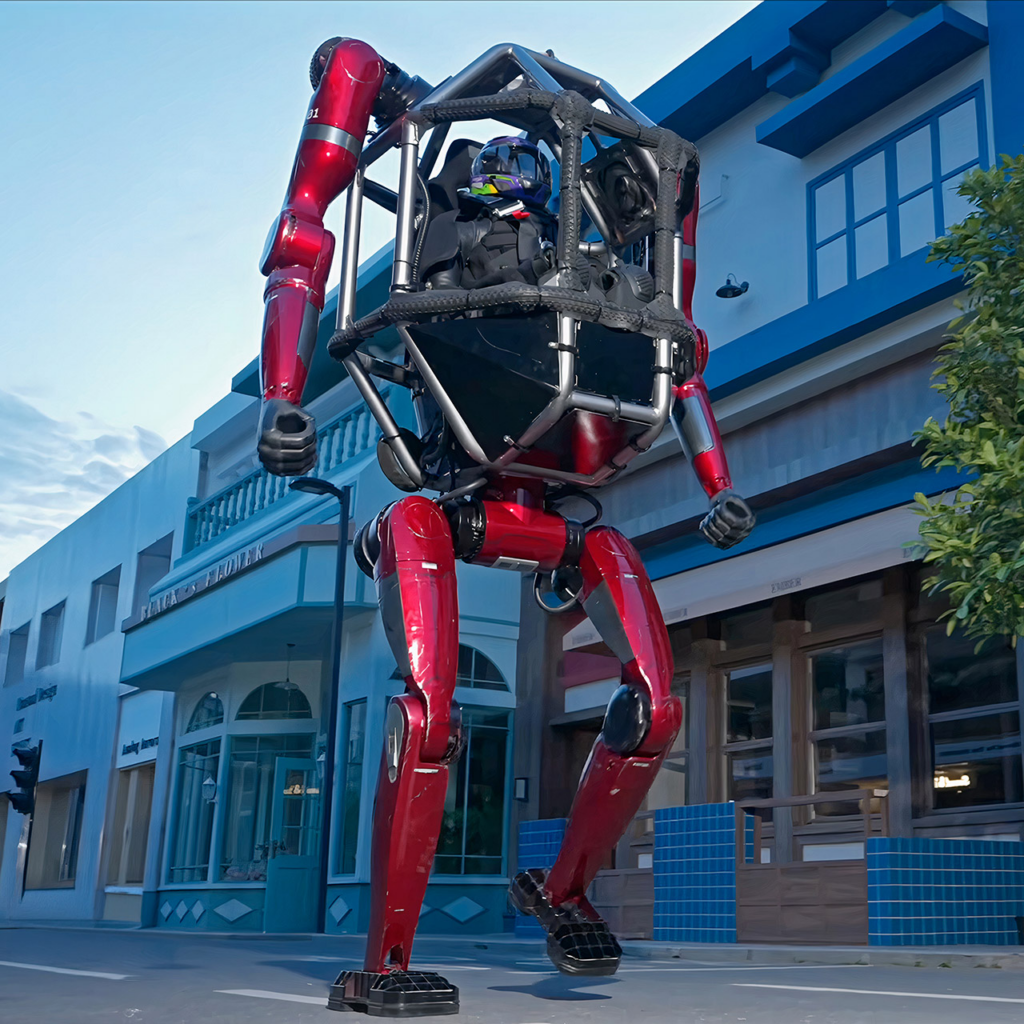
On 12 May 2026, Unitree Robotics — the Hangzhou-based company known for its consumer robot dogs — unveiled the GD01. This is not a service robot. It is an 11-foot (3.4-metre), 500 kg (1,102 lb) piloted mecha that carries a human in a cage-like upper-body cockpit. The GD01 launches as the world’s first production-ready manned mecha robot, with a starting price of 3.9 million yuan ($574,000 / €529,000).
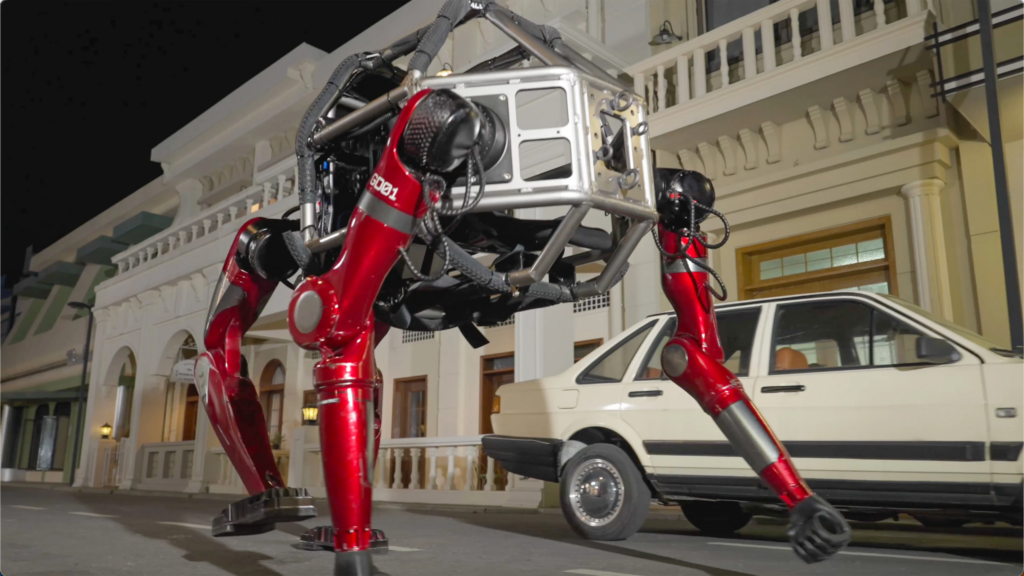
The GD01’s most distinctive capability is reconfiguration. In bipedal mode, it walks like a large humanoid — striking bricks and navigating terrain. When balance becomes unstable, it drops onto its back and continues moving on all fours in quadrupedal mode. That mode-switching makes it adaptable across environments that neither wheeled nor purely bipedal systems can handle consistently. Unitree describes target applications as theme parks, rescue operations, and challenging terrain environments where conventional vehicles cannot operate.
China’s Manufacturing Advantage Behind the GD01
The GD01 is not an accident. It reflects a structural manufacturing advantage that Chinese robotics companies now hold. Wang Peng, associate research fellow at the Beijing Academy of Social Sciences, described it directly. “Unitree’s ability to rapidly launch such products is backed by China’s highly dense and responsive manufacturing ecosystem. From high-performance motors and batteries to carbon-fiber materials, China’s mature supply-chain network allows companies to quickly source components, accelerate product iteration and reduce development costs. Such ecosystem advantages will be difficult for overseas manufacturers to replicate in the short term.”
By contrast, Omdia research estimates that Chinese companies accounted for nearly 90% of global humanoid robot sales in 2025. Unitree shipped more than 5,500 humanoid robots last year. It is preparing for an IPO on Shanghai’s STAR Market targeting 4.2 billion yuan ($608 million / €561 million) in capital. The GD01 is not its only new product — the company separately released an upper-body humanoid robot starting at 26,900 yuan ($4,290 / €3,958) in April 2026. At that price point, the technology is no longer experimental. It is approaching commercial.
Korea’s Hotel Robot Academy: Training by Watching
One of the week’s quieter but most forward-looking robotics stories came from a hotel in South Korea. A Korean hospitality group implemented a specific training methodology for its next-generation service robots. Staff wore wrist-mounted cameras that recorded hand movements during routine tasks — making beds, folding towels, setting tables, handling fragile objects. The captured data trained robot neural networks to replicate precise hand motions with a level of dexterity that general-purpose training datasets have struggled to produce.
The approach addresses a specific bottleneck in service robotics. Language models and vision models can teach robots broad world knowledge. The fine motor knowledge required to handle hotel linen, arrange place settings, or fold delicate fabrics requires domain-specific training data. Filming the wrists of trained hotel staff provides exactly that specificity at low cost. The programme is a small-scale implementation. Its methodology, however — close-range hand movement capture combined with imitation learning — is now being adopted across Korean manufacturing and service industries as a standard robot capability pipeline.
The Greyshark: A Hydrogen Submarine That Doesn’t Surface
Euroatlas, a European maritime technology company, confirmed this week that its Greyshark autonomous underwater vehicle (AUV) can patrol for 16 weeks without surfacing or requiring a support vessel. The system runs on hydrogen fuel cells — generating electricity through a chemical reaction between hydrogen and oxygen, emitting only water as a byproduct. The Greyshark is scheduled for sea trials in August 2026, testing endurance, autonomous navigation, and sensor capabilities in real-world conditions.
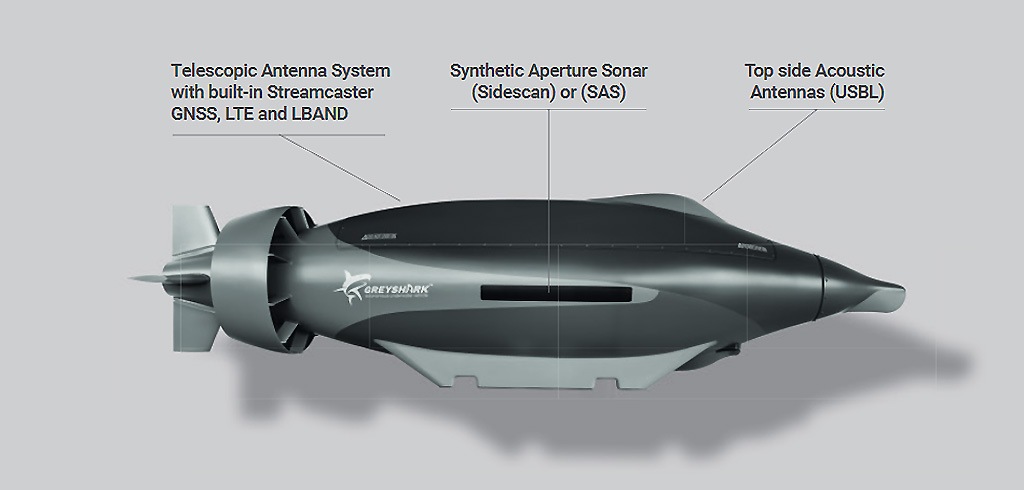
Six Greyshark vehicles, operated by a single person, could map the entire Strait of Hormuz in no longer than 24 hours, according to Euroatlas. That capability is directly relevant to current geopolitical conditions. Iranian mines deployed in mid-April 2026 in the Strait remain partially unlocated. “Even the Iranian authorities don’t know where the mines are, so clearing the Strait with manned assets would be extremely difficult, expensive, and dangerous,” Euroatlas researcher Luminița Codrean told Interesting Engineering. The Greyshark’s sensor fusion system combines multiple acoustic sensor frequency bands simultaneously — producing more detailed environmental data than single-sensor systems can generate.
Persistent Maritime Awareness: The Problem Greyshark Solves
The strategic case for autonomous underwater patrol is not simply about cost. Euroatlas systems engineer Konrad Schmidt described the fundamental limitation of current naval architecture. “One of the biggest needs in the maritime domain today is persistent maritime awareness. Persistent maritime awareness is simply impossible to achieve with only manned assets.” A manned submarine requires crew rotations, port calls, and support logistics. An autonomous vessel running on hydrogen fuel cells needs none of that. The 16-week endurance figure is not a performance statistic. It is the difference between continuous coverage and periodic surveillance.
The technology has attracted significant NATO interest. The Greyshark’s August trials will be a critical commercial and military evaluation. Beyond mine detection, the system targets narco-submarine detection — the small, low-observable vessels that drug cartels use to transport cocaine from South America to North America and Europe. The combination of long endurance, low acoustic signature, and sensor fusion gives the Greyshark a genuinely unique operational profile in that mission category.
TF Summary: What’s Next
Figure AI‘s eight-hour shift demonstration will drive enterprise customer conversations across logistics, warehousing, and manufacturing sectors. The BMW deployment already validates commercial manufacturing integration. The warehouse demonstration extends that validation to less structured environments. Helix-02’s fine motor capability — pills, syringes, caps — opens healthcare and pharmaceutical handling as a near-term sector.
MY FORECAST: Humanoid and autonomous robot advances of this scope will produce the first commercial humanoid labour contracts — where a company pays a robotics firm a per-shift rate rather than a per-unit purchase price — before the end of 2027. Figure AI‘s Helix-02 architecture makes this economically viable. The Greyshark’s hydrogen endurance makes uncrewed maritime patrol commercially deployable within 18 months of August’s sea trials.
Unitree’s GD01 will not achieve mass adoption in its current form — the pilot ergonomics and $574,000 price point limit the initial market. By contrast, Unitree’s $4,290 upper-body humanoid robot will see the most rapid commercial deployment of any product in this roundup. At that price, industrial pilots become financial experiments rather than capital commitments.
The rate of iteration is now faster than the rate of policy and regulatory response. That gap will produce the next ten episodes of this series — and they will be harder to write than this one.