


The Alphabet $80 billion AI fundraising announced is the largest equity capital raise by a US technology company in history. Alphabet — the parent company of Google — announced plans to raise $80 billion (€73.8 billion) through three concurrent share sales to fund what the company describes as “unprecedented customer demand” for its AI infrastructure. The announcement came alongside confirmation that Berkshire Hathaway‘s new CEO Greg Abel had agreed to invest $10 billion (€9.2 billion) in Alphabet through a private placement — purchasing $5 billion in Class A shares and $5 billion in Class C shares. That single commitment positions Alphabet alongside American Express and Coca-Cola as one of Berkshire‘s premier equity holdings. The market’s initial reaction was cautious. Alphabet shares fell approximately 2.5% in early trading after the announcement — as investors processed the scale of equity dilution alongside the company’s already enormous capital expenditure commitments.
What’s Happening & Why It Matters
The Three-Part Structure of the $80 Billion Raise
The Alphabet $80 billion AI fundraising is not a single transaction. It consists of three distinct mechanisms, each addressing a different investor category and timeline. The first is a $30 billion underwritten public offering — evenly split between $15 billion in ordinary Class A and Class C common stock and $15 billion in mandatory convertible preferred shares (depositary shares). Goldman Sachs, JPMorgan Chase, and Morgan Stanley are managing the underwritten offerings as joint book-running managers. The second is an at-the-market (ATM) program targeting $40 billion in Class A and Class C share sales. The ATM program launches in Q3 2026 and allows Alphabet to sell shares incrementally over time — partly to manage employee stock award tax obligations efficiently. The third is the $10 billion Berkshire Hathaway private placement — a direct bilateral transaction at fixed prices of $351.81 per Class A share and $348.20 per Class C share.
Why Alphabet Needs $80 Billion — When It Generates $80 Billion Annually

Alphabet generated approximately $350 billion in annual revenue in 2025 and produces substantial free cash flow. The question the announcement immediately raised is why the company — which also recently raised approximately $85 billion in debt — needs to dilute equity at all. The answer is scale and timing. Alphabet revised its 2026 capital expenditure guidance in April to between $180 billion and $190 billion — a figure that dwarfs any prior technology infrastructure investment cycle. Even with strong operating cash flow, funding $180 to $190 billion in capex from internal sources alone would require deferring other priorities including share buybacks, dividends, and research investment. The equity raise maintains financial flexibility while signalling to the market that Alphabet is prepared to invest at whatever scale AI demand requires.
Alphabet stated directly that it is “experiencing strong demand for its AI solutions and services from enterprises and consumers, at levels that are exceeding the company’s available supply.” That last phrase — exceeding available supply — is the critical commercial signal. Google Cloud‘s AI infrastructure is genuinely capacity-constrained. The $80 billion raise is the company’s response to that constraint.
Berkshire Hathaway Bets on the AI Infrastructure Cycle
The Alphabet $80 billion AI fundraising‘s most significant signal is the identity of the largest single investor. Berkshire Hathaway is not a technology investor by tradition. Under Warren Buffett‘s six-decade leadership, Berkshire famously avoided technology companies it described as too difficult to predict — with the notable exception of its large Apple position taken from 2016 onwards.
Greg Abel — who became CEO after Buffett’s transition in 2025 — has moved aggressively since taking the helm. Berkshire began building its Alphabet position in Q3 2025. By the time of the 1 June announcement, that position was already worth approximately $20 billion. The additional $10 billion private placement brings Berkshire‘s total Alphabet holding to approximately $32 billion.
Abel is making a clear and specific bet. AI infrastructure spending — not AI model development — is the most durable commercial opportunity in the current cycle. Alphabet owns both the cloud platform to sell that infrastructure and the AI models to populate it.
The Market’s 2.5% Drop — and What It Actually Means
Alphabet shares fell approximately 2.5% in early trading on 2 June — despite the Berkshire endorsement and the strong demand narrative. That decline is a specific and legitimate investor concern. Alphabet is a company with enormous free cash flow that typically returns capital to shareholders through buybacks. An $80 billion equity raise is a dilutive event — it increases the share count, reducing the value of existing shares on a per-share basis. The size of the raise suggests that internal cash generation, debt capacity, and existing cash reserves are collectively insufficient to fund the AI infrastructure buildout at the pace Alphabet believes is necessary.
By contrast, the mandatory convertible preferred shares component of the underwritten offering provides a structural insight. Mandatory convertibles are a hybrid instrument — they count as equity on the balance sheet but pay a dividend until conversion. Companies use them when they want to signal balance sheet strength without creating immediate common stock dilution. Alphabet‘s choice to include $15 billion in mandatory convertibles alongside $15 billion in common stock suggests the company is managing dilution optics as carefully as it is managing the actual capital raise.
Inside the AI Infrastructure Arms Race
The Alphabet $80 billion AI fundraising arrives in the context of an extraordinary global capital mobilization for AI infrastructure. As TF covered this week in its Choose France article, SoftBank committed €45 billion to AI data centers in France. Amazon committed $15 billion to European AI infrastructure. Microsoft is spending $80 billion globally on data center capacity in 2026 alone. Meta projects between $115 billion and $145 billion in 2026 capital expenditure. The combined capital deployment across Alphabet, Amazon, Microsoft, and Meta approaches $600 billion in AI infrastructure spending in a single year. That number has no historical precedent in any industry.
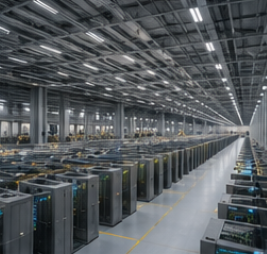
The competitive dynamic driving this spending is simple and brutal. AI demand is growing faster than data center capacity. The company that builds the most capacity — and builds it fastest — captures the most enterprise AI revenue. Every month of capacity shortage is revenue that flows to a competitor. Alphabet‘s own statement — that demand “exceeds available supply” — is simultaneously an admission of constraint and a justification for emergency capital mobilization.
TF Summary: What’s Next
The $30 billion underwritten public offering closes within days of the announcement — typical for an underwritten transaction of this scale. Goldman Sachs, JPMorgan, and Morgan Stanley will have priced and settled the transaction before the end of the week. The Berkshire Hathaway private placement closes concurrently with the underwritten offering. The $40 billion ATM program begins in Q3 2026 and deploys over time — likely over 12 to 18 months. Alphabet‘s full-year capex of between $180 billion and $190 billion is already underway.
MY FORECAST: The Alphabet $80 billion AI fundraising will be fully subscribed — and the 2.5% share price decline on announcement day will be recovered within 30 days as investors assess the long-term strategic rationale. Berkshire Hathaway‘s participation is the most important signal in the entire transaction. Greg Abel is not a sentimental investor. He committed $10 billion to Alphabet because he has assessed the AI infrastructure buildout cycle and concluded that Google Cloud‘s position — second in cloud market share behind AWS but first in native AI model capability — will generate returns that justify the dilutive raise. That assessment is almost certainly correct. The mandatory convertible structure gives existing shareholders a dividend cushion while the new capacity comes online. By the time the ATM program completes in 2027 or 2028, Alphabet‘s AI-driven cloud revenue will likely have grown sufficiently to make the dilution immaterial in earnings-per-share terms.