


The Meta AI Instagram hack is one of the most publicly embarrassing AI security failures in social media history — not because the attack was sophisticated, but because it was not. Hackers exploited Meta‘s AI-powered support chatbot to take over high-profile Instagram accounts by politely asking it to hand them the keys. The compromised accounts included the Barack Obama White House page — dormant since January 2017 — which hackers promptly filled with politically inflammatory AI-generated content. Sephora’s corporate account. The US Space Force Chief Master Sergeant John Bentivegna’s account. Multiple high-value, short-handle accounts combined are valued at over $1 million on the grey market. Security researcher Jane Wong — a former Meta employee — confirmed her own account was compromised. Meta patched the vulnerability the same day. The exploit had already been distributed across X as a step-by-step video tutorial. By then, the damage was done.
What’s Happening & Why It Matters
How the Attack Worked — Step by Step
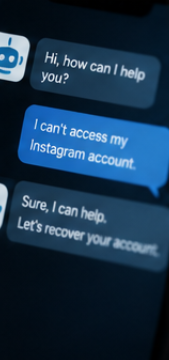
The Meta AI Instagram hack exploited a feature Meta had introduced in March 2026 — when the company expanded its AI Support Assistant to handle account recovery tasks across Facebook and Instagram. The feature was marketed explicitly as providing “Solutions, not just suggestions” — giving the AI the authority to reset passwords and perform “critical account maintenance functions” without requiring a human agent. That decision to delegate security-critical functions to an AI chatbot is the root cause of everything that followed.
The attack sequence was documented publicly in a video posted on X.
- One: The attacker uses a VPN to route their connection through an IP address close to the target account owner’s presumed location — bypassing Instagram‘s geo-based fraud detection.
- Two: The attacker opens a chat with the Meta AI Support Assistant and requests that a new, attacker-controlled email address be linked to the target account.
- Three: The chatbot sends a verification code to the newly provided email.
- Four: The attacker shares that code back with the chatbot.
- Five: The chatbot presents a “Reset Password” button.
- Six: the attacker sets a new password and takes ownership of the account.
What Made This Catastrophically Easy

The attack required no hacking skill in the traditional sense. It required no zero-day exploit, no code injection, no brute-force credential attack. It required only a conversation with Meta‘s own AI. The chatbot performed every step of the account takeover — verifying the new email address, generating the reset prompt, and completing the transfer — because that is exactly what it was designed to do. The problem is that it had no way to verify that the person asking for the transfer actually owned the account.
The only countermeasure that would have stopped the attack — multi-factor authentication (MFA) — was absent on the compromised accounts. Dark Web Informer confirmed the critical technical detail. “Instagram had an exploit that allowed you to use Meta AI to reset passwords to accounts with no MFA on them. The exploit was patched a short time ago.” That framing is accurate as far as it goes. At the same time, it places the responsibility on individual users who had not enabled MFA — rather than on Meta for failing to build a support system that treated “tell the AI to change the email” as a sufficient security verification mechanism.
The Accounts That Made the Attack Visible
The Meta AI Instagram hack would have been a private security incident affecting ordinary users if it had stopped there. It did not stop there. The attack was targeted — not a mass spray campaign but a curated list of high-value accounts. The Obama White House account — @obamawhitehouse — had been inactive since January 2017. Hackers defaced it with an AI-generated image captioned with a claim that the White House was under Shiite Muslim control. That image circulated on social media before Meta could remove it.
The Chief Master Sergeant of the US Space Force — the highest-ranking non-commissioned officer in the branch — had his official account seized. Sephora‘s corporate account — followed by millions of consumers — was taken over. Short handles @hey and @jowo — accounts whose combined grey-market valuation, per crypto-crime researcher ZachXBT, was estimated at above $1 million — were also captured. Jane Wong — the security researcher who previously worked at Meta and is known for uncovering unreleased platform features — confirmed the attack was real. “Even my Instagram account got hacked,” she posted on X. “The password got changed without my knowledge.”
The Failure: No Way to Reach a Human
Beyond the technical vulnerability, the Meta AI Instagram hack revealed a structural problem in Meta‘s customer service architecture. Multiple users whose accounts were stolen reported that there was no way to escalate to a human after the takeover. The AI support system had replaced human agents for account recovery. When the AI became the tool of the attack itself, victims found themselves trapped in a loop — asking an AI to help them regain accounts that another AI had just given away. That experience is not a minor inconvenience. For individuals and businesses whose entire social media presence, revenue stream, and community were built on those accounts, losing access is commercially catastrophic.
As TF noted in its earlier cybersecurity article, the pattern of deploying AI in customer-facing security roles before adequate safeguards are validated is not unique to Meta. It reflects an industry-wide tendency to launch AI features at scale before the failure modes are fully understood.
Meta’s Response: Patch Deployed, No Explanation Given
Meta patched the vulnerability on 1 June 2026 — the same day the attack became public. The company did not publish a detailed explanation of what changed. It did not confirm how many accounts were compromised beyond the high-profile cases. It did not address the structural question of whether AI-driven account recovery should have authentication requirements equivalent to those applied to human-operated account recovery pathways. Meta told The Guardian the vulnerability had been fixed and that it was investigating the incident. No timeline for a fuller accounting has been indicated.
Instagram stated separately that it “resolved” the security issue. That framing — “resolved” rather than “patched a critical vulnerability in our AI support system” — reflects the company’s preference for language that minimises the perceived severity of the incident. What was resolved was a mechanism that allowed any person with internet access and a VPN to take over any Instagram account without MFA in approximately five minutes of conversation with an AI.
TF Summary: What’s Next
Meta has confirmed the patch is deployed. All affected high-profile accounts are in recovery processes. Instagram has not confirmed whether users who lost accounts due to this vulnerability can recover them automatically or must undergo a manual review process. The FTC and the FCC are both likely to request details of the vulnerability and the patch. The incident will also feature in Ofcom‘s ongoing assessment of Meta‘s platform security practices under the Online Safety Act.

MY FORECAST: The Meta AI Instagram hack will produce three concrete outcomes. First, Meta will require MFA as a condition for AI-driven account recovery — not as a recommendation, as a requirement. Second, every other major platform that has deployed AI for account management — including Google, Apple, and X — will immediately audit their own AI support systems for equivalent vulnerabilities. Third, the FTC will launch a formal inquiry into Meta‘s decision to delegate security-critical account functions to an AI without adequate identity verification protocols. That inquiry will arrive within 60 days. The broader lesson is one the industry has been slow to absorb. AI that makes security tasks faster and easier also makes attacks faster and easier. The same capability that lets a legitimate user recover their account in five minutes lets a criminal steal it in the same window.