


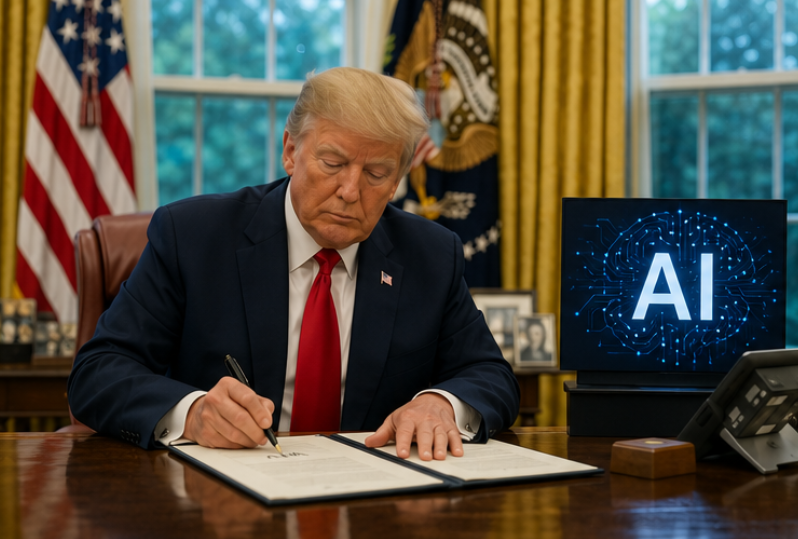
Trump’s AI security executive order was finally delivered — twelve days after the original signing was cancelled and the White House went quiet on the subject. President Trump signed the scaled-back version of the order privately, without the usual public livestream or ceremony. The signing generated no press photo opportunity. No technology CEOs were flanking the president.
By contrast, the order’s content is genuinely significant — even in weakened form. It asks AI companies to voluntarily submit their most powerful frontier models to the federal government for security review up to 30 days before public release. The EO directs agencies to build an AI cybersecurity clearinghouse. The order establishes benchmarks for assessing AI models’ offensive cyber capabilities. It asks federal agencies to shore up their own AI security defences.
As TF covered in its earlier article on the delay, the original version requested a 90-day review window. The final version requests 30. The original generated mandatory language. The final version is entirely voluntary.
What’s Happening & Why It Matters
What the Order Actually Contains — Three Core Elements
Trump’s AI security executive order operates across three distinct pillars. The first is the voluntary pre-release review mechanism — AI companies are asked, not required, to give the government 30 days to test frontier models before they launch. The second is the AI cybersecurity clearinghouse — a new federal body tasked with reviewing and sharing information on AI-related vulnerabilities across government agencies and, presumably, willing private sector partners. The third is agency security hardening — directing federal departments to assess and improve their own AI security posture against threats from adversarial AI models.
Notably, the order does not impose mandatory licensing requirements for AI models. It does not require pre-clearance before release. It does not create any enforcement mechanism for companies that choose not to submit their models for review. The voluntary approach is not accidental. It is the direct consequence of the industry opposition that killed the original order on 21 May.
From 90 Days to 30 — What the Negotiation Produced

The distance between the original order and the signed version tells the story of who holds power in Washington’s AI policy debate. As TF covered previously, the original draft requested a 90-day review window — three months for federal agencies to evaluate a frontier AI model’s security profile before public release. That window was reduced to 30 days in the final version. The original draft used language that critics interpreted as potentially creating a mandatory pre-release approval requirement. That language was removed entirely. The signed order explicitly and repeatedly uses “voluntary”.
Changes are the specific concerns that Elon Musk, Mark Zuckerberg, and former AI czar David Sacks raised in their calls to President Trump on the night of 20 May — the calls that caused the original signing to be cancelled hours before it was scheduled. The industry’s argument was straightforward. A 90-day mandatory review window would allow China to release competing models during the review period, handing Beijing a first-mover advantage on every frontier model cycle. That argument resonated with Trump’s stated priority of maintaining America’s AI lead. The result is an order that preserves the president’s ability to say he acted on AI security, while preserving the industry’s ability to release models on its own timeline.
The Cybersecurity Clearinghouse: The Substance That Survived
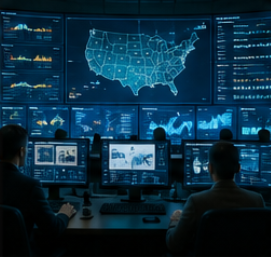
The most technically substantive element of Trump’s AI security executive order is the AI cybersecurity clearinghouse. The declaration establishes a dedicated federal infrastructure to track, analyse, and share information on AI-related security vulnerabilities. That is a genuine gap in the current federal architecture. As TF covered in its Mythos security article, Anthropic‘s Claude Mythos Preview has already demonstrated the ability to identify zero-day vulnerabilities across major operating systems and cloud infrastructure. The Financial Stability Board separately requested briefings on what Mythos found in banking systems. That landscape — powerful AI models identifying critical vulnerabilities faster than the government can track them — is precisely the environment the clearinghouse is designed to address.
Beyond the clearinghouse, the order’s directive to build benchmarks for assessing AI models’ offensive cyber capabilities addresses the same concern from a different angle. There is currently no standardised federal methodology for assessing the cybersecurity risk of a given AI model. The National Institute of Standards and Technology has existing AI risk frameworks. The order builds on those frameworks specifically for cyber threat assessment.
Is A Private Signing a Sign?
The decision to sign the order privately — without a ceremony, livestream, or photo opportunity — tells you something about the administration’s own confidence in the final product. Trump signed the original Make America Healthy Again executive orders in front of cameras. He signed his tax and border orders publicly. AI security is the topic he signed in a room with no audience. That choice is deliberate. A high-profile ceremony would invite comparison between what was promised on 21 May and what was delivered on 2 June. A quiet desk signing avoids that comparison.
The order’s language presents the administration’s continued ambivalence. “Advanced AI capabilities make our Nation stronger, but also introduce new national security considerations that require coordinated action,” the order states. “As these capabilities evolve, my Administration will continue to work closely with industry.” That phrasing — “work closely with industry” — is the tell. Every substantive constraint in the order is voluntary. Industry cooperation is the mechanism. Industry opposition killed the original order. The administration is not pretending otherwise.
What Civil Society and Security Researchers Are Saying
Independent AI safety researchers have generally welcomed the order’s existence — while being clear about its limitations. The 30-day voluntary review is better than no review. The cybersecurity clearinghouse is a genuine institutional improvement. The benchmark development process will produce useful infrastructure even if companies are not required to use it. By contrast, critics point out that voluntariness is the order’s defining and fatal flaw. If OpenAI and Anthropic voluntarily submit their models, Meta and xAI have a competitive incentive not to— thereby gaining the launch-speed advantage that the review period sacrifices. That dynamic makes voluntary compliance structurally unstable over time.
TF Summary: What’s Next
Federal agencies begin building AI cybersecurity benchmarks and the clearinghouse infrastructure immediately. No implementation timeline is specified in the order. AI companies are not required to notify the government of their plans to comply or not comply. NIST will lead the benchmark development process — drawing on its existing AI Risk Management Framework. The order does not affect Anthropic‘s ongoing supply chain risk designation. Congressional pressure for mandatory legislation continues independently of the executive order.
MY FORECAST: Trump’s AI security executive order will produce exactly two durable outcomes. The cybersecurity clearinghouse will be built to generate genuinely useful intelligence sharing between agencies and willing private-sector partners. The benchmark development process will produce the first standardised federal framework for assessing AI models’ offensive cyber capabilities — a meaningful contribution regardless of the order’s voluntary limitations. Beyond those two outcomes, the voluntary review mechanism will generate partial compliance in year one — Anthropic will submit, OpenAI probably will, Meta and xAI probably will not. By 2027, the voluntary mechanism will either be made mandatory through additional legislation or quietly acknowledged as a programme that large frontier labs choose not to use. The private desk signing told you which outcome the administration privately expects.