



A wool sneaker brand that couldn’t outrun Hoka is now buying GPUs. Welcome to the AI pivot economy.
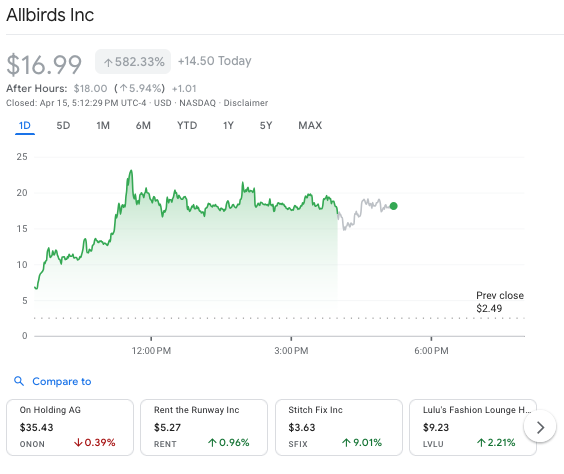
You bought the shoes. You loved the sustainability story. Then the stock tanked. Now, Allbirds — once the unofficial footwear of Silicon Valley’s tech elite — has sold its brand, closed its stores, and announced it is reinventing itself as an AI compute infrastructure company. Furthermore, it is rebranding as NewBird AI. Additionally, its stock surged as much as 700% on the news, going from under $3 a share to over $17 in a single session. The company had a market capitalization of just $21 million (€19.3 million) the day before the announcement.
This is, objectively, one of the most extreme corporate pivots in recent memory. Moreover, it tells you something important about the state of the AI market in 2026. Specifically, it tells you that simply adding “AI” to a company’s identity is still enough to make investors sprint to the buy button — regardless of what the underlying business actually knows how to do.
What’s Happening & Why It Matters
From Merino Wool to Machine Learning

Allbirds was founded in 2015 by former professional soccer player Tim Brown and renewable resources expert Joey Zwillinger. The company built its identity around one powerful idea: comfortable, stylish shoes made from natural materials — primarily merino wool — rather than plastics and petroleum products. Furthermore, that idea resonated hard with a specific audience. The tech crowd in San Francisco adopted the Wool Runner as a near-uniform. By 2016, Allbirds had introduced its debut shoe to considerable fanfare. Consequently, the brand rode that wave straight to a 2021 IPO.
At its peak, Allbirds commanded a valuation of approximately $4 billion (€3.68 billion). However, the peak did not last. Trends shifted — competitors like Hoka and On moved in aggressively. Customer acquisition costs climbed. Sales began a steady and painful decline. Between 2022 and 2025, revenue fell nearly 50% — dropping from $298 million (€274 million) to just $152 million (€140 million). Full-year revenue fell 20% in 2025 alone, following a 25% drop the year before. Furthermore, the company posted a net loss of $77.28 million (€71.1 million) in the same period. By late 2025, Allbirds had closed all of its remaining full-price stores across the United States.
The $39 Million Fire Sale
By early 2026, the endgame for the footwear business was clear. On 30 March 2026, Allbirds signed a definitive agreement to sell its brand and footwear assets to American Exchange Group (AXNY). The deal was valued at approximately $39 million (€35.9 million). For context, that represents roughly 1% of the company’s peak valuation. American Exchange Group — which also manages brands including Ed Hardy, Aerosoles, and Mudd — will continue producing Allbirds footwear products and building on the brand’s legacy. Consequently, the wool runners will still exist. They will simply belong to someone else.
The proceeds from the sale will be distributed to shareholders as a special dividend in the third quarter of 2026, subject to stockholder approval. A special shareholder meeting is scheduled for 18 May 2026 to vote on both the asset sale and the new financing arrangement. Furthermore, shareholders of record as of 20 May 2026 will be eligible to receive that dividend.
Enter NewBird AI
With the footwear business effectively sold, the shell company formerly known as Allbirds needed a new purpose. On 15 April 2026, it announced its purpose, and the market responded with an explosive rally. The company revealed a $50 million (€46 million) convertible financing facility from an undisclosed institutional investor, expected to close in the second quarter of 2026. The funds will finance a complete transformation into AI compute infrastructure, operating under the name NewBird AI.

The plan is straightforward in structure, even if it is audacious in ambition. NewBird AI will initially acquire high-performance, low-latency GPU hardware. It will then lease that compute capacity to enterprises, AI developers, and research organizations under long-term lease arrangements. Furthermore, the customers represent organizations that cannot secure the processing power they need through traditional hyperscalers — such as Amazon Web Services, Microsoft Azure, or Google Cloud — or through volatile spot markets. NewBird AI’s long-term vision is a “fully integrated GPU-as-a-Service (GPUaaS) and AI-native cloud solutions provider.” Over time, it intends to expand through partnerships and potential strategic acquisitions.
The company’s own announcement identified the market opportunity: “The rise of AI development and adoption has created unprecedented structural demand for specialized, high-performance compute that the market is struggling to meet. Global enterprise spending on AI services and data centre investment is on the rise. GPU procurement lead times are increasing for high-end hardware. North American data centre vacancy rates have reached historic lows, and market-wide compute capacity is fully committed.”
The Stock Surge — and the Sceptics
The announcement sent Allbirds stock from under $3 to over $17 — a surge of more than 700% intraday, according to CNBC. Furthermore, various reports cited figures between 400% and 700% depending on the timing of measurement. Either way, a company with a $21 million (€19.3 million) market cap the day before saw its valuation explode in hours. That kind of move on an announcement with no revenue, no customers, and no proven AI technical capability deserves scrutiny.
Sceptics are not hard to find. The company has no background in data centres, cloud services, or GPU procurement. It has spent four years watching revenue halve while recording tens of millions in losses. The $50 million (€46 million) convertible facility provides runway — but convertible notes typically convert into equity at a discount, creating significant dilution risk for existing shareholders. Furthermore, the competitive landscape for GPU leasing is not empty. Established players with deep technical expertise, supply chain relationships, and proven enterprise credibility are already in this space. Therefore, the question of what Allbirds brings to that competition — beyond a recognizable name and a willingness to try — is genuinely unanswered.
The parallel to other high-profile pivots is uncomfortable. In 2017, Long Island Iced Tea Corp changed its name to Long Blockchain Corp and watched its stock surge 200%. Furthermore, several struggling Bitcoin miners pivoted to AI infrastructure in recent months, generating similar — if temporary — enthusiasm in the stock market. Consequently, the pattern of “rebrand to the hot thing and watch the stock pop” is well established. Whether the underlying business eventually justifies the valuation is a separate question that markets are not asking today.
What the Real AI Compute Crunch Looks Like

To be fair to NewBird AI, the market opportunity it is targeting is real. North American data centre vacancy rates are at historic lows. GPU procurement lead times for high-end hardware stretch for months. Enterprises and AI developers genuinely cannot access the compute they need through hyperscalers or spot markets. Nvidia‘s dominance in AI chips means supply is constrained.
Meanwhile, demand from companies training and running large AI models is accelerating. Therefore, a business that acquires GPUs and leases them to customers who cannot get them elsewhere addresses a real structural gap. The question is whether a former sustainable shoe company has the relationships, operational expertise, and supply chain access to execute in that gap.
Additionally, the company must also remove a notable clause from its charter. In its SEC filing, Allbirds noted that it will ask stockholders to approve a proposal to remove “references to the company being operated for the environmental conservation public benefit.” Consequently, the sustainability mission — the brand’s founding purpose — will be formally retired alongside the wool runners.
TF Summary: What’s Next
The Allbirds-to-NewBird AI story is funny, instructive, and slightly alarming — all at the same time. Furthermore, it is a near-perfect encapsulation of where the AI investment bubble stands in April 2026. A brand that burned through hundreds of millions, sold for a fraction of its peak value, and has zero technical credentials in AI compute just triggered a 700% stock surge by announcing it will buy GPUs. The market is not evaluating capability. It is buying the narrative. Consequently, the question of whether NewBird AI can execute its plan is being entirely decoupled from its stock price today.
The immediate milestones will reveal everything. The 18 May 2026 shareholder vote will determine whether the asset sale and convertible financing facility proceed. If approved, NewBird AI enters the market in the second half of 2026 with $50 million (€46 million) in capital, no operational history in AI infrastructure, and an expectation set by a stock move that prices in enormous success before a single GPU has been deployed. Either it is the most unexpected AI infrastructure success story in recent years — or it is another chapter in the long and colourful history of companies chasing whatever the market is excited about. The wool is off the table. The chips are on it.
— Text-to-Speech (TTS) provided by gspeech | TechFyle