



Mark Zuckerberg is building an AI version of himself — and his staff are first in line to talk to it.
Meta had already spent years reshaping the internet. Now, the company turned its attention inward — and the result was stranger than anyone expected. The social media giant built a photorealistic, AI-powered 3D version of its own CEO, Mark Zuckerberg, designed to interact with employees on his behalf. The project, confirmed in April 2026, placed Meta at the centre of a genuinely new conversation about leadership, identity, and what it means to communicate at scale in an AI-first company.
The effort was early-stage but unmistakably deliberate. Zuckerberg himself was personally involved in training and testing the digital replica, feeding it his mannerisms, speech patterns, tone, and publicly available statements. The goal was clear: give employees across a workforce of nearly 79,000 people a way to interact with their CEO that felt personal, even when the real Zuckerberg was nowhere near the conversation.
What’s Happening & Why It Matters
The AI Zuck Is Real — and is in the Building

Meta‘s Superintelligence Labs are developing photorealistic, AI-powered 3D characters capable of holding real-time conversations. The AI Zuckerberg is at the top of that priority list. The character draws on his voice, facial expressions, tone, and public communication style. Crucially, it ingests his current thinking on company strategy — so responses do not just sound like Zuckerberg, they carry his actual positions.
The ambition goes beyond aesthetics. The project is designed to make employees across Meta’s global operation feel connected to their founder, even when direct access is practically impossible. At a company with thousands of engineers, product managers, and operations staff spread across continents, the real Zuckerberg cannot be everywhere. The AI version can.
Zuckerberg is not delegating this from a distance. He spends five to ten hours per week coding on AI projects and attends technical engineering reviews personally. The AI character project gets the same hands-on treatment. Testing, refinement, and iteration all run through him directly.
Two AI Projects, Two Distinct Jobs
An important distinction is already creating confusion. The AI character and the CEO agent are two completely separate projects. Conflating them misses the point of both.
The CEO agent, first reported earlier in 2026, functions as an executive productivity tool. It retrieves information fast, cutting through the layers of people Zuckerberg would normally need to consult. It compiles briefings, flags engineering updates, and surfaces relevant signals from across Meta’s product portfolio. The agent does not communicate outwardly — it works inward, supporting Zuckerberg’s decision-making behind the scenes.
The AI Zuckerberg character works in the opposite direction. It faces outward toward employees, offering conversation, feedback, and a sense of proximity to leadership that a $1.6 trillion ($1.47 trillion €) organisation cannot otherwise provide. Where the CEO agent removes friction from Zuckerberg’s intake of information, the AI character manages his output of presence.
Together, the projects tell a story about what Meta believes AI can do for corporate structure. The company is not just building AI for consumers. It is rebuilding itself around AI from the inside out.
Meta’s AI Workplace Transformation
The AI Zuckerberg is not an isolated experiment. It is inside a sweeping internal transformation. Meta CFO Susan Li credited AI coding agents with a 30% rise in output per engineer since the start of 2025, with heavy users reporting even larger gains. Zuckerberg told investors in January 2026: “We’re investing in AI-native tooling so individuals at Meta can get more done. We’re elevating individual contributors and flattening teams.”
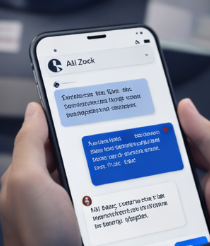
Internally, employees already use tools like My Claw — a personal AI agent that accesses chat histories and work documents and communicates with colleagues on users’ behalf. Another system, Second Brain, built by a Meta employee on top of Anthropic‘s Claude model, indexes project documents and responds to complex queries like an AI chief of staff.
AI usage is a factor in performance evaluations. Product managers face a new AI-focused “skills baseline exercise,” including technical system design tests and what Meta calls “vibe coding.” Some employees worry the exercise signals job cuts. Meta insists the exercise identifies training needs — not redundancy targets. The anxiety is real regardless.
AI Characters — and the Risks That Come With Them
Meta has been here before, to a degree. In September 2023, the company launched celebrity-based AI chatbots featuring the voices and likenesses of Snoop Dogg, Tom Brady, Kendall Jenner, and Naomi Osaka. The rollout generated attention but limited traction. Those celebrity AI profiles were discontinued by mid-2024.
AI Studio followed, giving ordinary users the ability to create their own AI characters and allowing creators to build AI versions of themselves for fan engagement. The programme ran into trouble when users generated overtly sexual personas, drawing concern from regulators and child safety advocates. In January 2026, Meta restricted teen access to its AI characters entirely.
The AI Zuckerberg carries its own complications. Questions about authenticity and reliability in leadership communication follow this project wherever it goes. If the AI character says something that does not reflect Zuckerberg’s actual view, the consequences inside a company of nearly 79,000 people are meaningful. Trust in leadership — already under pressure from widespread AI-driven restructuring — depends on accuracy and honesty. A photorealistic CEO saying the wrong thing is a new kind of corporate liability.
AI Leadership as Enterprise Product

The commercial implications of a successful AI Zuckerberg stretch well beyond Meta’s internal operations. Meta AI crossed 1 billion monthly active users in early 2026. The infrastructure, the models, and the distribution network already exist. An internal deployment of a CEO avatar at scale functions as a live proof of concept — one that no sales pitch could replicate.
Enterprise AI agent market projections point toward $82 billion by 2028, driven by demand from companies running Microsoft Teams, Slack, and similar platforms. If Meta demonstrates that an AI CEO avatar improves engagement and reduces meeting load across a near-80,000-person organisation, every Fortune 500 company is a potential customer for similar technology. Meta’s combination of Llama models, its vast user base, and a real-world internal deployment gives it a distribution edge most enterprise AI startups cannot match.
Uber CEO Dara Khosrowshahi disclosed earlier in 2026 that his employees had already built an AI clone of him. The trend has a name. It also has a frontrunner.
TF Summary: What’s Next
The AI Zuckerberg project is early, but the direction is unmistakable. Meta is converting its AI infrastructure investment — between $115 billion and $135 billion (€105.8 billion and €124.2 billion) in planned 2026 capital expenditure — into live internal products that double as enterprise demonstrations. The photorealistic CEO avatar is the most visible of those products. Whether it improves employee connection or deepens anxiety about AI’s role in the workplace depends entirely on execution. Authenticity, accuracy, and transparency are not optional extras here — they are the product.
The question this project raises goes well beyond Meta. If a CEO can be replicated convincingly enough for 79,000 employees, what does leadership communication actually mean in an AI-first company? The answer is taking shape inside Meta’s Menlo Park campus — and the rest of the corporate world is watching closely.
— Text-to-Speech (TTS) provided by gspeech | TechFyle