


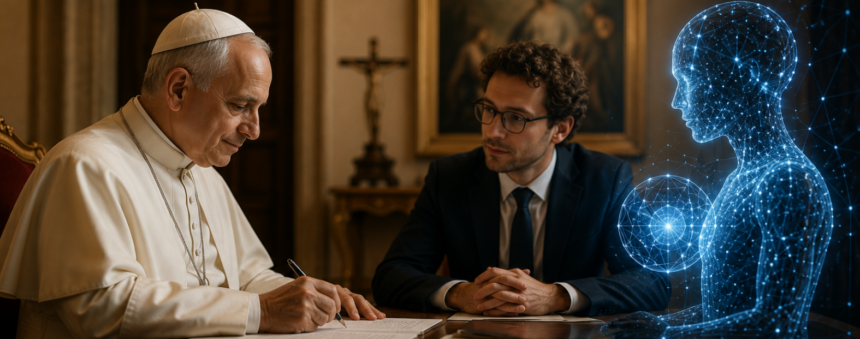
Pope Leo XIV’s AI encyclical with Anthropic is one of the most unexpected partnerships in modern institutional history. The Vatican announced that Pope Leo XIV will present his first major teaching document — titled Magnifica Humanitas (“Magnificent Humanity”) — on 25 May 2026. The encyclical addresses the protection of human dignity in the age of artificial intelligence. Presenting it alongside the Pope will be Christopher Olah, co-founder of Anthropic — the AI safety company whose refusal to strip safeguards from its military contracts led the Trump administration to designate it a “supply chain risk” in February 2026. That designation was the first time such a label was applied to a US company. The pairing of the head of the world’s largest Christian institution and the co-founder of America’s most safety-focused AI lab is not accidental. It is a deliberate statement about what kind of AI future the Church believes humanity should pursue.
What’s Happening & Why It Matters
Magnifica Humanitas: What the Encyclical Covers
An encyclical is one of the most significant documents a Pope can issue. It is a formal letter addressed to the world’s bishops — and through them, to all Catholics and people of goodwill. Encyclicals carry significant doctrinal weight. They set the Church’s position on major moral and social questions for generations. Leo XIII‘s Rerum Novarum of 1891, which addressed the rights of workers in the Industrial Revolution, became the foundation of modern Catholic social teaching. Pope Leo XIV has already cited that document explicitly — describing the AI revolution as posing the same existential questions that industrialisation raised over a century ago.
The Pope will present Magnifica Humanitas alongside Curial cardinals, theologians, and Olah. The document centres on “the protection of the human person in the age of artificial intelligence.” That outlook is careful and deliberate. It does not reject AI. It does not embrace it uncritically. Instead, it places the human person — human dignity, human agency, human flourishing — at the centre of every question the technology raises.
Why Christopher Olah Is Standing at the Vatican
Christopher Olah is one of the most respected researchers in AI safety. He is a co-founder of Anthropic and the inventor of mechanistic interpretability — a research discipline focused on understanding what is actually happening inside AI systems at a mathematical level. His presence at the encyclical launch is not ceremonial. It signals that the Vatican engaged directly with Anthropic‘s thinking in developing the document’s intellectual framework.
Anthropic bills itself as the AI company that places safety and risk mitigation at the forefront of its research. Its Acceptable Use Policy prohibits using its models for lethal autonomous weapons without human oversight or for mass domestic surveillance. Those are the exact restrictions the Trump administration asked Anthropic to remove from its military contracts. Anthropic refused. The Pentagon designated it a supply chain risk. OpenAI signed the Pentagon contract instead. The alignment between Anthropic‘s stated values and the Church’s view of AI and human dignity is not coincidental. Both institutions are explicitly arguing that technology must serve people — not the other way around.
Pope Leo XIV: An American Pope With a Global Agenda
Pope Leo XIV is the first American Pope in history. His election earlier in 2026 — announced with the customary smoke signal from the Sistine Chapel — generated global interest precisely because of his nationality. As an American, he has a particular relationship with the Trump administration.
The Trump White House has pursued an aggressive AI commercialisation strategy — one that explicitly deprioritises safety restrictions in favour of speed and military capability. By launching his first encyclical in partnership with Anthropic — the company the Trump administration blacklisted — Leo XIV is making a clear institutional statement. The Catholic Church’s moral authority and the AI safety movement are aligned. The Trump administration’s approach to AI is not.
That choice is deliberate. Vatican observers note that Leo XIV has already demonstrated a willingness to engage directly with contemporary technology questions. His encyclical does not approach AI as an abstract philosophical concern. It addresses it as a present moral emergency requiring the Church’s active engagement.
The Industrial Revolution Comparison — and Why It Resonates

The comparison to the Industrial Revolution is the encyclical’s most historically grounded argument. Rerum Novarum in 1891 came at a moment when industrial capitalism was reshaping the lives of millions of workers without any moral framework governing that transformation.
Factories, child labour, the destruction of craft traditions, and the concentration of wealth — all of the forces were operating faster than existing ethical and legal structures could respond. Rerum Novarum argued that economic progress must serve human dignity, not override it. That argument produced the entire tradition of Catholic social teaching on labour, justice, and economic rights.
Magnifica Humanitas applies the same structure to AI. The technology is advancing faster than ethical frameworks can respond. Existing legal structures were not designed for it. The people most affected — workers displaced by automation, individuals whose data trains AI systems, communities whose infrastructure is reshaped by AI investment — have no meaningful voice in the decisions being made. The Church’s argument is familiar because it has been made before. The context is new. The moral urgency is not.
What the Encyclical Is Expected to Address
The full text of Magnifica Humanitas will be published on 25 May. Based on the Vatican’s announcement and the context of Pope Leo XIV’s prior statements, several areas are expected to be central. The document will likely address labour and automation — specifically, whether AI-driven job displacement imposes an unjust burden on workers — and will build on the Church’s existing social teaching on employment rights. As TF covered in its earlier article on China’s AI employment ruling, courts are already grappling with the question. The Church is entering that debate.
The encyclical will also address AI and surveillance — the use of AI by states to monitor, control, and suppress their populations. Anthropic has publicly raised concerns that AI tools falling into the hands of authoritarian regimes are instruments of mass repression. That concern directly parallels the Church’s historical experience with totalitarianism. Beyond those areas, the document is expected to address AI and education, AI and healthcare, AI and human creativity, and the specific risks posed by AI systems that humans cannot understand or audit.
The Trump Administration Context: A New Flashpoint
The South China Morning Post described the Anthropic presence at the Vatican as a potential “new flashpoint with the US.” That assessment is measured but accurate. The Trump administration’s relationship with the Vatican has been complex throughout 2026.
Several key figures in the Trump White House are Catholic. At the same time, the administration’s aggressive AI militarisation agenda and its treatment of Anthropic as a supply chain risk represent a direct conflict with the values the encyclical will articulate.
The White House chief of staff held a separate meeting with Anthropic CEO Dario Amodei over the Mythos AI model in the period leading up to the encyclical announcement. The timing suggests active back-channel engagement. The public announcement of Olah’s role at the Vatican launch confirms that those conversations have not produced alignment.
Catholic Social Teaching and the AI Safety Movement
The partnership between the Vatican and Anthropic represents a deeper philosophical alignment. Both institutions believe that the development of powerful AI systems carries moral weight that cannot be resolved by market forces alone. Both believe that human dignity — the inherent worth of every person, regardless of productivity or economic utility — must be protected against technologies that treat people as data points, labour units, or surveillance subjects.
That convergence is not unique to the moment. Anthropic‘s founding documents explicitly argue that building AI to benefit all of humanity, not just its shareholders, requires structural safeguards. The Church’s social teaching argues the same thing about economic systems. The language is different. The underlying moral architecture is recognisable to both traditions.
TF Summary: What’s Next
Magnifica Humanitas publishes on 25 May. The full text will be available through the Vatican‘s official channels in multiple languages simultaneously. Christopher Olah will join Pope Leo XIV at the formal launch event in Rome. Curial cardinals and theologians will present alongside them. The document will immediately be the subject of intensive analysis by AI researchers, ethicists, policymakers, and religious leaders worldwide. Its reception by the Trump administration will be closely watched.

MY FORECAST: Pope Leo XIV’s AI encyclical, in collaboration with Anthropic, will produce two concrete outcomes. First, it will give the global AI safety movement a moral and institutional vocabulary that extends beyond the secular tech policy sphere — making arguments about human dignity and AI governance accessible to the 1.4 billion Catholics worldwide and the billions more who follow the Church’s moral leadership on social questions. Second, it will accelerate a formal Vatican technology ethics office — a permanent institutional body that engages with AI, biotechnology, and digital governance questions with the same sustained depth that the Church brings to economic and environmental ethics. That body does not yet exist in its current form. Magnifica Humanitas is the document that will make the case for creating it.