


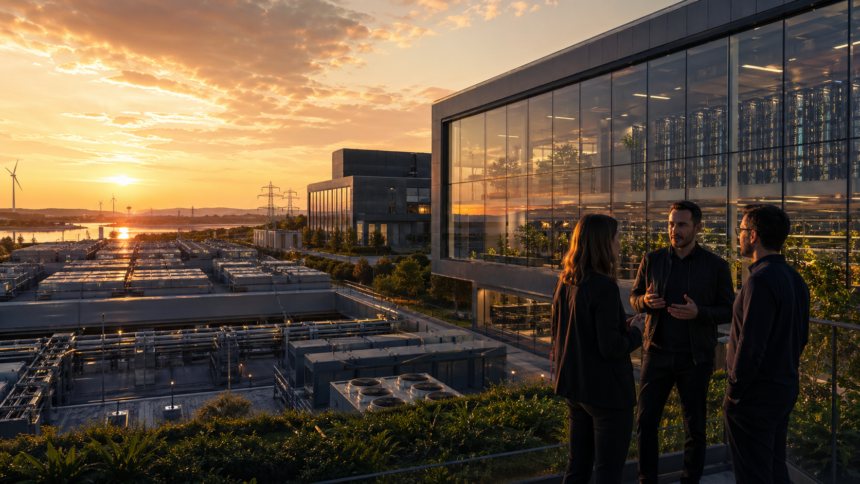
Google committed up to $40 billion to Anthropic. Amazon pledged $25 billion days earlier. Between them, two hyperscalers are betting on Claude in the AI race.
On 24 April 2026, Anthropic and Google announced one of the largest single investments in AI history. Google — through its parent company Alphabet — will invest up to $40 billion (€36.9 billion) in Anthropic, the AI safety company behind the Claude family of models. The deal closes at a valuation of $350 billion (€322.9 billion) for the official funding round — the same figure attached to Anthropic‘s February 2026 raise. That number, however, likely understates what the market actually thinks the company is worth. Secondary market trading on platforms like Forge Global and Hiive now places Anthropic‘s valuation at approximately $1 trillion (€922 billion) — surpassing OpenAI in private market terms.
The announcement came just four days after Amazon disclosed a separate $5 billion (€4.6 billion) investment in Anthropic, with an option to invest up to $20 billion (€18.4 billion) more tied to commercial milestones. With Google’s backing, Anthropic has secured up to $65 billion (€59.9 billion) in fresh funding in a single week. The company’s annualized revenue reached $30 billion (€27.7 billion) as of March 2026 — up from approximately $9 billion (€8.3 billion) at the end of 2025. That is a more than threefold increase in revenue in under four months.
What’s Happening & Why It Matters
The Deal Structure: $10 Billion Now, $30 Billion Later
The structure of the Google deal is straightforward. Google commits $10 billion (€9.2 billion) in cash immediately, at Anthropic‘s current $350 billion valuation. The remaining $30 billion (€27.7 billion) is contingent on Anthropic hitting specific performance targets. Google has also agreed to provide Anthropic with 5 gigawatts of computing capacity over five years through Google Cloud. That capacity starts coming online in 2027. Beyond the five gigawatts, the agreement leaves the door open for Anthropic to procure several additional gigawatts in the future.
This computing arrangement builds directly on a three-way deal between Anthropic, Google, and semiconductor giant Broadcom announced earlier this month. That earlier agreement established Anthropic‘s access to Google‘s custom Tensor Processing Units (TPUs) at scale — an important alternative to Nvidia‘s GPUs, which are in short supply globally. As a result, the new $40 billion commitment is not purely financial. It is also a major infrastructure guarantee in an industry where computing access is as strategically important as capital itself.
Why Anthropic Needs the Money — and the Computing

Anthropic has faced a very specific problem in recent months. Its Claude Code coding assistant — the product most responsible for the company’s explosive revenue growth — has driven demand beyond what current infrastructure can support. Users and enterprise customers have reported widespread Claude usage limits, generating frustration and competitive vulnerability. The revenue growth is real, but the company’s ability to meet the demand has been straining.
Anthropic CFO Krishna Rao addressed this directly in an April press release announcing the earlier Google-Broadcom computing deal. “This agreement will help us keep pace with our unprecedented growth,” he said. Anthropic CEO Dario Amodei made the same point in the context of the Amazon deal. “Our users tell us Claude is increasingly essential to how they work, and we need to build the infrastructure to keep pace with rapidly growing demand,” he said. “Our collaboration with Amazon will allow us to continue advancing AI research while delivering Claude to our customers, including the more than 100,000 building on AWS.”
The pattern is clear. Anthropic has built a product that enterprises and developers genuinely rely on. The constraint is not product quality — it is physical computing capacity. Both the Amazon and Google deals address that constraint directly. In January, Anthropic struck a separate deal with CoreWeave for additional data centre capacity. That deal, the Amazon agreement, and the expanded Google commitment together represent a systematic effort to build the infrastructure needed to match Anthropic‘s commercial ambitions.
Google’s Position: Partner, Investor, and Rival
The relationship between Google and Anthropic is one of the most unusual in the technology industry. Google is simultaneously an investor, an infrastructure supplier, and a direct product competitor. Google Cloud offers Anthropic‘s Claude models to enterprise customers — generating commercial revenue for both companies. At the same time, **Google‘s Gemini AI models compete directly with Claude in the enterprise AI market.
Google‘s history with Anthropic dates to 2023. That year, Google invested $300 million (€276.9 million) for approximately 10% of the company. Months later, Google added another $2 billion (€1.84 billion). Before the new deal, Google‘s total investment in Anthropic exceeded $3 billion (€2.77 billion), and the company held approximately 14% of Anthropic‘s equity. The $40 billion commitment dramatically increases that position.
Reports from Bloomberg indicate that Google‘s top executives have grown anxious about being outpaced, specifically in AI coding. In this segment, Anthropic has built what many analysts consider a commanding lead over Google‘s own products. Claude Code, and Anthropic‘s Cowork agent — designed for non-engineering knowledge workers — are both growing rapidly. Rather than trying to match Anthropic purely through internal development, Google has chosen to deepen its financial stake and its infrastructure relationship simultaneously.
The Amazon Deal: Context and Comparison

The Google announcement follows an equally significant deal announced on 20 April. Amazon invested an additional $5 billion (€4.6 billion) in Anthropic and confirmed an option to invest up to $20 billion (€18.4 billion) more, contingent on commercial milestones. That deal also includes a major infrastructure commitment. Anthropic is committed to spending over $100 billion (€92.2 billion) on Amazon Web Services (AWS) technologies over ten years — including AWS Trainium and Graviton chips. In return, AWS customers gain direct access to the full Claude console within the AWS environment.
The two deals — Amazon‘s and Google‘s — are structured similarly. Both feature an immediate cash injection at the $350 billion valuation, with a larger contingent tranche tied to performance metrics. Both include significant computing capacity guarantees. The parallel structures suggest Anthropic deliberately negotiated comparable terms with both hyperscalers — preserving leverage and avoiding over-dependence on either. That is a deliberate strategic choice, not a coincidence.
The Valuation Story: Official vs. Secondary Markets
The official funding round valuation of $350 billion tells only part of the story. The secondary market gives a very different picture. Private trading platforms — where early employees, investors, and others trade shares outside formal fundraising rounds — value Anthropic at approximately $1 trillion (€922 billion). That figure, cited by Business Insider based on transactions on Forge Global and Hiive, would make Anthropic more valuable than OpenAI on secondary markets — where OpenAI trades at approximately $852 billion.
The gap between the official valuation ($350 billion) and the secondary market figure ($1 trillion) reflects two things. First, institutional investors who lead formal funding rounds negotiate larger discounts and more contractual protections. Second, smaller private investors on secondary platforms are pricing in anticipated growth, potential IPO timing, and the competitive advantages they believe Anthropic currently holds. The difference reflects the speed of Anthropic‘s revenue growth — from $9 billion annualized to $30 billion in under four months — which most formal financial models had not yet caught up to.
The IPO Is Coming — Possibly Before Year-End
Anthropic is reportedly considering an IPO as early as October 2026. The timing would align with OpenAI‘s target for a potential public offering in Q4 2026. Both companies going public in the same quarter would represent the largest concentration of AI company listings in market history. The Google and Amazon deals likely accelerate that timeline rather than delay it — both validate the company’s commercial trajectory and provide the infrastructure capital needed to sustain the growth story that public market investors will want to see.
Anthropic was founded in 2021 by Dario Amodei, his sister Daniela Amodei, and a group of researchers who departed OpenAI. The company’s founding premise was that building safe, interpretable AI required independent research — not an accelerationist race to commercial scale. That founding philosophy remains embedded in Anthropic‘s brand identity, its model development approach, and its government relationships. It is embedded in a balance sheet backed by some of the largest investors on earth.
TF Summary: What’s Next
Anthropic‘s immediate priority is scaling infrastructure to match its revenue trajectory. The five gigawatts of Google Cloud computing capacity comes online starting in 2027 — providing a significant expansion window for Claude Code, Cowork, and future model deployments. The CoreWeave and AWS capacity deals add to that foundation. In the near term, the company must address the Claude usage limits that have frustrated enterprise customers. That pressure is what drove the infrastructure deals in the first place, and the investment capital is the fuel needed to resolve it at speed.
MY FORECAST: The longer-term story is the IPO. If Anthropic proceeds with a public listing in October 2026, it will face a market that must reconcile an official valuation of $350 billion, a secondary market price of $1 trillion, and $30 billion in annual revenue, which is still growing rapidly. The Google and Amazon deals serve as credibility anchors for that story — signalling that the two largest cloud platforms have committed, at enormous scale, to Anthropic‘s success. In a week where the global AI industry saw layoffs, trials, hardware failures, and policy battles, this deal may be the clearest signal of all about where the real capital believes the AI race is heading.