

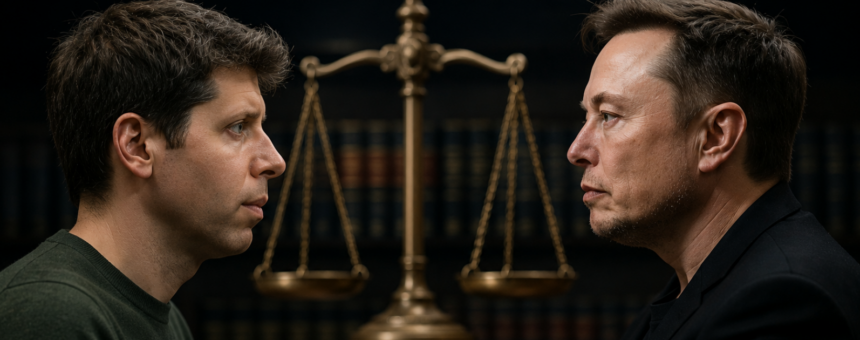
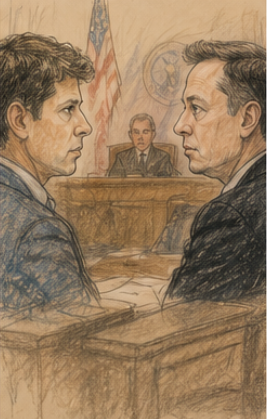
The Musk v. Altman trial closing arguments started on 14 May — the final day of proceedings in Phase One of the most-watched AI legal case in history. Lawyers for both sides addressed the nine-person advisory jury for a combined four hours in the Ronald V. Dellums Federal Building in Oakland. By the end of Thursday’s session, every major claim, every personal attack, and every evidentiary conflict from three weeks of testimony had been compressed into two competing stories for the jury to carry into deliberations. Jury deliberations begin Monday, 18 May 2026. Phase Two — covering remedies — begins the same day, with the remedies heard separately by Judge Yvonne Gonzalez Rogers alone. Musk was not in the courtroom. He was in Beijing with President Trump. Altman and Brockman attended. The judge brought the jury chocolates.
What’s Happening & Why It Matters
Musk’s Closing: “Five Witnesses Called Him a Liar”
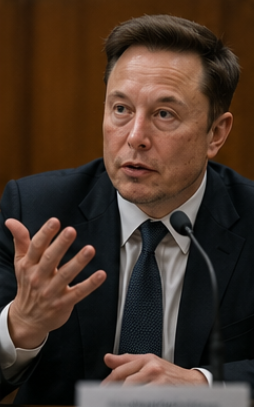
Musk‘s lead attorney, Steven Molo, opened Thursday’s session by going straight for the jugular. He told jurors that five witnesses had called Sam Altman a liar under oath. Those five were Musk himself, former OpenAI chief scientist Ilya Sutskever, former CTO Mira Murati, and former board members Helen Toner and Tasha McCauley. “Liar’s a very powerful word in a courtroom,” Molo said. “I confronted Sam Altman with the fact that five witnesses in this trial, all people that he’s known for years and worked with, called him a liar under oath.”
Molo built his entire closing around that credibility question. “Sam Altman’s credibility is directly at issue in this case,” he told jurors. “He’s the defendants’ main witness. If you cannot trust him, if you don’t believe him, they cannot win. It’s that simple.” The argument is elegant in its focus. If the jury doubts Altman, OpenAI‘s account of the company’s history collapses.
Molo’s Substantive Case: Self-Dealing and Arrogance
Beyond the credibility attack, Molo pressed the substantive claims. He accused OpenAI of “wrongfully trying to enrich investors and insiders at the nonprofit’s expense.” He argued that OpenAI failed to prioritise AI safety despite its founding promise to do so. He also targeted Greg Brockman directly — citing Brockman’s acknowledgement that his OpenAI stake was worth nearly $30 billion. “The arrogance, the lack of sensitivity, the failure to account for just common decency is really, really abhorrent,” Molo told the jury. He said Microsoft was “aware of what OpenAI was doing every step of the way” — arguing that Microsoft‘s co-defendant status was justified because the company aided the conversion knowingly.
At the same time, Molo ran into a direct problem mid-argument. He told jurors that Musk was seeking “billions of dollars of disgorgement.” Judge Gonzalez Rogers stopped him. She told Molo to either retract the statement or “drop your claim for billions of dollars.” Both sides later agreed that the judge would correct the statement to the jurors directly. The intervention signals that even on the remedies question, Musk‘s team has been imprecise — and Judge Gonzalez Rogers is watching closely.
OpenAI’s Closing: “Midas Touch in Some Areas, but Not in AI”
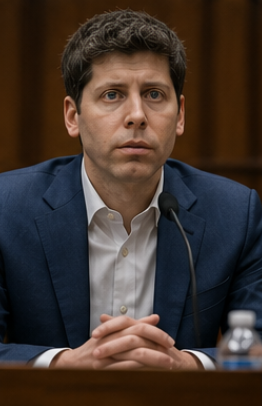
OpenAI‘s lead attorney, William Savitt, delivered the session’s most memorable line. “Mr. Musk may have the Midas touch in some areas,” he told the jury, “but not in AI.” The quip summarizes OpenAI‘s core counter-narrative. Musk contributed relatively little to OpenAI‘s actual success — and the company’s extraordinary growth happened after he left.
Savitt also pressed the statute-of-limitations defense directly. OpenAI argues that Musk waited too long — that he cannot claim the harms that occurred before August 2021. Judge Gonzalez Rogers wrote in a prior filing that “if the jury finds that Musk failed to file his action within the statute of limitations, it is highly likely she will accept that finding and direct a verdict to the defendants.” That is an extraordinary statement for a judge to make. It tells the jury that a finding on timing alone can end the case for OpenAI.
Sarah Eddy: “Selective Amnesia” and the For-Profit He Built
OpenAI lawyer Sarah Eddy took a different angle. She accused Musk‘s team of resorting to “sound bites and irrelevant false accusations.” More pointedly, she dismantled the idea that Musk did not know OpenAI would need to become profitable. “By 2017, everyone associated with OpenAI — including Musk, then still on its board — knew it needed more money to fulfill its mission than it could raise as a nonprofit,” she said. She accused Musk of “selective amnesia.”
Eddy delivered the closing’s most cutting substantive point. If Musk truly believed AI should serve humanity — not one person — he would not have tried to fold OpenAI into Tesla. He would not have made his own rival xAI a for-profit company. “The other founders refused to turn the keys of AGI over to one person, let alone Elon Musk,” she said. That line is the jury’s clearest invitation to see the lawsuit as motivated by competitive frustration rather than betrayed idealism.
Microsoft’s Closing: “A Responsible Partner at Every Step”
Microsoft‘s lawyer Russell Cohen kept his closing brief. Microsoft was not involved in the key founding events, he argued. “Microsoft was a responsible partner at every step.” That framing distances Microsoft from the personal narrative between Musk and Altman and focuses the jury on the co-defendant’s narrower legal exposure. Microsoft‘s liability depends on whether the jury finds it “aided and abetted” a breach of charitable trust — a higher bar than simple awareness of OpenAI‘s structural evolution.
The Statute of Limitations: The Hidden Killer Argument
The most technically significant issue in Thursday’s closing arguments is the one most easily overlooked. The jury must first decide whether Musk filed his lawsuit within the required window. The claims at issue — breach of charitable trust and unjust enrichment — are subject to specific statutory timelines. OpenAI argues the clock started running well before Musk filed in 2024. If the jury agrees, and if the judge accepts that finding, the entire case ends without reaching the merits. Judge Gonzalez Rogers’ own pre-trial filing made clear she is prepared to follow the jury’s lead on this question. That makes timing — not the charitable trust question — potentially the outcome-determining issue.
What the Courtroom Atmosphere Says
Two final details from Thursday reveal the room’s tone. Musk was absent — in Beijing with President Trump, while his own lawyers argued the most important day of his case. Molo told jurors that Musk was “sorry he could not be here.” Altman and Brockman sat in court throughout. Beyond that, Judge Gonzalez Rogers brought the jury chocolates — a detail noted in multiple courtroom accounts. Her warm relationship with the jury stands in contrast to her sharp management of both legal teams. “You do not want to be held in contempt, I guarantee you,” she warned a lawyer mid-week. On Thursday, she reminded the jury that lunch would be provided during deliberations. It was a long three weeks. They earned it.
TF Summary: What’s Next
Jury deliberations begin Monday, 18 May. The nine-person advisory jury’s verdict is not binding — Judge Gonzalez Rogers makes the final liability determination. Phase Two also begins Monday. The judge will hear arguments about potential structural remedies and damages. That phase is entirely in her hands. The jury has no role in Phase Two. A Phase One verdict could arrive within Monday’s start — or take longer if jurors disagree on the statute of limitations question, which requires understanding specific legal timelines rather than simply weighing credibility.
MY FORECAST: The Musk v. Altman trial closing arguments will not change the outcome prediction markets have tracked throughout — approximately 33% odds for Musk. The statute-of-limitations question is the case’s hidden hinge. Savitt spent significant time on it during closing because the judge, in a prior filing, told him it could end the case entirely in OpenAI’s favour. If the jury finds that Musk filed too late, the trial ends without a ruling on the charitable trust. That outcome is more likely than a full liability finding against OpenAI. Even if the jury finds in Musk’s favor on the merits, Judge Gonzalez Rogers has already signalled scepticism about the damages methodology. A moral victory for Musk, combined with a fraction of the claimed remedy, is the most probable outcome of Phase Two — if it arrives at all.