



Spain’s innovation ecosystem made its case to the world this week across two very different stages. In Madrid, the South Summit 2026 opened its 15th edition on 3 June at La Nave — Europe’s largest innovation and entrepreneurship gathering. Themed “AI Convergence,” it drew more than 20,000 attendees, approximately 4,900 startups, over 2,000 investors, and around 600 international speakers. Simultaneously, on Ibiza, the Ibiza Tech Forum held its fourth edition — positioning the island not as a party destination but as a 542 km² (209 sq mile) live laboratory for technologies that can scale globally. Both events carried the same central argument. Spain’s talent is world-class. Spain’s innovation culture is genuine. The challenge is structural. Too many of the best companies and founders are still being forced to relocate to the United States to find the capital they need to grow.
What’s Happening & Why It Matters
South Summit: AI Is Not a Threat — It Is the Opportunity
South Summit 2026‘s founding message was direct. María Benjumea, founder and president of South Summit, opened the event by telling the audience that artificial intelligence is not a threat to European innovation. It is the defining opportunity of their generation. “A startup born in Spain must be able to think of Europe as its natural home, not as 27 different borders,” she said. That truth holds the summit’s core tension. Spain’s innovation is European. The capital market it competes in is global. Those two realities are not yet aligned.

At the same time, the event’s theme presents something deeper than aspiration. Of the 100 finalist startups in South Summit’s Startup Competition this year, 50 use AI as their core technology. Those 100 finalists were selected from more than 4,500 applications across 110 countries — the most international field in South Summit’s history. Europe accounted for nearly 77% of finalists. The United States contributed just 6%. Spain is not importing an AI startup culture. It is growing one.
The Europe-Without-27-Borders Argument
South Summit’s opening session returned repeatedly to a single structural barrier. European startups face the challenge of scaling across 27 separate regulatory, tax, legal, and market environments — each with different employment laws, funding mechanisms, and consumer protection frameworks. A US startup can reach 330 million consumers through a single legal entity. A Spanish startup scaling into France, Germany, and Poland is effectively crossing international borders with each step.
Enrico Letta, former Italian Prime Minister and author of the European Council’s 2024 report on the EU single market, addressed this gap from the South Summit stage. His report had already identified the fragmentation problem as Europe’s primary structural obstacle to scaling technology companies. Sebastian Thrun, founder of Google X, argued that AI has dramatically shortened the cycle from idea to prototype. He described it as a genuine equaliser — one that gives European founders the same velocity advantage that Silicon Valley proximity once provided exclusively to US companies.
The Defense and AI Vertical: A New South Summit Category
South Summit 2026 introduced something genuinely new this year. The Defense and AI vertical debuted on 3 June — a dedicated programme addressing the growing intersection of artificial intelligence, dual-use technologies, and European defence strategy. The vertical was opened with a session titled “Spain’s Bet on Defence Innovation,” which featured NATO’s DIANA accelerator — the alliance’s defence innovation hub. Additionally, the programme included Amparo Moraleda, President of Airbus Spain, alongside deep tech investors and dual-use startup founders.
That vertical’s arrival at South Summit is a shift in investor sentiment that has accelerated across 2026. European defence technology — once a niche sector primarily funded by governments — has attracted significant venture capital interest this year. As TF covered in its Mistral AI Airbus BMW article, European industrial players are signing sovereign AI contracts to reduce dependence on US providers. South Summit’s Defense and AI vertical is where the startup layer of that trend surfaces.
The Numbers Behind The Innovation Story
Spain’s total startup ecosystem valuation reached €125 billion (€125B) in 2025 — representing 2.3x growth since 2020 and positioning the country as the eighth largest tech ecosystem in Europe. Spanish startups raised €3.1 billion in venture capital in 2025 — the third best year on record, behind only the exceptional years of 2021 and 2022. More than 500,000 STEM graduates enter the Spanish workforce annually. Spain produces strong technical talent through IE University, UPC Barcelona, and Universidad Politécnica de Madrid. The country also operates as a gateway between European and Latin American markets — a genuine commercial advantage that no northern European tech hub can replicate.
By contrast, the structural weakness is equally clear. Early-stage and breakout-stage funding is at strong levels. Late-stage investment — rounds above €100 million — is the primary challenge. Spanish companies that need significant growth capital often face a choice. Accept less capital on domestic terms. Or relocate to the United States and access the deep pools of growth-stage funding that Madrid and Barcelona still cannot match. That relocation dynamic is what Benjumea described from the South Summit stage. It is the problem that **the Choose France 2026 investment summit’s €93 billion in commitments demonstrates is solvable — when a government makes attracting capital a sustained national priority.
Ibiza as a Testbed: Small Island, Global Laboratory
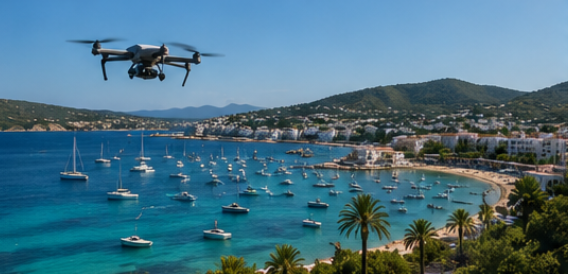
The second innovation story this week came from an unexpected geography. Ibiza — the Balearic Island better known for nightlife than for technology — hosted the fourth edition of the Ibiza Tech Forum at the Caló de s’Oli Auditorium in Sant Josep de sa Talaia. The event’s host, Sant Josep Mayor Vicent Roig, articulated a specific case for why a small island is an ideal innovation testing ground. “As an island of 542 square kilometres, it is the perfect testbed for trialling technologies that can then be scaled up nationally and internationally,” Roig told Euronews.

That argument is grounded in real geography. An island with defined borders, a known population, established infrastructure, and limited sprawl creates a controlled environment that urban innovation hubs cannot replicate. Technologies tested on Ibiza — AI-powered tourism management, drone delivery networks, data-driven public services, autonomous mobility — can be validated at a manageable scale. Successful pilots then justify investment for national or continental deployment.
Sensorisation, Data, and Tourism’s Hidden Problem
Roig’s central policy point at the Ibiza Tech Forum concerned public administration’s relationship with data. “Public authorities still have unfinished business when it comes to sensorisation,” he said. Ibiza — like many popular Mediterranean destinations — faces a tension between economic growth and quality of life. Tourism brings vital revenue. It brings crowding, infrastructure strain, and resident frustration. Roig argued that data collection and AI analysis can change that conversation. “The feeling of congestion is often greater than the reality,” he said — meaning that real-time sensorisation data can separate genuine overcrowding from perceived overcrowding, allowing public policy to respond proportionately rather than reflexively.
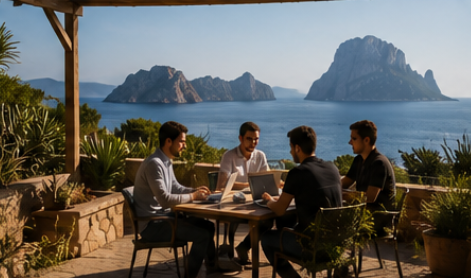
That insight extends beyond tourism. It is the same data infrastructure challenge facing smart city deployments across Europe. The island’s compact size makes it a natural pilot zone for the kind of networked sensor environment that would be prohibitively expensive and politically complex to deploy across a large mainland city. International companies, families, and professionals are increasingly choosing Sant Josep as a year-round base — attracted by its international connections, safety, and Mediterranean quality of life. That residential influx creates both demand for smart infrastructure and a funding opportunity for the companies building it.
The Funding Gap That Both Events Identified
Both South Summit and the Ibiza Tech Forum converged on the same structural diagnosis. Spain has talent. It does not yet have the capital depth to capture the full commercial value of that talent. Pilar Carrato, Chief Financial Officer of CDTI — Spain’s Centre for Industrial Technological Development — delivered the bluntest assessment at the Ibiza Tech Forum. “Startups need to know what stage they are at and who they should be approaching, otherwise they are going to waste a lot of time,” she told the forum. Her three non-negotiable ingredients for securing investor backing: a multidisciplinary team, a scalable model with a credible path to the J-curve, and strategic alignment between the startup’s stage and the specific investor they are approaching.
That advice sounds simple. In practice, it describes an information gap that the Spanish ecosystem has not fully closed. Early-stage founders know their technology. Many do not know their investor landscape with the same precision. At the same time, the investor landscape itself is underdeveloped at the growth stage. Spain’s €3.1 billion in venture capital is impressive in absolute terms. It represents less than 3% of Europe’s total venture capital deployment. A country that generates the eighth largest tech ecosystem in Europe attracts a fraction of the capital its position would justify.
What Both Events Said About Europe’s Future
Both South Summit and the Ibiza Tech Forum are ultimately making the same argument from different angles. Europe’s innovation capacity is real. Its capital markets, regulatory environment, and border fragmentation are structural obstacles that require political and institutional solutions alongside commercial ones. As TF covered in its Panathēnea 2026 article, the conversation about Europe’s AI innovation gap is happening simultaneously in Madrid, Athens, and Paris. The answers emerging from all three cities are similar. More capital. Fewer borders. Faster regulatory approval. And a willingness to treat defence, AI, and deep technology as connected opportunities rather than separate domains.

Spain, more than any other European country, made the strongest institutional case for that integration. King Felipe VI attended South Summit 2026 alongside the Mayor of Madrid and President of the Madrid region. That level of institutional presence at a startup forum is significant. It signals that Spain’s political leadership has concluded the same thing its founders have been saying for years. The talent is here. The ideas are here. Building the capital environment to match them is the work that remains.
TF Summary: What’s Next
South Summit Madrid 2026 runs until 5 June at La Nave. The Startup Competition winner will be announced on the event’s final day. The Ibiza Tech Forum has concluded its fourth edition. Both events are expected to announce specific investment commitments and partnership agreements in post-event communications over the coming weeks.
MY FORECAST: Spain’s innovation ecosystem is at an inflection point. South Summit’s €42 million economic impact on Madrid, the Ibiza Tech Forum’s positioning of the island as a global tech testbed, and the €125 billion ecosystem valuation all point toward a country that has built the foundations of a genuine top-five European tech hub.

The missing element is growth-stage capital at scale. The events of this week will not solve that gap. By contrast, they will attract the attention of the investors and institutional players who can. Spain’s strongest advantage over the next five years is not its talent — which is already recognised — but its combination of talent, climate, language gateway to Latin America, and a political class that is finally treating technology as a national economic priority rather than a cultural curiosity.
The country that figures out how to retain its best companies through the growth stage will capture disproportionate returns from the AI cycle. Spain is closer to doing that than any headline about brain drain or capital flight suggests.