


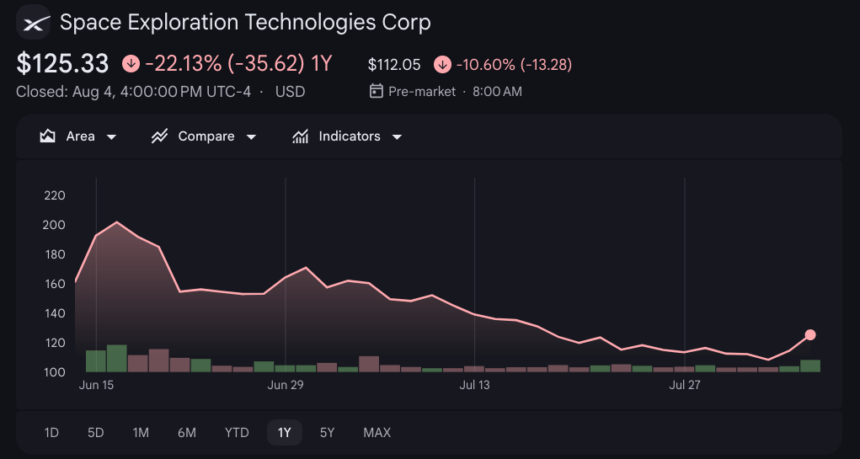
Revenue jumped 92%. AI spending jumped sixfold. The stock still dropped 8% after hours, because investors zeroed in on one number: $18.4 billion in AI infrastructure spending, more than double the quarter’s entire revenue.
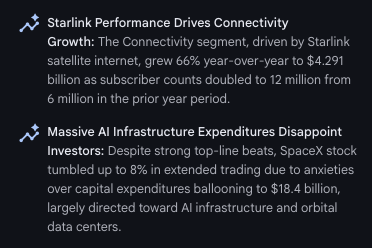
SpaceX reported its first quarterly results as a public company Tuesday, and the numbers pulled investors in two opposite directions at once. Revenue jumped 92% year-over-year to $7.8 billion, beating analyst expectations of $6.93 billion. The net loss narrowed to $541 million, roughly half what Wall Street had forecast. Starlink subscribers doubled to 12 million. Then came the number that spooked traders: capital expenditure soared sixfold to $18.4 billion, more than double the quarter’s total revenue, driven by AI infrastructure spending. Shares fell as much as 10% in after-hours trading.
What’s Happening & Why It Matters
Starlink Is Carrying the Company
Connectivity is SpaceX’s clearest financial success. Starlink revenue rose 66% year-over-year as subscriber numbers doubled from 6 million to 12 million. Elon Musk told analysts on the earnings call: “It’s not out of the question that at some point, Starlink will deliver a majority of the world’s internet.” CFO Bret Johnsen said the company is on pace to reach $100 billion in annualised recurring revenue by year-end, adding that SpaceX had already contracted an additional $6.7 billion in cloud services revenue for a six-month period starting in October.
Musk defended the December ARR target against sceptics. “To be clear, the $100 billion ARR in December is not a question mark,” he said. “That’s what we would achieve if we basically did nothing.” It separates Starlink’s steady growth from the far riskier AI bet the market is punishing SpaceX for making.
Why Wall Street Focused on the Spend
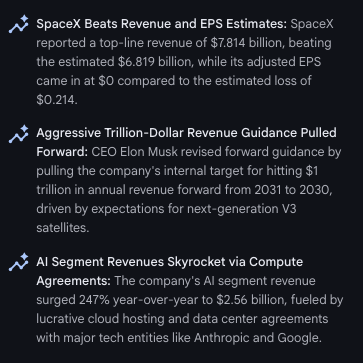
SpaceX entered the AI business in February through its merger with Musk’s own xAI. Reselling AI compute capacity for short-term revenue is against SpaceX’s core rocket and satellite mission, and analysts flagged that mismatch. Alphabet and Amazon could each spend more than $200 billion on AI, with Microsoft and Meta not far behind, so SpaceX’s spending increase alone wasn’t unusual by industry standards. What rattled investors was the scale relative to SpaceX’s actual quarterly revenue, not the AI race.
The stock’s trajectory since June tells the deeper story. Shares opened at $150 on their 12 June IPO day and jumped 19% on the first day of trading. By Tuesday’s close, the stock had fallen roughly half from its June peak. Musk’s own fortune has dropped to $783 billion, according to Forbes, down from making him the world’s first trillionaire. A lockup provision preventing company insiders from selling shares begins expiring, adding another source of volatility investors are bracing for.
Starlink Mobile Is More Than Satellites
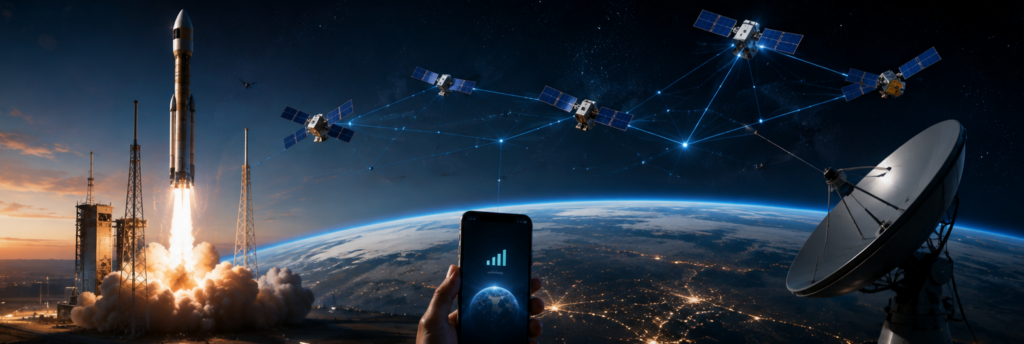
Beyond the earnings numbers, SpaceX filed detailed plans describing where Starlink’s mobile ambitions are headed. An 11-page regulatory submission to Canada’s telecom regulator described a second-generation direct-to-device system built on allocated 2 GHz spectrum, with next-generation satellites launching in 2027 and thousands more added by the end of 2028 to reach continuous global coverage, including polar regions. Rather than launching a standalone consumer carrier, SpaceX signalled it would make satellite capability available to any interested carrier and that carrier’s own subscribers, at least in the Canadian market.
A carrier-partnership model resets what “Starlink Mobile” means in practice. Instead of Musk’s phone service competing against AT&T or T-Mobile, SpaceX appears to be positioning itself as infrastructure other carriers plug into, similar to how Direct to Cell already works with T-Mobile in the US and Rogers in Canada. A recent independent analysis found Starlink could reach as many as 30% of US households within five years, on the strength of that infrastructure-provider model.
An FCC Proposal May Change Satellites & Your Phone
A separate regulatory fight is unfolding at the FCC that could affect how Starlink and rival satellite operators deliver mobile service in the future. The agency’s 22 July proposal would let satellites communicate with consumer devices using unlicensed Wi-Fi and Bluetooth spectrum, covering more than 225 MHz across three heavily used bands, without requiring satellite operators to hold an exclusive license. The proposal is scheduled for consideration at the FCC’s 6 August open meeting.
Not everyone welcomes the idea. Laurence Brett Glass, an electrical engineer who founded the Wyoming-based ISP Lariat, told the FCC the plan poses an “existential threat” to spectrum users. “[The] proposal does not align with the laws of physics or with the public interest,” he said. The core tension is straightforward: opening unlicensed bands to satellite traffic could let more companies compete on direct-to-device service without buying dedicated spectrum, but it also risks interference with the dense Wi-Fi and Bluetooth networks millions of households already depend on daily.
TF Summary: What’s Next
SpaceX’s stock lockup provision begins expiring later this week, a development analysts expect to add volatility regardless of the earnings reaction. The FCC’s Wi-Fi and Bluetooth spectrum-sharing proposal faces a vote at the agency’s 6 August open meeting. SpaceX’s next-generation direct-to-device satellites are targeted for a 2027 launch, with full constellation buildout continuing through the end of 2028. Starlink’s $100 billion annualised recurring revenue target is on track for December, according to CFO Johnsen.
MY FORECAST: Expect SpaceX’s stock to stay volatile through the lockup expiration, then stabilise once investors get more clarity on how the AI spending converts into contracted revenue beyond the $6.7 billion Johnsen already disclosed. The FCC’s spectrum-sharing proposal will pass in some modified form at the 6 August meeting, given Chairman Carr’s public framing around unlocking next-generation technology, but expect interference-protection conditions attached to address the concerns Glass and other critics raised. Watch whether SpaceX’s carrier-partnership approach to Starlink Mobile, rather than a standalone consumer carrier, is the template other satellite operators copy. Infrastructure-provider economics look safer than competing against AT&T and Verizon on price.
Related Stories
- SpaceX Shares Fall Below Their IPO Price
- Sour Sentiment Triggers AI, Chip Stocks Sell Off
- South Korean Stocks Rebound After a 3-Day AI-Driven Selloff
RELATED KEYPHRASE 1:
RELATED KEYPHRASE 2:
RELATED KEYPHRASE 3:
RELATED KEYPHRASE 4: