


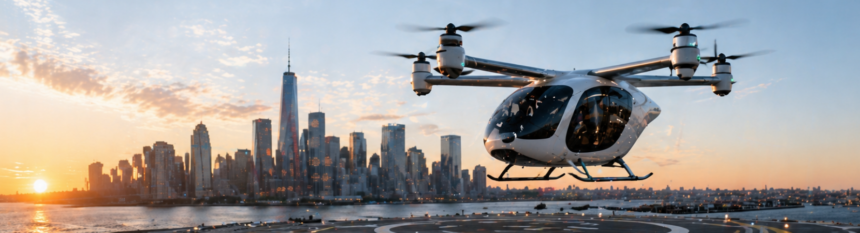
An air taxi flew from JFK to Manhattan in under 10 minutes. Japan Airlines is testing humanoid robots for baggage handling. GM’s Super Cruise hit 1 billion hands-free miles.
Three technology tests made headlines this week — each one advancing transport in a different direction. On 27 April 2026, Joby Aviation flew New York City’s first-ever electric air taxi between JFK International Airport and Manhattan. The trip took under 10 minutes. Meanwhile, Japan Airlines announced a humanoid robot trial at Tokyo Haneda Airport starting in May 2026 — targeting labour shortages in one of the world’s busiest aviation hubs. At the same time, General Motors confirmed its Super Cruise driver assistance system had crossed 1 billion hands-free miles. That distance is more than half the way to Uranus.
Each story points toward the same destination. The way people travel — by road, by air, or through the airport — is changing faster than most people realise. These are not concept cars or prototype flights behind glass. They are real, operational systems being tested by real passengers and real workers.
What’s Happening & Why It Matters
Joby Aviation: JFK to Manhattan in Under 10 Minutes
On 27 April 2026, Joby Aviation completed New York City’s first point-to-point electric vertical takeoff and landing (eVTOL) demonstration flights. Aircraft N545JX flew from JFK International Airport to multiple Manhattan heliports — including Downtown Skyport, the West 30th Street Heliport, and the East 34th Street Heliport in Midtown. The entire journey took under 10 minutes. By car, the same trip takes between 60 and 120 minutes depending on traffic. That is a travel time reduction of up to 92%.
The Joby aircraft carries one pilot and four passengers. It takes off and lands vertically like a helicopter. After liftoff, its propellers tilt forward to generate horizontal thrust. The aircraft reaches speeds of up to 200 miles per hour (322 kilometres per hour). It produces zero operating emissions. At the same time, it is significantly quieter than a conventional helicopter — an important consideration in a city already exhausted by noise.
Why New York and Why Now
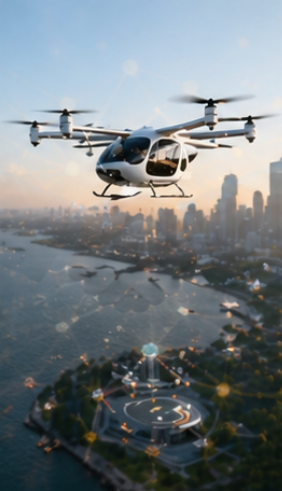
The flights are part of the FAA‘s eVTOL Integration Pilot Program (eIPP), launched by the US Department of Transportation in March 2026. The programme selected eight projects across 26 states. The Port Authority of New York and New Jersey — which operates JFK, LaGuardia, and Newark airports — won a spot in the programme. Its partnership with Joby made the 10-day Manhattan-JFK campaign possible.
Port Authority Chairman Kevin O’Toole confirmed the strategic purpose. “These flights advance our work to determine how next-generation aviation technology can serve the people of New York and New Jersey,” he said. Beyond demonstrating the technology, the flights give the FAA real-world operational data in complex commercial airspace — exactly what the agency needs before granting full type certification.
Joby targets commercial service beginning in the second half of 2026. The first commercial operations will launch in Dubai, available through the Uber app. Toyota has committed nearly $1 billion (€921 million) as Joby’s preferred manufacturing partner, with engineers embedded directly on the factory floor. Wall Street projects Joby’s revenue growing from approximately $110 million (€101 million) in 2026 to $2 billion (€1.84 billion) by 2030.
Japan Airlines: Robots Handle the Baggage
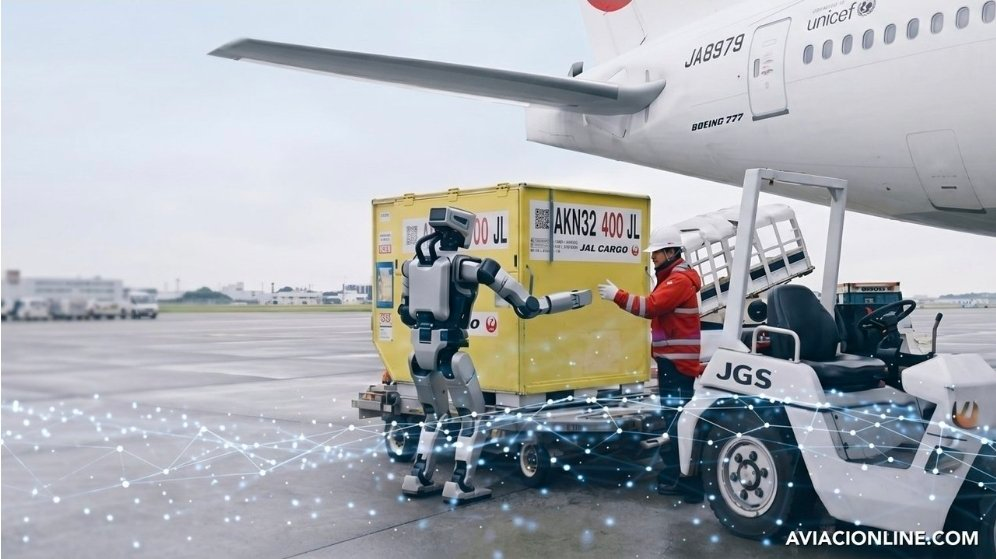
On 28 April 2026, Japan Airlines (JAL) announced a humanoid robot trial at Tokyo Haneda Airport — Japan’s busiest domestic hub and the busiest airport in Asia by passenger volume. The trial begins in May 2026 and runs through 2028. The robots will take on physically demanding ground-handling tasks — moving cargo containers, assisting with baggage operations, and potentially cleaning aircraft cabins.
The robots handle existing airport equipment without modification. That is a deliberate engineering choice. GMO AI & Robotics — the technology partner leading the trial — explained the logic. “While airports appear highly automated and standardised, their back-end operations still rely heavily on human labour and face serious labour shortages,” the company stated. Humanoid robots that operate existing ground support equipment avoid the cost of redesigning airport infrastructure from scratch.
Japan’s Labour Crisis Driving the Trial
Japan’s demographic situation makes this trial urgent. The country has one of the world’s most rapidly ageing populations. Ground handling workers are in chronically short supply, particularly for physically intense tarmac roles. JAL explicitly states that the trial is a response to workforce shortages, not a replacement for human staff. The robots will work alongside human teams, not instead of them.
The current robots operate for approximately two to three hours before needing to recharge. That limitation makes this an early-stage trial, not a production deployment. The two-year timeline from May 2026 to 2028 gives JAL the operational data to assess performance at scale before making any commitment. By contrast, fixed automation, such as conveyor systems and autonomous guided vehicles, already handles significant portions of baggage sorting at major hubs worldwide. Humanoid robots are the next logical step for tasks that require flexible physical manipulation — the kind that existing fixed machines cannot perform.
What Other Airports Are Doing
JAL‘s announcement is part of a global pattern. British Airways is deploying self-driving robot baggage carriers called Auto-DollyTugs at London Gatwick Airport. Trials are also running at Cincinnati/Northern Kentucky International Airport. Amsterdam Schiphol is testing autonomous baggage tractors and a robotic system called Cobot Lift — capable of handling up to 90% of bags — to reduce workforce strain. The global airport robots market is projected to grow at a compound annual rate of 16.6% through 2035. That rate reflects genuine commercial demand, not speculative hype.
GM Super Cruise: A Billion Miles and Counting
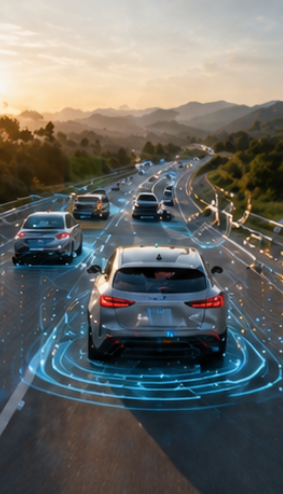
On 28 April 2026, General Motors announced that its Super Cruise driver assistance system had crossed 1 billion hands-free miles — equivalent to nearly 2,100 trips to the Moon and back or 1.6 billion kilometres. The milestone took eight years to reach. Notably, nearly half of the total distance — approximately 485.9 million miles (782 million kilometres) — was driven in the past 12 months alone. That acceleration reflects rapid subscription growth and expanding vehicle compatibility.
Super Cruise operates across approximately 750,000 vehicles spanning 23 different GM models in North America — from the Chevrolet Bolt to the Cadillac Escalade. Over the past year, customers used the system for 7.1 million hours across 28.7 million trips. The average Super Cruise trip covers 17 miles (27 kilometres) with the driver’s hands off the wheel for approximately 24 minutes. Over 50% of users engage the system at least once per week. Nearly 85% use it at least once a month.
What GM Is Building Toward
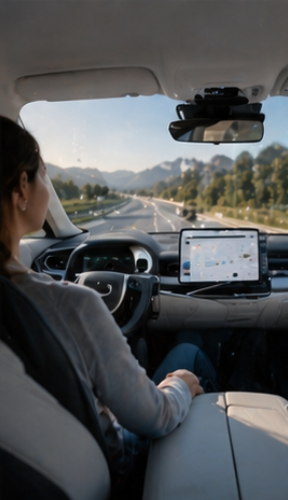
The billion-mile milestone is not the destination — it is the training data. GM VP of Vehicle Autonomy Rashed Haq described Super Cruise’s role in the company’s plan. “This 1 billion miles driven hands-free by our customers is just the start,” he said. “Super Cruise is the cornerstone of GM’s autonomous roadmap, from today’s hands-free features to eyes-off, starting with the Escalade IQ in 2028.”
GM CEO Mary Barra added further detail on the company’s Q1 2026 earnings call. “We’re stress testing it in a digital environment capable of simulating roughly 100 years of human driving every single day,” she said. That simulation programme, combined with real-world data from 750,000 vehicles, creates a feedback loop that accelerates model improvement far faster than any single manufacturer could achieve with test fleet data alone.
Beyond simulation, GM is integrating Google Gemini AI across 4 million vehicles as part of its next software update. That integration adds conversational AI, advanced navigation, and real-time personalisation to the existing Super Cruise hardware. By contrast, Tesla‘s Full Self-Driving (Supervised) has logged nearly 10 billion miles — setting the competitive benchmark that GM is working to close. Super Cruise subscriptions grew 70% year-over-year, suggesting the gap in usage data is shrinking. The Level 3 eyes-off capability on the Escalade IQ in 2028 will be the first major step beyond today’s hands-free system.
TF Summary: What’s Next
Joby Aviation‘s 10-day New York campaign continues through early May 2026. The company targets FAA type certification and commercial launch in Dubai in the second half of this year. The JFK flights give both Joby and the FAA real operational data in some of the world’s most complex controlled airspace. That data feeds directly into the certification process. Beyond New York, Joby has agreements with Delta Air Lines and Uber for commercial integration. If certification stays on schedule, passengers could book an air taxi through the Uber app as early as late 2026.
MY FORECAST: Japan Airlines‘ humanoid robot trial begins in May and runs for two years. Performance data from Haneda will determine whether the programme expands to other airports or additional roles. For GM, the next milestone is the Cadillac Escalade IQ with Level 3 eyes-off capability in 2028. Between now and then, the Gemini AI integration expands Super Cruise’s utility for millions of existing owners. All three stories share the same underlying logic: the hardest part of deploying new transport technology is not the engineering. It is accumulating enough real-world miles, flights, and operational hours to prove the system works safely at scale. This week’s announcements suggest all three programmes are well on their way.