

Day One of the Musk v. Altman trial delivered courtroom drama, a gag order warning, and a witness who started by telling jurors he once worked as a lumberjack. This is not a normal tech trial.
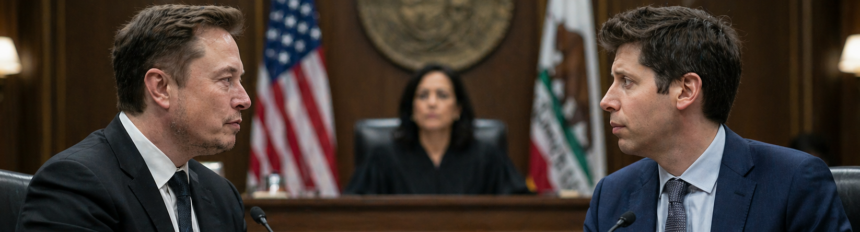
On 28 April 2026, jury selection wrapped up and testimony began in Musk v. Altman — the federal trial that could determine the future of the world’s most valuable AI company. The courtroom is the Ronald V. Dellums Federal Building in Oakland, California. Judge Yvonne Gonzalez Rogers presides. Nine jurors from across the Bay Area will render the advisory verdict. Elon Musk took the stand as the first witness. Sam Altman sat nearby in the gallery — at least for part of it.
Before testimony began, Judge Rogers scolded Musk publicly. Over the weekend, Musk had posted repeatedly on X about the case. One post read: “Scam Altman and Greg Stockman stole a charity. Full stop.” Rogers warned him that a gag order was possible. Then the jury entered — and the real show started.
What’s Happening & Why It Matters
Opening Statements: Two Very Different Stories
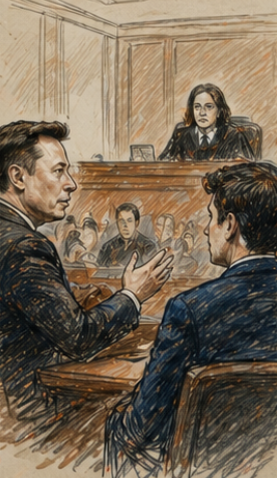
Musk‘s lead attorney, Steven Molo, opened with a simple, direct setup. “Ladies and gentlemen, we are here today because the defendants in this case stole a charity,” he told the jury. He described OpenAI‘s founders as people who took a mission built for humanity and converted it into a mechanism for personal enrichment. “They enriched themselves, they made themselves more powerful, and they breached the very basic principles on which the charity was founded,” Molo said.
OpenAI‘s lead attorney, William Savitt, offered a very different account. “We are here because Mr. Musk didn’t get his way at OpenAI,” Savitt told the jury plainly. “That’s what happened. He quit, saying they would fail for sure. But my clients had the nerve to go on and succeed without him.” Savitt argued that Musk had used promises of funding to pressure OpenAI‘s founding members. He also claimed Musk had tried to take control of the company and merge it with Tesla. When that failed, he left — and sued years later after founding a rival company.
Russell Cohen, attorney for Microsoft, argued that the statute of limitations barred the case against his client. He pointed to a September 2020 post by Musk on X describing OpenAI as “essentially captured by Microsoft” — evidence, Cohen argued, that Musk had known about the Microsoft relationship years before filing suit.
Musk Takes the Stand: From Lumberjack to AI Pioneer
Musk took the stand shortly after noon on Tuesday. His lawyers began with his personal background — a deliberate strategy to build relatability with a Bay Area jury that, polling showed, holds mixed opinions of him. Musk described moving to North America from South Africa to participate in the technology industry. He recalled early jobs as a lumberjack and a restaurant server before his first business ventures. He then walked jurors through the founding missions of SpaceX and Tesla.
Musk then turned to OpenAI. He described the origin story in clear terms. A close friend — a co-founder of Google — had called him a “speciesist” for being pro-human on AI safety. That conversation, Musk testified, convinced him that he urgently needed to create a counterweight to Google’s AI research division, DeepMind. “I came up with the idea, the name, recruited the key people, taught them everything I know, provided all of the initial funding — besides that, nothing. It was a lot,” Musk said from the stand.
The Core of Musk’s Testimony
Musk testified that he contributed at least $44 million to OpenAI in its early years. He confirmed he would not have donated that money, time, or energy if OpenAI had not been structured as a non-profit. “I could have started it as a for-profit, and I chose not to,” he told jurors. “I specifically chose to make it something for the benefit of all humanity.”
Asked by his lawyer whether he would have joined the venture regardless, Musk said he would have started a non-profit AI safety organization “with or without Sam Altman and Greg Brockman.” He described recruiting AI researcher Ilya Sutskever from Google in 2015 as critical to OpenAI‘s success. Sutskever, Musk said, was “perhaps one of the top three AI researchers in the world at the time.”
Musk also explicitly raised the existential stakes. “I have extreme concerns over AI,” he testified. “It could also kill us all. We don’t want to have a Terminator outcome.” He told jurors that the verdict in this case carries consequences far beyond OpenAI itself. “If the verdict comes out that it’s OK to loot a charity, charitable giving in America will be destroyed.”
The Altman Counter-Narrative
Altman did not testify on Day One. He was not in the courtroom for much of Musk’s testimony, though Greg Brockman remained seated at the front of the gallery. Earlier in the day, Altman made a virtual appearance at an Amazon Web Services event — a deliberate contrast to Musk’s presence on the witness stand. The timing drew attention on social media.
OpenAI‘s legal team argues that the for-profit conversion was not a betrayal. Their position is that Musk knew from the beginning that OpenAI would eventually need a for-profit structure to attract top talent and raise the capital required to compete in frontier AI. Savitt argued Musk was part of those early discussions. When Musk failed to install himself as CEO, he walked. He then sued only after founding xAI — his own for-profit AI rival.
One exhibit already entered into evidence makes the personal dimension of this case vivid. A 2023 email shows Altman telling Musk: “You are my hero.” Musk’s response was characteristically blunt. “I hear you and it is certainly not my intention to be hurtful, for which I apologize, but the fate of civilization is at stake.”
What Musk Is Asking For — and the Influence
Musk is not seeking personal financial gain. The remedies his team requests would all flow to OpenAI‘s non-profit arm. Musk wants the court to require OpenAI to unwind its for-profit conversion entirely. He wants Altman removed from the non-profit board and from his role as CEO of the for-profit entity. Brockman faces the same removal demand. Musk is also seeking approximately $130 billion (€119.9 billion) in damages directed to the non-profit — representing profits that Altman, Brockman, and Microsoft allegedly gained through the conversion.
The trial runs in two phases. The nine-person jury hears Phase One — the liability question. Phase Two, which begins on 18 May if liability is found, covers remedies. Crucially, Judge Gonzalez Rogers — not the jury — decides the actual damages and structural remedies in Phase Two. The jury’s role is advisory.
The stakes are unmistakable. OpenAI targets a potential $1 trillion valuation IPO in Q4 2026. A Musk victory could derail that entirely — forcing a structural unwind and leadership change at the exact moment the company prepares to go public. Even a partial finding of liability could significantly complicate the IPO roadshow. OpenAI has already listed the Musk litigation as a disclosed risk in early IPO documents.
The Expert Witnesses and the Road Ahead
Both sides bring serious expert witnesses. Musk‘s team calls Stuart J. Russell — AI researcher and professor at the University of California, Berkeley, co-author of the foundational AI textbook Artificial Intelligence: A Modern Approach, and founder of the Center for Human-Compatible Artificial Intelligence. Russell will likely testify on the nature of OpenAI‘s founding mission and the significance of its structural changes. The second expert is David M. Schizer — Columbia Law professor, dean emeritus, and author of How to Save the World in Six (Not So Easy) Steps: Bringing Out the Best in Non-profits. Schizer will address charitable trust law.
Beyond Musk, this week’s testimony includes Altman, Brockman, Microsoft CEO Satya Nadella, former OpenAI co-founder Ilya Sutskever, and former President of OpenAI Mira Murati. Musk’s testimony continues on Wednesday. Each side receives approximately 20 hours of total trial time. Microsoft receives a separate 5 hours.
TF Summary: What’s Next
Musk’s testimony continues on Wednesday, 29 April. Altman is expected to take the stand later this week. His testimony will be closely watched for his characterization of the founding conversations — and whether he addresses the Brockman diary entry, which is the most damaging piece of internal evidence. The diary entry, written in 2017, reads: “I cannot believe that we committed to non-profit if three months later we’re doing b-corp then it was a lie.” Judge Gonzalez Rogers cited that entry specifically when she ruled the case would go to trial.
MY FORECAST: Phase One of the trial runs through approximately mid-May. If the jury finds OpenAI liable, Phase Two — remedies — begins on 18 May. Prediction markets give Musk approximately a 36% probability of winning. Legal analysts broadly agree that even a partial win could reshape the AI industry’s approach to nonprofit-to-for-profit transitions. The case is not just about OpenAI. It is about whether mission statements made to charitable donors carry legally enforceable obligations in an industry where those missions are increasingly worth trillions of dollars.