


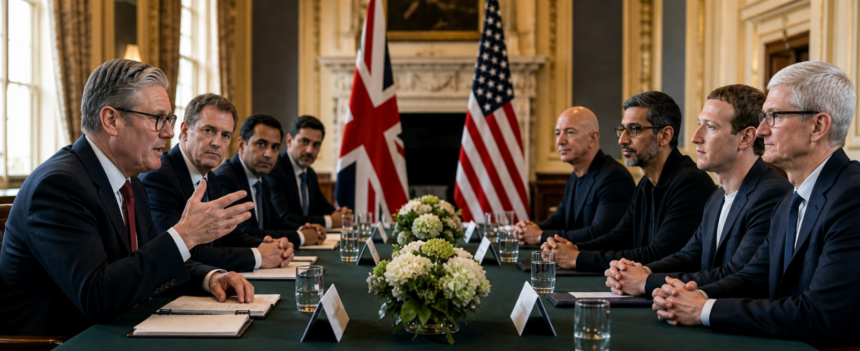
Keir Starmer’s top business adviser held 16 undisclosed meetings with Google, Meta, and Apple. The U.K.’s “moonshot” science agency sent £52 million to U.S. tech firms.
Two separate investigations published simultaneously raised serious questions about how the U.K. government manages its relationship with American technology companies. The first — published by The Guardian — revealed that Varun Chandra, Prime Minister Keir Starmer’s most senior business adviser, held 16 undisclosed meetings with top U.S. tech executives, including Google, Meta, and Apple. The second — a joint investigation by The Guardian and Democracy for Sale — found that the Advanced Research and Invention Agency (ARIA), the U.K.’s publicly funded “moonshot” science body, directed more than £52 million ($65 million / €60 million) of British taxpayer money to American technology firms and US-linked venture capital groups — sometimes to companies that set up U.K. operations just days before receiving their grants.
Taken together, the two stories describe a pattern that critics are calling “lobbying behind closed doors” — one in which the lines between government policy, private business interests, and U.S. tech access are increasingly blurred. Furthermore, both stories raise a question that neither Downing Street nor ARIA has satisfactorily answered: in whose interest is the U.K.s technology strategy being run?
What’s Happening & Why It Matters
Varun Chandra: 16 Meetings, None of Them Disclosed
Varun Chandra is not a household name in British politics. He is, however, one of the most influential people in Keir Starmer’s government. Chandra left his role as managing director of Hakluyt & Company — a secretive corporate intelligence firm whose clients include some of the world’s largest corporations — to join Downing Street as Starmer’s top business and investment adviser in July 2024. He was subsequently appointed as the U.K.’s U.S. Trade Envoy, directly involved in U.S.-U.K. trade negotiations. He is, by any measure, a central figure in shaping how the U.K. government interacts with Silicon Valley.
The Guardian investigation found that Chandra held 16 meetings with senior executives from Google, Meta, Apple, and other major US technology companies — none of which appeared in any transparency disclosure. That absence is legally permitted. Under current U.K. rules, special advisers — the category of government appointee that Chandra holds — are not required to publish a list of their meetings with external companies. Ministers and senior civil servants must disclose meetings quarterly. Special advisers do not.
The Conflict of Interest That Was Never Publicly Declared
The transparency gap is even more pronounced given Chandra’s financial background. A separate openDemocracy investigation has established that Chandra retains a stake in Hakluyt Capital I Pooling LP — an investment fund he helped establish. At the same time, Hakluyt has backed several AI companies. One portfolio company — Viz.AI — holds a multi-million-pound NHS contract. Chandra was also part of a Downing Street meeting with heads of major AI companies in August 2024, despite having no publicly stated role in the AI policy review being discussed.
openDemocracy reported that Chandra holds this stake even though he was supposed to have severed his financial ties with Hakluyt upon joining the government. Hakluyt’s U.K. revenues grew 30% in the year to July 2025 — the first full financial year after Chandra joined Number 10. Downing Street has stated that “Varun Chandra resigned from his position at Hakluyt and has made all relevant declarations.” It declined to comment further. Critics argue that the relevant declaration rules do not go far enough. Jill Rutter, a senior fellow at the Institute for Government, described the situation as “a conflict of interest” that raises questions about government transparency.
What Lobbying Reform Advocates Are Saying
The episode has attracted direct criticism from anti-corruption campaigners. Alex Runswick, director of Transparency International U.K. said: “This story highlights the most glaring loophole — that meetings with special advisers do not need to appear in transparency releases or the lobbying register, so the public do not know who is meeting some of the most influential people in government.” The Ethics and Integrity Commission is currently conducting a review of lobbying rules. Several parliamentary committees have called for special advisers’ meetings to be published on the same basis as ministers’. The previous Conservative government rejected that proposal. Downing Street has not committed to changing the rules.
ARIA: £52 Million to UU.S.Companies, Some Set Up Days Before Receiving Grants

The second investigation cuts to a different but equally urgent problem. ARIA — the Advanced Research and Invention Agency — was established by an Act of Parliament in January 2023. Its founding mission is clear: fund high-risk, high-reward scientific research that drives U.K. economic growth and restores Britain’s position as a global scientific leader. ARIA‘s total budget is £800 million over five years. Following the June 2025 spending review, the government committed a further £1 billion over 2025–2029. It is, by any measure, a significant public investment in the U.K.’s scientific future.
The joint Guardian/Democracy for Sale investigation found that more than one-eighth of ARIA‘s two-year research budget — £52 million — went to 14 American entities. Transparency disclosures show £23 million going directly to nine U.S. tech firms. A further £6 million went to Normal Computing — a company that established its U.K. arm just three weeks before its ARIA deal began. An additional £29.4 million went to three U.S. venture capital groups. Among them: Pillar VC, which received £10.9 million and incorporated its U.K. subsidiary just one day before its contract began; Renaissance Philanthropy, backed by former Google CEO Eric Schmidt, which received £13.3 million; and Fifty Years, which received £7 million to run a 14-week entrepreneurship training course for 50 British scientists per cohort.
The Sam Altman Connection and a Struggling AI Company
Among the most scrutinised grants is a £8.7 million award to Rain Neuromorphics — a US AI company backed by OpenAI CEO Sam Altman. Rain Neuromorphics received the grant in October 2024. In 2025, the New York Post reported that the company was seeking emergency financing. ARIA has since closed one of its two contracts with the company. Rain Neuromorphics did not respond to requests for comment from the investigating journalists. That combination — a struggling company, a high-profile backer, a closed contract — raises questions about ARIA‘s due diligence processes and the protections in place to ensure public money yields public benefit.
Other recipients include MorphoAI, linked to Y Combinator; Sangtera, tied to the U.S. National Science Foundation; and CIC Venture Café Global Institute — a Massachusetts-based company that incorporated a U.K. arm on the same day it won its ARIA contract. CIC received £5.4 million to run networking events for tech investors and entrepreneurs in London, Manchester, and Edinburgh.
What ARIA Says — and What Critics Argue
ARIA defended its approach directly. “Our mission is to unlock breakthroughs that benefit the U.K. which means funding the best ideas across universities, startups and private companies. Over 80% of our funding goes to U.K.based teams — and where we fund international organisations, it is to transfer scientific capabilities to the U.K., with contractual protections ensuring the benefits flow back here,” the agency stated. ARIA also noted that it does not typically take equity stakes in funded companies — instead relying on contractual royalty arrangements on any IP commercialised outside the U.K.
Critics are not persuaded. Professor Cecilia Rikap of University College London argued that the funding risks “strengthening US technology dominance rather than U.K. scientific capacity.” Labour MP Chi Onwurah, chair of the Commons Science and Technology Committee, said: “It’s unclear how funding US-based venture capital and tech firms meets the aims, or aligns with the government’s commitment to regional innovation.” ARIA is also exempt from the Freedom of Information Act — a provision Dominic Cummings insisted upon when he designed the agency. That exemption makes independent scrutiny of its decisions significantly harder than for any other public body.
The Pattern: U.K. Tech Policy and American Interests
Both stories reflect a tension in U.K. technology policy. The Starmer government has made attracting U.S. tech investment a central plank of its economic strategy. That strategy has included high-profile state dinners with Silicon Valley executives, AI growth zones, and a series of “tech prosperity deals” with American companies. Chandra’s undisclosed meetings fit directly within that strategy — government officials building relationships with U.S. tech decision-makers. The question critics are raising is not whether those relationships should exist, but whether they should happen without any public record. The ARIA story raises a related but distinct concern. Building a U.K. science and innovation base by channelling public money to U.S. venture capital groups, U.S. startups, and U.K.-incorporated companies that received grants days before may not be the most direct path to strengthening Britain’s own scientific capacity.
TF Summary: What’s Next

The Ethics and Integrity Commission review of lobbying rules is ongoing. Campaign groups are calling for special adviser meetings to be added to the transparency disclosure framework alongside minister and senior civil servant meetings. Downing Street has not confirmed whether it will support such a change. Chandra’s position is under growing scrutiny — and the government’s handling of his conflict-of-interest declarations will face sustained pressure from opposition parties and transparency campaigners in the coming weeks.
For ARIA, the Commons Science and Technology Committee has signalled that it will examine the agency’s UU.S. funding decisions more closely. ARIA‘s new executive director — former DARPA official Kathleen Fisher, who took over in February 2026 — has not yet addressed the controversy publicly. The agency’s FOI exemption makes external accountability difficult. That exemption itself may come under renewed legislative scrutiny given the investigation’s findings. Both stories will continue developing. At their core, they ask the same question: when U.K. public money and government influence flow toward American technology interests, who in the British government is accountable for the outcomes?