


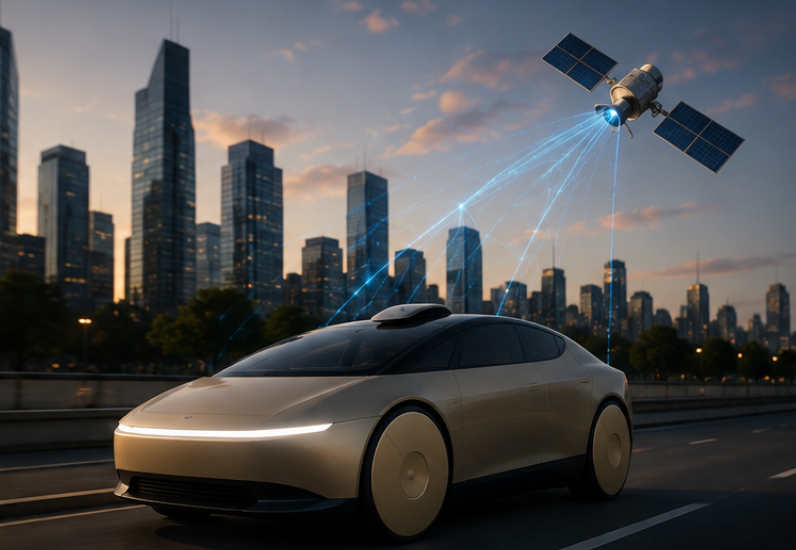
No steering wheel. No cellular dead zones. A satellite dish built right into the bodywork, so slick you’d never spot it. Musk says every car needs this eventually. His own head of AI says the robotaxi doesn’t need it to drive at all.
Tesla’s official Robotaxi account posted photos Sunday of the first Cybercab built with an integrated Starlink antenna, moving the story from spotted-in-the-wild speculation to an official unveiling. The gold-finished terminal is flush in the bodywork, tucked in alongside Tesla’s self-driving computer, interior microphones, emergency stop hardware, and backup 5G LTE antennas. No external dish. No visible hardware breaking up the Cybercab’s lines. Musk explained the reasoning on Tesla’s Q2 earnings call weeks earlier: “We can’t have robotaxis stuck in these like Bermuda Triangles of lack of cellular connectivity.”
What’s Happening & Why It Matters
The Car Doesn’t Starlink to Drive
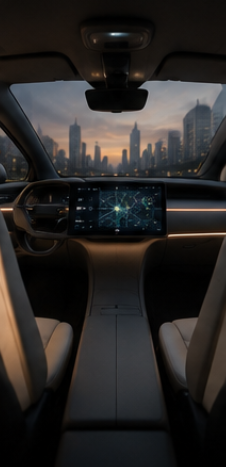
Here’s the detail that undercuts Musk’s own safety perspective. Tesla’s head of AI, Ashok Elluswamy, clarified the connection isn’t there for safety at all. Cybercab’s driving stack runs on onboard cameras and compute. The satellite link exists for navigation support, customer service, and fleet management — useful functions, but not the difference between a car that drives itself and one that doesn’t.
There’s a passenger-facing angle too. Musk said the high-speed connection lets riders stream 4K video on the Cybercab’s 21-inch display during the ride. That’s a real amenity. It’s also a smaller justification than “robotaxis stranded without connectivity,” which is the outlook Musk led with.
‘Company One’ Paying ‘Company Two’
Strip away the branding, and there’s a simpler read here. Starlink is run by Musk’s SpaceXAI, which had its own IPO in June. A Starlink terminal built into every Cybercab is recurring revenue for that company — regardless of which corporate entity technically owns what by the time it scales. Electrek’s choice is the point: this is another way for Elon Musk to have Tesla pay SpaceX.
That’s not a problem for Tesla’s actual operations. It’s a useful thing to notice, though, given how much of Musk’s public commentary this year has drifted toward cross-company integration — Grok inside Tesla vehicles, constant SpaceX-Tesla merger speculation, and satellite hardware baked into the robotaxi fleet.
Not Solving a Problem That Exists… Yet

Tesla’s robotaxi service runs in four cities: Austin, Houston, Dallas, and Miami. All four have strong existing cellular coverage. There’s no immediate operational gap Starlink is closing today. The bigger justification is where Musk says this is heading. He confirmed on 22 July that Starlink integration extends beyond Cybercab to Tesla’s entire lineup going forward — new production vehicles only, with no retrofit program planned for existing Model 3, Model Y, or Cybertruck owners.
Musk urged the argument over the weekend, seeing satellite connectivity as an industry-wide requirement rather than a Tesla-specific feature, tied to how much bandwidth AI systems are expected to consume as they scale. It’s a big claim for a feature that looks nice built into a car nobody can buy yet.
Where the Fleet Stands
Cybercab production started at Giga Texas earlier this year. More than 100 units had been spotted in factory lots by July, according to Electrek’s own reporting. Tesla still can’t sell the vehicle to consumers, and it can’t run unsupervised, without a human safety monitor present, in any market. The Starlink integration is a genuine engineering milestone. It’s arriving well ahead of the regulatory and commercial clearances that would let it matter.
TF Summary: What’s Next
Tesla hasn’t announced a specific timeline for Cybercab’s commercial sale or unsupervised operation. Starlink integration extends to future production vehicles across Tesla’s lineup, with no retrofit program for existing owners. SpaceX’s proposed next-generation Starlink constellation, including its Starmind concept of up to a million satellites, is pending FCC review. No confirmed date exists for expanding robotaxi service beyond Tesla’s current four-city footprint.
MY FORECAST: Expect this integration to matter more once Tesla expands robotaxi service into markets with weaker cellular coverage — rural corridors, highway stretches between cities — where the Bermuda Triangle analogy Musk used applies. Deployed exclusively to dense urban markets with strong LTE, the feature is closer to a proof of concept than a solved problem. Watch for the SpaceX-Tesla financial relationship to draw more scrutiny as this rolls out across the full vehicle lineup, given how every new Starlink-equipped Tesla is a recurring revenue line for a company Musk also controls.
Related Stories
- SpaceX Slides on 12M Subscribers, AI Spending and Mobile Plans
- Tesla Robotaxis Are Now Live in Miami — Rain Is the Real Test
- Waymo Is Bringing Autonomous Rides to 4 New US Cities