



One chip for the masses. One built for 8K video and 30-billion-parameter AI agents running on-device. The real reason two chips exist isn’t a feature decision — it’s what a 2nm wafer costs to make at TSMC.
Qualcomm opened Snapdragon Summit 2026 in Maui by confirming what leaked specs and benchmark listings had already signalled for weeks: this year’s flagship mobile chip isn’t one platform; it’s two. The Snapdragon 8 Elite Gen 6 and the higher-tier Snapdragon 8 Elite Extreme Gen 6 both move to a 2nm manufacturing process — Qualcomm’s first jump to that node — built on TSMC’s advanced fabrication line. It’s the first time the company has divided a flagship Snapdragon generation into two distinct silicon tiers rather than shipping one chip with binned variants.
What’s Happening & Why It Matters
Splitting Up: What a 2nm Wafer Costs
Here’s the structural reason behind Qualcomm’s decision, and it has less to do with any specific feature the company wanted to withhold than with the economics of the manufacturing node itself. TrendForce reported in April 2026 that TSMC was achieving 2nm yields in the 60-to-70% range, while Samsung’s competing 2nm process sat around 55% — a level TrendForce characterised as below the threshold needed for confident mass production. That yield gap is why Qualcomm, alongside Apple and several other major fabless chip designers, continues steering its most advanced silicon to TSMC rather than splitting orders across foundries.
A pricier flagship SoC, layered on top of a memory market where DRAM contracts have already been renegotiated upward through 2026, gives phone makers a straightforward justification for raising retail prices further. As TF covered in RAMageddon Hits MacBook Air Supply as Chip Shortage Deepens, the same AI-driven memory shortage squeezing laptops and consoles all year sits beneath this chip announcement too — a two-tier flagship structure lets Qualcomm’s OEM partners absorb rising component costs at the top of the range without forcing every device in the lineup to carry the same price increase.
What Separates the Two Chips
The performance gap between the standard and Extreme variants is real but modest. Qualcomm’s generational comparisons put the standard Gen 6 at 10% higher CPU performance than last year’s Gen 5, with a 37% improvement in power efficiency. The Extreme Gen 6 pushes CPU performance about 13% higher than Gen 5 — a real but narrow gap over the standard chip, driven more by cache and memory configuration than raw clock speed, since both variants share an identical eight-core layout with two prime cores reaching up to 5GHz and six performance cores at up to 4GHz.
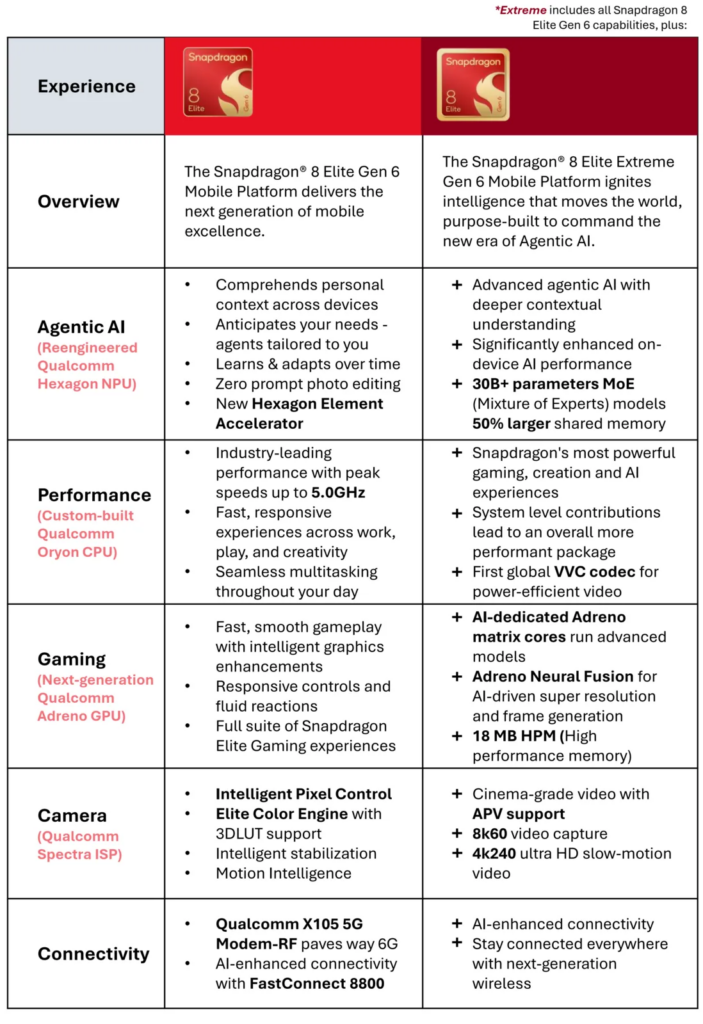
The gap widens in the camera pipeline. The standard Gen 6 handles 8K video at 30fps; the Extreme pushes that to a smooth 60fps, alongside native hardware support for professional-grade codecs reserved for dedicated cinema cameras. Memory support scales to LPDDR5x/5300 with up to 24GB of RAM on flagship configurations, paired with UFS 5.0 storage—headroom matching the ceiling MediaTek’s Dimensity 9600 Pro already established when it moved to a 2nm process.
Running AI Agents On-Device, Up to 30-Billion Parameters
The generational leap Qualcomm is selling here sits in on-device agentic AI capability. Both chips are built to run AI agents — up to 30 billion parameters, per Qualcomm’s figures — without sending data to a cloud server for processing. That’s a significant local-compute threshold, putting flagship Android phones within range of running capable AI models offline, a distinction for privacy, latency, and the kind of continuous background AI assistance TF covered smartphone makers racing toward throughout 2026.
Qualcomm’s Neural Fusion technology, paired with an upgraded Adreno GPU, is positioned around smoother, better-looking gaming performance on top of AI workload improvements — giving OEMs a chip marketed on raw gaming credentials and on-device intelligence rather than either alone.
Confusion by Design
Here’s the awkward part of Qualcomm’s strategy that TechRadar and 9to5Google both flagged: the shared branding across both chips is already creating genuine confusion for buyers trying to determine which phone shipped with the better camera silicon. Both chips carry the “Snapdragon 8 Elite Gen 6” name, distinguished by whether “Extreme” appears alongside it — a naming convention that puts real technical burden on consumers comparing spec sheets across a fragmented, multi-brand Android market spanning Honor, iQOO, Motorola, Nubia, OnePlus, OPPO, REDMI, RedMagic, vivo, Xiaomi, and ZTE devices, all expected to ship variants of one chip or the other within weeks.

That naming ambiguity mirrors a strategy shift TF has watched build across the chip industry — what started as Samsung-exclusive “for Galaxy” overclocked variants several generations back has become a formal two-tier product line Qualcomm sells to every major OEM, suggesting the company sees enough demand at the ultra-premium end of the market to justify designing, validating, and manufacturing two distinct dies rather than one chip unlocked through binning alone.
TF Summary: What’s Next
Phones built on both chips, including the Xiaomi 18 Pro, Motorola Signature 27, OnePlus 16, and iQOO 16, are expected to launch within weeks of the Snapdragon Summit announcement. Snapdragon Summit 2026 continues through 24 September 2026 in Maui, with further technical detail expected across the sessions. Qualcomm has not confirmed final pricing for either chip, leaving OEMs to set device-level retail prices once silicon costs are finalised.
MY FORECAST: Expect the naming confusion TechRadar and 9to5Google already flagged a consumer complaint once devices ship, given how both chips share branding despite the real gap in camera and AI capability between them — OEMs marketing “Snapdragon 8 Elite Gen 6” without clarifying which variant sits inside a specific device will draw comparisons to Apple’s Pro-versus-standard confusion that TF has covered persisting across multiple iPhone generations. The two-tier structure itself is more durable than a one-off response to this year’s memory shortage. Given how 2nm yields and DRAM costs are likely to stay constrained through 2027, expect Qualcomm to maintain a comparable split-flagship strategy for at least the next generation, rather than reverting to a single unified chip once current supply pressure eases.
Related Stories
- RAMageddon Hits MacBook Air Supply as Chip Shortage Deepens
- TSMC and Sony Are Investing Billions in a New Chip and Sensor Plant
- Surprise and Shine: Watches S12 and Ultra 4, AirPods 5, iPhones 18 and Duo