


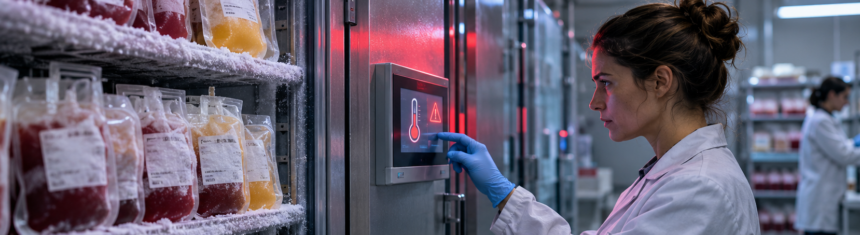
Attackers raised temperature limits at three blood service sites, and Italy’s Coop stores report the same pattern
The French blood bank cyberattack targeted plasma freezers at three sites, and the wider supermarket cooling hacks reach Italy. TF tracked the reports. Staff caught the attack in time, and officials say no blood product was lost.
What’s Happening & Why It Matters
French Blood Plasma Freezers Targeted

The French blood service, EFS, says attackers raised temperature and defrost limits to extreme levels at three plasma cold-storage sites on Monday 2 November 2026. Monitoring systems flagged the changes, and staff moved or secured the plasma. EFS reports no health consequences or lost products, and collection continued.
The sites held plasma for transfusions and for making medicines. The attack reached them through a refrigeration supplier, which CBS News and others name as Coolworld. Coolworld says a third-party component was vulnerable and a limited number of units were affected. France’s cybersecurity agency ANSSI and the Health Ministry are investigating.
Le Canard enchaîné first reported the attack and said setpoints were raised from -30°C to 110°C. EFS has not confirmed the figure. A programmed setpoint does not show how hot the units got.
Italy’s Coop Stores Join the List

Coop Radenza confirmed a suspected cyberattack on the remote control system for frozen-food counters at four stores. Three are in Catania and one is in Palermo, both in Sicily. Temperatures rose, and shopkeepers discarded food. Chief executive Danilo Radenza says screening found no more damage.
Italy’s National Cybersecurity Agency (Acn) received a report from a Tuscan catering company. Acn detected an attack on an Emilia firm making frozen foods. Postal police are checking links with other countries, and no group has claimed responsibility. Acn urges operators to check for internet-exposed remote systems, strengthen VPN and multi-factor authentication, and replace unsupported devices.
Germany, Sweden and the UK Add to the Count
Stores in at least eight European countries discarded food after tampering on Monday, according to The National. Edeka had fridges hacked at a store in Reisbach, Germany. In Sweden, Coop is moving refrigeration to 5G modems. Seven affected stores are back up but disconnected from the internet. In the UK, hackers tried to target small meat firms with minimal impact.
Danfoss says its systems were targeted again and should stay off the open internet. CBS reports Ahold Delhaize expects fourth-quarter sales to drop by up to $281 million (about €250 million) after October’s attacks. TF covered the stores hit in its second-wave story.
What Officials Tell Operators

Richard Horne, chief of the UK’s NCSC, warned on 3 November old technology will fail more often against hackers. The EU cybersecurity agency ENISA called for faster information-sharing across borders. Italy’s government plans meetings with Acn and intelligence chiefs.
Advice is consistent. Map every remote-access path, set hard temperature limits remote commands cannot override, and run independent alarms. Require named multi-factor accounts for vendors, and rehearse moving products to backup storage.
My take: The EFS case worked as designed. Alarms ran apart from the compromised settings, and a technician acted. Supermarkets lost food, while the blood service shows a tested fallback. Health care operators should copy the design before the next wave.
TF Summary: What’s Next
ANSSI and the Health Ministry will report what happened at the three EFS sites. Italian authorities will test for links to the French and Belgian waves. Regulators will press supermarkets and hospitals to take refrigeration controllers off the open internet.
MY FORECAST: Another health care or food storage operator will report a cooling attack by the end of November 2026. Investigators will name one supplier weakness behind several waves. Nobody will face charges in 2026.
Related Stories
- Hackers Warm Supermarket Fridges Across Europe in Second Wave
- TF Cybercrime Round-up: 3–4 November 2026
- TF Cybercrime Round-up: 30 October 2026
- Binance Replaces 90% of $6.3Bn Hack Losses as FBI Blames North Korea
- PHP2Shell: PHP Vulnerabilities, AI Research and Patches