


LinearB Inc Launches Agentic Studio to Enhance Software Delivery Amid AI Adoption
Application development intelligence startup LinearB Inc. announced today its initiative to alleviate the growing congestion in organizational software delivery pipelines caused by the widespread adoption of artificial intelligence (AI) coding tools.
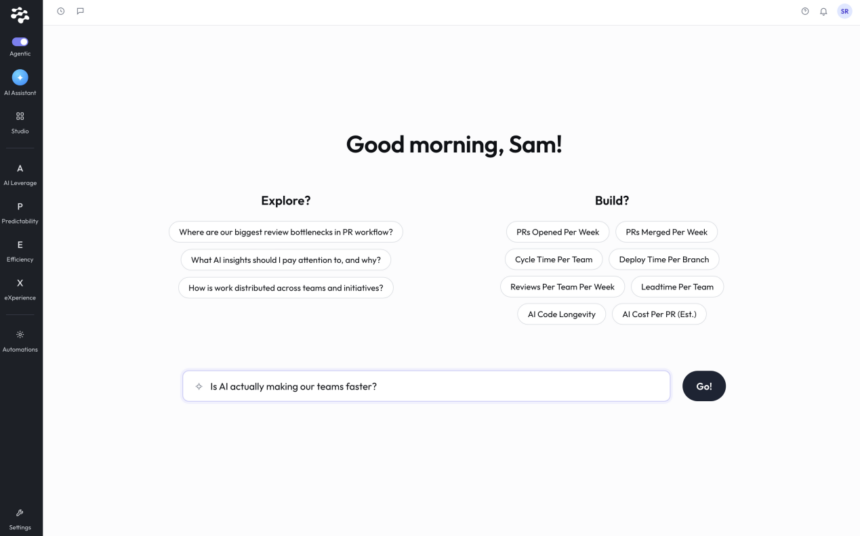
The company unveiled Agentic Studio, a new solution designed to provide more actionable context for both human engineers and autonomous coding agents. LinearB aims to address the challenges surfacing from the emergence of generative AI coding tools such as Claude Code and Codex, which, while making the act of writing software code significantly easier, have created new complexities for enterprise software development teams in shipping that code into production.
In its recent Software Engineering Benchmarks report, LinearB analyzed over 2.7 million pull requests from 250 organizations. The findings revealed that teams utilizing AI coding tools experienced nearly a doubling of merged code changes year-over-year. However, these AI-assisted pull requests were approximately 2.6 times larger than those authored by humans, resulting in an average wait time for reviews that was over five times longer. Furthermore, AI-generated code changes were merged just 79% of the time at elite organizations, compared to a 92% merge rate for human-produced code.
LinearB indicates that human software engineers are struggling to manage this backlog because traditional dashboards offer mere metrics without providing the contextual insights required to effectively resolve these pull requests. Agentic Studio aims to tackle this issue by normalizing data and insights from Git repositories and project tracking tools into a unified context layer. This enhancement allows software engineers to query in plain language, facilitating a clearer understanding of the root causes of stalled release velocities and providing actionable recommendations to expedite development.
Co-founder and CEO Ori Keren emphasized the importance of context in the software delivery lifecycle, stating, “We realized we hold a knowledge graph that nobody else has of everything that is happening across the software delivery lifecycle. That’s exactly what agents and teams need to deliver high-quality software faster, so we rebuilt LinearB around it.”
What sets Agentic Studio apart is its dual-focus on supporting both autonomous coding agents and human developers. Keren explained that the platform integrates through protocols such as the Model Context Protocol to supply historical context—including rework rates, past production incidents, and code ownership—to AI agents, thereby preventing them from making uninformed modifications to pull requests.
Early adopters of Agentic Studio have reported significant productivity gains. For example, cryptocurrency exchange Kraken utilized LinearB’s MCP integration to identify delay factors in its code reviews, ultimately discovering that timezone misalignments were the primary issue rather than the size of pull requests. By reorganizing its workflows accordingly, Kraken reduced its code review times by more than 50% within four months.
Dan Lines, LinearB’s Chief Operating Officer, remarked, “For years, engineering leaders told us the same thing: metrics are useful, but they don’t tell you what to do. A dashboard says your cycle time is two days, but so what? Now, with Agentic Studio, a leader can ask what to improve in their engineering organization and receive a clear answer. When that same context is fed to coding agents, the platform moves beyond mere reporting and takes action.”
To further assist AI agents in operationalizing the context provided, LinearB is developing an array of new agent skills. The first, an “effort skill,” is currently available in early access. This skill assesses the complexity of pull requests, considering aspects like proposed changes, rework history, and potential risks to dynamically calibrate the computational effort AI agents should expend while processing them. Simple, low-risk modifications can be completed more swiftly with minimal tokens, while more sensitive, high-priority changes will involve deeper reasoning and thorough testing to ensure stability.
LinearB plans to expand its library of agent skills in the upcoming months, focusing on areas such as automated code review, merge governance, and token cost optimization.