


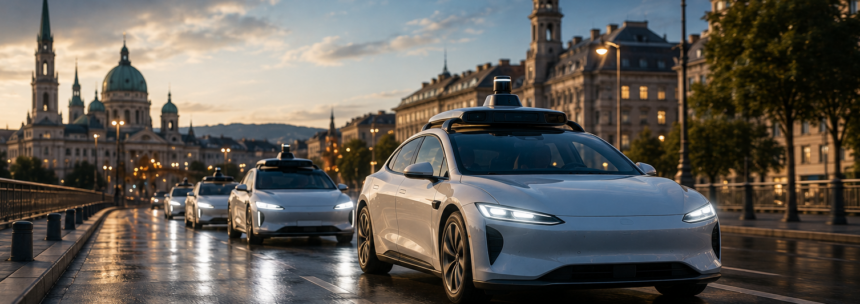
One city, expanding to five. Zagreb was the proving ground. Uber’s asset-light playbook and a Chinese autonomous driving company that’s already profitable in four cities go for scale, right as Europe’s robotaxi market starts to move.
Uber and Chinese autonomous driving company Pony AI announced Friday an expanded partnership to deploy more than 2,000 robotaxis across Europe, growing from a single pilot city to five. The companies haven’t named the four new cities yet, and details will come in phases. What’s confirmed: the deal also extends to the Middle East. This builds on the March 2026 launch in Zagreb, Croatia — Europe’s first commercial robotaxi service, run with local partner Verne handling fleet ownership and day-to-day operations.
What’s Happening & Why It Matters
Uber: No Need to Buy Cars
Here’s the model, and it’s an intentional one. Pony AI supplies the Level 4 autonomous driving stack — the actual self-driving technology. Uber contributes demand, routing bookings, payments, and customer service through its existing app. Day-to-day fleet management — maintenance, cleaning, charging — falls to a local operator in each market, and vehicle ownership can vary by country depending on who’s willing to hold that asset.

That structure keeps Uber asset-light. It doesn’t need to buy a single car to scale the fleet across five cities. It’s the same playbook Uber’s applying elsewhere in Europe — as TF covered in Robotaxis Go Public in Dallas as London Approves Its Own Trial, Uber’s also running a supervised service with Wayve in London, and testing autonomous operations there with Baidu too. Uber isn’t betting on one autonomous vehicle partner. It’s stacking several at once, letting each prove itself in a different market before deciding where to concentrate.
Pony AI: Not Our First Dance
This isn’t Pony AI’s first rodeo. The company already runs driverless, paid robotaxi services across four Chinese cities — Beijing, Shanghai, Guangzhou, and Shenzhen — and says it’s reached city-level breakeven unit economics in several of those markets. That’s a significant detail. Profitability per vehicle has been the open question hanging over the entire robotaxi sector, and Pony AI is one of the few companies that can point to real operational data answering it, not just a roadmap.
CEO James Peng called the expansion a natural next phase. “This expanded agreement marks an important new phase in the partnership between Pony AI and Uber,” he said. “By combining Pony AI’s proven autonomous driving technology and operational know-how with Uber’s global mobility platform and extensive market reach, we aim to build sustained commercial operations.” Pony AI is also running a separate pilot in Luxembourg with Stellantis and Bolt, testing Level 4-capable Peugeot e-Traveller vehicles with the eventual goal of operating without safety drivers at all.
Europe’s Slower Path to Autonomous Vehicles

Europe hasn’t moved as fast as the US or China on the technology, and the reason is structural rather than technical. Approvals run country by country, sometimes city by city, with no single regulatory framework covering the whole continent the way federal rules coordinate US deployment or national policy drives China’s rollout. That’s why Zagreb mattered so much — it wasn’t just a launch, it was the regulatory, insurance, and operational proving ground the larger rollout needed before Uber and Pony AI would commit to five cities at once.
Pony AI isn’t alone in racing toward European scale, either. Rival WeRide partnered with Denmark’s GreenMobility to deploy autonomous vehicles there starting 2027, confirming the whole sector sees the same opening.
TF Summary: What’s Next
The four new European cities haven’t been named, with Pony AI and Uber saying rollout details will follow in phases. The Zagreb service is expected to become bookable through the Uber app soon. No specific timeline exists yet for reaching the full 2,000-vehicle target across five cities, or for the separate Middle East deployment mentioned alongside the European announcement.
MY FORECAST: Expect the four new cities to lean toward markets with existing favorable robotaxi regulation — candidates in Germany, the Netherlands, or Scandinavia, where national frameworks have moved faster than in France or Italy. Watch for Uber’s parallel bets — Wayve in London, Baidu’s separate London pilot, Pony AI across five cities — to start producing competitive pressure on pricing and safety-driver requirements within the next 18 months. A company running three autonomous vehicle partnerships isn’t hedging. It’s positioning to scale with whichever partner clears regulatory approval fastest in each specific market, and Pony AI’s existing Chinese profitability data gives it a real edge in that race.
Related Stories
- Robotaxis Go Public in Dallas as London Approves Its Own Trial
- Waymo Is Bringing Autonomous Rides to 4 New US Cities
- Tesla Debuts Starlink on the Cybercab as Musk Eyes Industry Adoption