


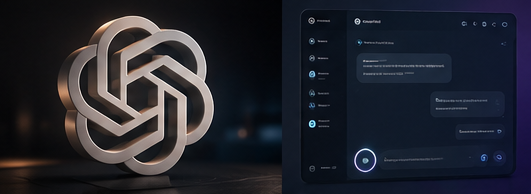
A senior OpenAI employee told the Financial Times that “chat is dead.” Within weeks, ChatGPT will stop being a chatbot and start being a superapp. Coding tools, AI agents, partner integrations with Canva and Booking.com — and a name: Aria. Here is what OpenAI is actually building.
OpenAI’s ChatGPT superapp overhaul is the most significant product restructuring the company has attempted since ChatGPT launched in November 2022. The Financial Times reported that OpenAI is preparing a complete rebuild of ChatGPT — internally codenamed Aria. The changes roll out within weeks. A senior employee summarised the shift in four words. “Chat is dead.” In practice, that means OpenAI is moving from a product that answers questions to a product that executes tasks. The rebuilt ChatGPT will bundle Codex — OpenAI‘s AI coding tool — alongside autonomous agents and integrations with external partners including Canva and Booking.com. Meanwhile, OpenAI is simultaneously abandoning projects it now describes as “side quests” — including narrowing its focus on Sora video generation.
What’s Happening & Why It Matters
Why OpenAI Is Killing the Chatbot
The “chat is dead” declaration reflects a specific revenue insight. OpenAI‘s core product and platform lead Thibault Sottiaux described the direction to FT directly. “It will transcend the actual surface. What we’re building towards is where you have your own personal agent that is capable of helping you across everything in your life, be it personally or at work.” That vision — a personal agent, not a Q&A tool — is the commercial bet behind the entire overhaul.
The numbers driving this decision are clear. OpenAI‘s Codex coding product grew sixfold since February 2026 — reaching more than 5 million weekly users. Business customers using OpenAI‘s tools already account for 40% of revenue. The company wants that proportion to reach 50% by year-end. By contrast, free consumer chat users generate relatively little revenue per user. The superapp pivot steers every ChatGPT session toward higher-value products — coding, agents, and partner services — that convert free users into paying subscribers.
What Aria Will Actually Do

The rebuilt ChatGPT — Aria — will redesign the website and mobile apps simultaneously. The interface steers users toward coding tools and integrated applications. Canva and Booking.com are confirmed as launch partners. Additional integrations with productivity, commerce, and communication platforms are expected before launch. The agent capability is the core innovation. Aria’s agents will complete multi-step tasks autonomously — booking travel, managing files, generating code, and running workflows — without requiring the user to specify each individual action.
Additionally, OpenAI is consolidating multiple separate products into a single interface. Previous standalone offerings — the memory assistant, the image generator, the canvas document tool — now appear as Aria features rather than independent products. As TF covered in its Anthropic Series H article, Anthropic‘s Claude Code grew rapidly on the same coding-as-revenue thesis. OpenAI is now racing to recapture that market with Codex at the centre of its product strategy.
The IPO Context: Commercial Pressure Behind the Pivot
The timing of [OpenAI’s ChatGPT superapp overhaul] is not incidental. OpenAI targets an IPO as early as September 2026. The S-1 it files must tell a story about revenue trajectory, not chat volume. Business clients generate higher and more predictable revenue than individual chat sessions. Agents and coding tools carry commercial contracts that public market investors can model. By contrast, a consumer chatbot — however popular — is a difficult revenue story for institutional investors who compare it to Anthropic‘s $47 billion annualised run rate and Google‘s enterprise AI infrastructure.
Moreover, the overhaul addresses a specific competitive vulnerability. Anthropic‘s Claude Code, Google‘s Antigravity 2.0, and Microsoft‘s MAI-Code-1-Flash all launched in the past three weeks. All three target the same enterprise developer market Aria aims to own. OpenAI invented the consumer AI chatbot. It now needs to prove it can convert that brand recognition into business software revenue before the IPO window closes.
Sora Gets Deprioritised — and Why That Matters

One of the overhaul’s most revealing elements is what OpenAI is stepping back from. Sora — the AI video generation tool launched in early 2026 — is now described internally as a “side quest.” OpenAI will maintain Sora but will not invest additional resources in expanding it. That decision reflects commercial pragmatism. Sora generates enormous press attention. It generates comparatively little business revenue. By contrast, every engineer working on Sora is an engineer not working on Aria. The “chat is dead” declaration is also, implicitly, a “video generation is not the point” declaration.
That deprioritisation carries competitive implications. Google‘s Gemini Omni — launched at Google I/O 2026 — directly targets the video generation market Sora was building. By stepping back from Sora, OpenAI cedes that segment to Google while concentrating on the agent and coding market where it has a stronger defensible position.
TF Summary: What’s Next
The Aria redesign of ChatGPT launches publicly within weeks. No specific launch date has been confirmed. OpenAI will announce partner integrations ahead of the rollout. Sora remains available but receives reduced investment. Codex‘s expansion into the enterprise market accelerates. The IPO timeline — targeting September 2026 — defines the commercial urgency behind every decision.
MY FORECAST: OpenAI’s ChatGPT superapp overhaul will succeed commercially — and that success will be measured entirely in enterprise revenue share, not user growth. Aria’s agent capability is real. The coding revenue trajectory is real. By contrast, the superapp positioning risks one specific failure mode: feature overload. ChatGPT‘s brand value is simplicity and accessibility — the product anyone could use. A superapp bundling travel booking, code generation, and document management requires a user experience sophistication that most consumers do not want from a conversational AI. OpenAI will capture the enterprise market it is targeting. At the same time, a simpler competitor — possibly Apple‘s newly rebuilt Siri AI — will absorb the casual consumer segment that Aria abandons in its pursuit of business revenue.
Related Stories
- Link “Anthropic Series H article” via “as TF covered in its Anthropic Series H article” → https://techfyle.com/anthropic-series-h-funding-round-965-billion-valuation-2026
- Link “Google IO 2026” via “Google’s Gemini Omni — launched at Google I/O 2026” → https://techfyle.com/google-io-2026-gemini-android-developer-announcements
- Link “Microsoft Build 2026” via “Microsoft’s MAI-Code-1-Flash” → https://techfyle.com/microsoft-build-2026-mai-models-project-solara-wearable-ai