



Sam Altman is proposing to give Washington 5% of OpenAI — worth $42.6 billion at the company’s $852 billion valuation. Donated, not sold. Modelled on Alaska’s oil fund. And he wants Anthropic, Google, and Meta to do the same. None of them have agreed to anything yet.
OpenAI’s 5% government equity proposal surfaced through Financial Times reporting, confirmed independently by CNBC and Bloomberg. OpenAI has proposed handing the US government a 5% stake in the company — a holding worth roughly $42.6 billion at OpenAI‘s $852 billion post-money valuation from its March funding round. CEO Sam Altman argued the move was the best way to share the upside of AI with the public. Altman suggested a stake of that size in early discussions with the Trump administration, as part of a arrangement under which Washington would hold 5% of each of the leading US AI developers — potentially including Anthropic, Google, and Meta. By contrast, it’s unclear if those other firms would agree with the proposal. None of them have confirmed involvement. The talks are conceptual — no term sheet, no legal filing, no Congressional action.
What’s Happening & Why It Matters
The Alaska Permanent Fund Model
OpenAI’s 5% government equity proposal rests on a specific structural mechanism. Under the framework described, OpenAI would donate the equity rather than sell it — avoiding a direct cash outlay from taxpayers. The proposed structure echoes the Alaska Permanent Fund — a state-owned corporation seeded with oil revenues that pays annual dividends to residents. As of 31 May 2026, that fund was valued at nearly $91.2 billion. The stake would be transferred to a special government fund, which would receive dividends and then distribute the money — building on an idea OpenAI first floated in April as a “Public Wealth Fund” that would return dividends directly to citizens.

The donation structure is politically significant. A stake the government pays nothing for is easier to defend publicly than a stake purchased with taxpayer funds — and easier for OpenAI to claim generosity rather than a regulatory capture. Additionally, discussions reportedly involved senior Trump administration officials, including Commerce Secretary Howard Lutnick and Treasury Secretary Scott Bessent — though any such arrangement would likely require Congressional approval before becoming binding.
Why Now? Political Pressure Over Altruism
OpenAI’s 5% government equity proposal did not emerge from abstract generosity. OpenAI is seeking to defuse mounting political pressure in Washington. As TF covered in its OpenAI 42-state subpoena article, OpenAI faces active state attorney general investigations into child safety and model sycophancy. As TF covered in its Florida AG lawsuit article, the company faces direct legal action from at least one state. Meanwhile, OpenAI confidentially filed draft IPO paperwork with the SEC in June — though the company has since indicated it has not committed to a listing timeline, with some advisers reportedly weighing a delay until 2027.
By contrast, the equity offer addresses a specific competitive vulnerability TF has tracked extensively. As TF covered in its Claude Fable 5 suspension article, the Trump administration has already demonstrated a willingness to suspend a rival frontier lab’s flagship model on national security grounds. OpenAI is offering the government a direct financial stake precisely as the White House regulates the rollout of advanced models such as Anthropic‘s Mythos-class systems.
The Sanders Connection
OpenAI’s 5% government equity proposal arrives one week after Senator Bernie Sanders introduced legislation TF covered in detail in its Sanders AI Sovereign Wealth Fund article. Sanders proposed a 50% one-time stock tax on AI companies with over $200 million in annual revenue — a $7 trillion sovereign wealth fund paying every American over $1,000 annually. Altman has had direct conversations with Sanders, according to the FT. Sanders publicly endorsed a similar proposal for public equity in AI companies — while pushing for a considerably more expansive 50% version through his own legislation.
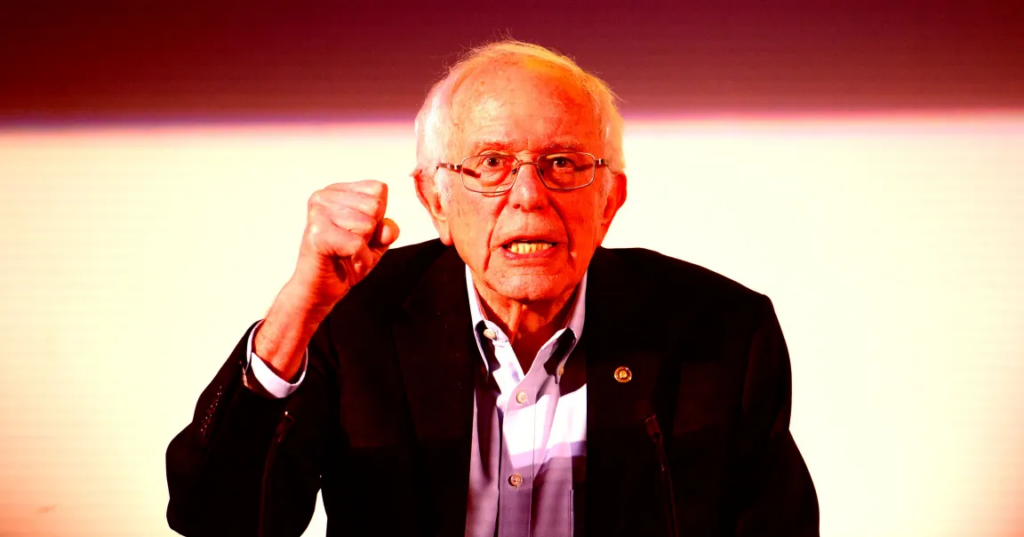
The gap between OpenAI’s proposed 5% and Sanders’ proposed 50% defines the entire political negotiating space TF flagged in its earlier coverage. OpenAI‘s offer functions as a pre-emptive counter-proposal — establishing a much smaller number as the “reasonable” outcome before Congress can seriously entertain Sanders’ far larger ask. Every future negotiation over AI equity redistribution has two anchoring points: OpenAI’s voluntary 5% and Sanders’ compulsory 50%.
The Government’s Existing Equity Precedent
OpenAI’s 5% government equity proposal is not unprecedented within the current administration’s industrial policy. The Trump administration previously took stakes in private companies — investing in Intel Corp, IBM, and other quantum and critical-mineral companies during the president’s second term. As TF covered in its Apple-Intel chip deal article, the US government holds approximately a 10% stake in Intel — a position that grew from roughly $8.9 billion to more than $60 billion in nine months.
By contrast, an equity stake in a private AI company operating at OpenAI‘s scale and political sensitivity is categorically different from a stake in a legacy semiconductor manufacturer. Intel‘s government stake addressed concerns about national manufacturing capacity. A government stake in OpenAI creates a direct financial interest in the commercial success of a company whose products the same government is simultaneously regulating for safety and national security risk — a structural conflict that critics on both sides of the aisle will scrutinise closely.
TF Summary: What’s Next
No formal term sheet or legal filing has been produced. Anthropic, Google, and Meta have not publicly responded to being named as potential participants. Any binding arrangement would require Congressional approval. OpenAI declined to comment to the FT on the specifics. Reports describe some discussions of a smaller stake — as low as 1% — suggesting the 5% figure may not be final.
MY FORECAST: OpenAI’s 5% government equity proposal will not be adopted in its current form — the Congressional approval requirement, combined with the unresolved conflict-of-interest concerns, makes swift implementation unlikely. By contrast, some version of donated AI equity to a public fund will advance within 18 months, because the political pressure driving the proposal is not going away. OpenAI needs a defensible answer to Sanders-style redistribution arguments before its eventual IPO reaches public investors. A voluntary, modest, donated stake — 1% to 5%, structured through a fund resembling the Alaska model — is the outcome that satisfies both OpenAI’s commercial interests and the bipartisan political appetite needed to pass. Whether Anthropic, Google, and Meta follow depends entirely on whether refusing is more politically costly than participating — a calculation that is very different in 12 months than it does today.
Related Stories
- Bernie Sanders Introduces $7 Trillion AI Public Ownership Bill
- Anthropic’s Fable 5 Full Restoration
- OpenAI Subpoenaed by 42 States — and a UK Lab Is Scanning Children’s Brains to Find Out Why