


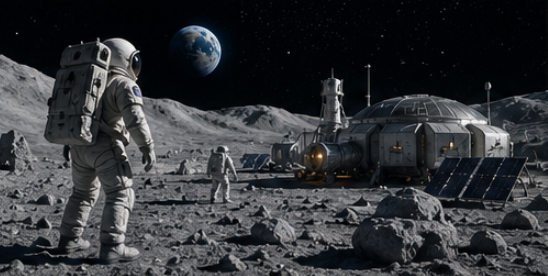
Astrobotic, Firefly, and Intuitive Machines will land four science payloads on the Moon by late 2028. This is Phase 1 of a permanent lunar base NASA still won’t put a total price tag on — despite a leaked internal estimate of $20 billion just for the base alone, before Mars.
NASA’s $590 million lunar lander contracts were announced — the latest concrete step in an ambitious Moon Base programme that agency officials conceptualised only months earlier. NASA selected three commercial space companies to deliver four robotic science missions to the lunar surface in late 2028. Astrobotic, Firefly Aerospace, and Intuitive Machines will carry out the deliveries under NASA‘s Commercial Lunar Payload Services (CLPS) initiative — the mechanism NASA has used since 2018 to buy transportation to the lunar surface from private companies rather than building its own landers. Astrobotic received $297.9 million for two deliveries — the only company awarded more than one mission. Firefly received $144.2 million and Intuitive Machines received $148.3 million, each for a single delivery. NASA called it “Phase 1” of a plan to build a permanent lunar settlement where astronauts will eventually live and work.
What’s Happening & Why It Matters
What the Four Missions Carry
NASA’s $590 million lunar lander contracts each carry a specific and consistent scientific payload. Each delivery carries three NASA instruments. The first is the Stereo Camera for Lunar Plume Surface Studies (SCALPSS) — an array of four cameras using stereo photogrammetry to produce a 3D view of how a lander’s engine exhaust disturbs lunar dust during descent. The second is a Laser Retroreflector Array (LRA) — a passive, cookie-sized device requiring no power that is laser beams from orbiters or landing spacecraft to help them navigate. The third is a radiation monitor.
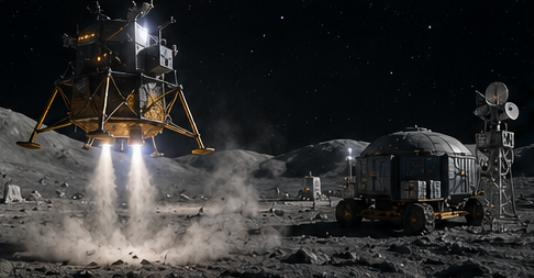
The dust research specifically addresses a documented operational problem. NASA Moon Base programme executive Carlos García-Galán explained that landing sites currently are approximately 1.5 miles (2.4 km) apart to avoid engine plume damage to nearby equipment — without data on the phenomenon. As NASA plans multiple landings in quick succession near a shared base site, understanding and mitigating that dust disturbance is operationally essential rather than merely scientifically interesting.
The Total Cost Question
NASA’s $590 million lunar lander contracts arrive alongside a persistent and unresolved transparency problem. NASA has not disclosed what its broader Moon-to-Mars programme will cost taxpayers — a question the agency has not answered for more than a month. Administrator Jared Isaacman gave no total cost estimate at a 26 May briefing despite direct questions from reporters. NASA has not updated a $20 billion, seven-year cost estimate Isaacman gave in March for building the lunar base alone — a figure that does not include the broader Moon-to-Mars programme.
Additionally, the transparency gap arrives one week after NASA‘s own Office of Inspector General reported that contract values on four cancelled or repurposed Artemis systems more than doubled — from $2.8 billion to $5.9 billion. A 2024 inspector general audit found lunar delivery costs had already risen to approximately $1.2 million per kilogram — a 20% increase from NASA’s original 2019 estimate. Against that documented history of cost escalation, the agency’s silence on a comprehensive Moon-to-Mars total is a specific and legitimate concern for Congressional oversight.
Two Successes, Two Tip-Overs, One Failure
NASA’s $590 million lunar lander contracts rest on a commercial track record that is genuinely mixed. All three selected companies have attempted uncrewed moon landings since 2024. Only Firefly‘s Blue Ghost lander successfully touched down intact and upright — in March 2025, the first private company to achieve that feat. Astrobotic‘s Peregrine mission failed in Earth orbit shortly after launch in January 2024. Intuitive Machines‘s Nova-C lander reached the surface in February 2024 but tipped over — an outcome repeated in a second attempt in 2025, which scuttled the science objectives for most of its onboard payloads.
By contrast, García-Galán called the mixed record as intentional strategy rather than failure. NASA plans to fly upgraded versions of each company’s existing lunar landers to increase mission frequency and improve reliability — treating each attempt as an iterative learning opportunity rather than requiring perfection before scaling. “We’re building a proving ground for Moon Base operations,” said Ryan Stephan, NASA’s Moon Base acting director of cargo landers. “Accelerating our Moon mission ordering cadence and launch opportunities enable us to move quickly to learn, iterate, and improve.” That philosophy accepts a higher failure rate in exchange for faster iteration — a trade-off NASA is betting will produce reliable systems faster than waiting for each mission to succeed before ordering the next.
An Acquisition — and the China Race Driving Urgency
One detail complicates Astrobotic‘s largest-ever award. Astrobotic is currently in the process of being acquired by Voyager Technologies — a deal pending regulatory approval and expected to close in July 2026, the same month the new contracts take effect. NASA proceeded with the award despite the pending ownership change — a signal of confidence in the underlying technical team regardless of the corporate transition.
The urgency driving NASA‘s accelerated Moon Base cadence is explicitly geopolitical. Isaacman told lawmakers in April the US-China lunar competition “could be decided in months, not years” and warned that China aims to reach the lunar surface before the end of the decade. García-Galán delivered a direct message to industry at the Space Symposium conference in April. “If you are in industry and wondering if you need to make that investment to increase your high bay, to increase the number of supply chain vendors that you have — this is the signal to say: we’re here to stay with this demand, and we’re building a moon base.”
The Blue Origin Complication
NASA’s $590 million lunar lander contracts arrive amid a separate setback for NASA‘s broader lunar plans. Blue Origin was set to deliver a prototype of its massive robotic lander, Blue Moon, to the lunar south pole. By contrast, Blue Origin suffered a major setback in May when a New Glenn rocket exploded on the launchpad, destroying infrastructure that will take months to rebuild. García-Galán hinted the Blue Moon lander may launch on a different vehicle if needed, saying NASA is “looking at other options” should Blue Origin‘s recovery timeline not meet the agency’s schedule. That contingency planning underscores how NASA‘s accelerated multi-vendor CLPS strategy is specifically designed to prevent any single company’s setback from stalling the entire Moon Base timeline.
TF Summary: What’s Next
The four newly awarded missions launch to the lunar surface in late 2028. NASA has lined up 17 commercial lunar surface deliveries across multiple providers. The agency plans to solicit additional proposals for a power and avionics technology demonstration, another science manifest, and a South Pole optical imager. NASA is considering repurposing an engineering development version of a Mars rover — nicknamed PROMISE — for lunar surface characterisation. Phases 2 and 3 of the Moon Base programme, covering pressurised habitats and power generators, target the 2030s.
MY FORECAST: NASA’s $590 million lunar lander contracts will produce at least one additional landing failure among the four missions — consistent with the sector’s current track record, where only one of six prior CLPS attempts by the three companies has fully succeeded. By contrast, that failure rate will not slow NASA‘s cadence; the agency’s explicit strategy treats iteration speed as more valuable than individual mission success given the geopolitical race against China. The unanswered total-cost question is a genuine political liability before the end of 2026. Congress cannot indefinitely approve incremental $590 million and $1 billion tranches without a comprehensive Moon-to-Mars budget, particularly with the Inspector General’s own report already documenting contract values doubling on cancelled Artemis systems. Expect a formal Congressional hearing demanding a total programme cost estimate before Isaacman’s next major funding request.
Related Stories
- SpaceX Goes Public — the Largest IPO in Stock Market History
- Space Racers: Impulse’s Big Raise, Blue Origin’s Timeline, and SpaceX Starfall
- China Tops Global Supercomputer Rankings and Opens the World’s First Underwater Data Centre