


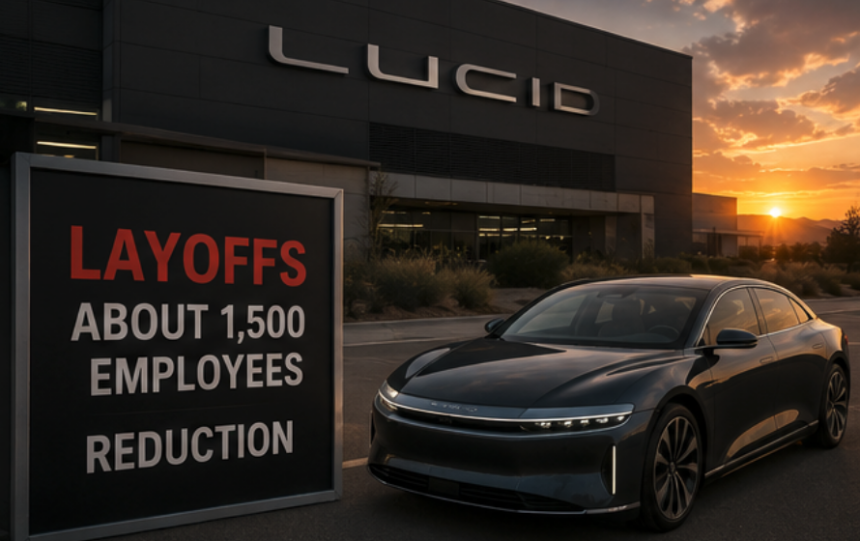
In February, Lucid cut 12% of its workforce. On 22 June, it cut another 18%. Combined, that is roughly 2,500 people gone in four months. The company eliminated its second production shift in Arizona. The new CEO has been in the job for three weeks. The EV market is cooling. This is not a restructuring. It is a survival move.
Lucid executed its second mass layoff of 2026 — and the numbers confirm what the stock price had been signalling all year. Lucid Motors is laying off 18% of its workforce, or around 1,500 employees, just four months after the EV maker cut 12% of its staff. Additionally, the company eliminated the second shift of EV production at its factory in Casa Grande, Arizona.
The cuts are the first formal action by new CEO Silvio Napoli — who only took the role officially on 1 June 2026. The company is betting its turnaround on two upcoming mass-market electric crossovers, the Cosmos and the Earth.
The Cosmos, expected to start around $50,000, will rival the Tesla Model Y and the Rivian R2, with production slated to begin before the end of the year. Meanwhile, Lucid shares had already fallen roughly 49% in 2026 through June 18 as investors assessed weakening EV demand, higher operating costs and uncertainty surrounding future production levels.
What’s Happening & Why It Matters
30% of the Workforce in Four Months
Lucid’s second mass layoff of 2026 is not a standalone event. This is Lucid’s second round of layoffs in 2026, following a 12% workforce reduction in February. Restructuring among EV startups is nothing new, but few have had to move fast or often. The combined impact is stark. At the end of 2025, the company employed about 9,000 people, suggesting that the combined measures could eliminate approximately 2,500 positions. That is roughly 28% of the company’s entire workforce eliminated in a single calendar year — before summer ends.
The financial rationale is specific. The cuts are expected to generate annualised savings of around $158 million. Additionally, Lucid will pay approximately $32 million in severance. The company’s own spokesperson said it plainly. “These are difficult decisions taken to align production with demand, reduce inventory, and adapt to declining market conditions.” That language — “declining market conditions” — is a different register from the growth narrative Lucid maintained through 2025.
A New CEO… From the Elevator Industry?
Lucid’s second mass layoff of 2026 is simultaneously the first significant decision by a CEO with no automotive background. Napoli is an unusual pick to run an EV startup. He spent his career at Schindler Group, the Swiss maker of elevators and escalators, where he served as chairman and CEO. The appointment is a deliberate signal. Lucid‘s majority owner — Saudi Arabia’s Public Investment Fund (PIF) — decided that automotive industry expertise was less important than operational execution capability and cost discipline. By contrast, cutting 18% of the workforce three weeks into the job suggests Napoli arrived with a clear mandate. He was not sent to build. He was sent to restructure.
COO Marc Winterhoff — who served as interim CEO until Napoli’s arrival — has departed. The COO position itself has been eliminated. The executive layer is being simplified alongside the workforce.
The Arizona Factory — Second Shift Eliminated
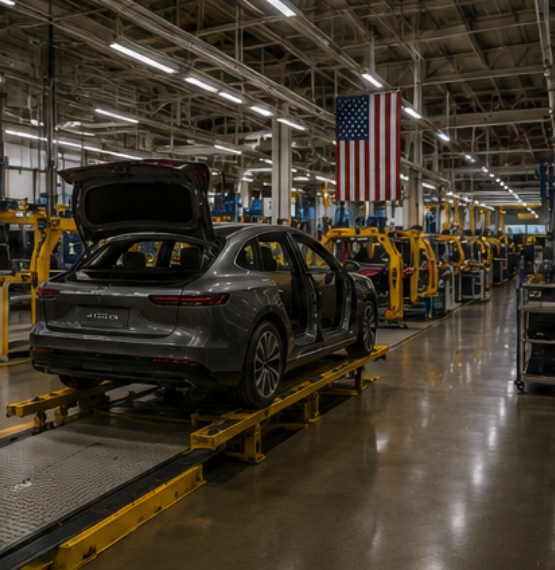
The production change is as significant as the headcount reduction. Lucid eliminated the second production shift at its AMP-1 factory in Casa Grande, Arizona — its primary US manufacturing facility. Running two production shifts signals expansion. Eliminating one signals contraction. Combined with the 1,500 job cuts, the factory change confirms that Lucid is no longer producing at a pace that justifies its current operational footprint.
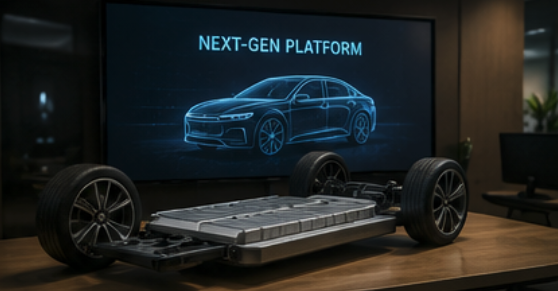
Additionally, the company is evaluating the timing of production for vehicles based on its upcoming midsize EV platform. Lucid had previously planned to begin production of those models in late 2026, although management has indicated that manufacturing plans are under review. That “under review” language is the most concerning element for investors. The Cosmos — Lucid‘s mass-market bet — was announced as the company’s path to volume. If its production timeline slips, the entire financial case for the restructuring weakens.
The Saudi Backstop — the Reason Lucid Survives
Lucid’s second mass layoff of 2026 is sustainable in a way that similar cuts at other EV startups were not. Lucid is majority-owned by Saudi Arabia’s Public Investment Fund, which has poured billions into keeping the company alive. That backstop is the only reason Lucid can absorb two mass layoffs in a single year without an existential crisis.
By contrast, the PIF’s patience is not infinite — and the 2026 pattern tests it. A 12% cut in February, an 18% cut in June, a killed production shift, a revolving door of executives, and a CEO from the elevator business trying to “simplify” a company that has never come close to its production targets. The PIF is one of the world’s most sophisticated sovereign investors. It will evaluate Lucid against its other portfolio companies — including Uber, Noon, and its Saudi industrial holdings — and it will make the eventual exit decision accordingly.
US EV Demand Cooling
Lucid’s second mass layoff of 2026 is a sector condition that goes beyond Lucid‘s own execution challenges. The layoffs come as the electric vehicle market in the United States has cooled, with major automakers pulling electric models from their own product plans. Ford, General Motors, and Volkswagen all delayed or cancelled electric vehicle programmes in 2025 and 2026.
The commercial challenge Lucid faces in 2026 is structural — it must launch a mass-market vehicle at $50,000 during a period when even Tesla Model Y demand is softer than peak 2022 levels.
Timing the Cosmos launch correctly — neither too early before the factory is ready, nor too late after competitors capture the segment — is the decision that will determine whether Napoli’s restructuring produces a sustainable company or merely a smaller one.
TF Summary: What’s Next
The restructuring is expected to complete by Q3 2026. Lucid will pay $32 million in severance. The COO role is permanently eliminated. Cosmos production timing is “under review.” The Earth — the second mass-market vehicle — follows by the end of 2027 under the current plan. Napoli will present his full strategic vision at Lucid‘s next investor event.
MY FORECAST: Lucid’s second mass layoff of 2026 will be the last large-scale workforce reduction before the Cosmos launch — or it will be followed by a third cut if the Cosmos launch slips past Q1 2027. The $50,000 crossover is the company’s entire financial thesis. Without it generating meaningful volume — at least 10,000 to 15,000 units in the first 12 months — the PIF will face a decision it has thus far avoided.
The restructuring savings of $158 million annually are real, but they do not change Lucid‘s fundamental challenge: it is a very expensive company to operate at very low production volumes. A CEO from the elevator business will apply manufacturing efficiency discipline. The question is whether that discipline can produce a competitive vehicle launch at a competitive price in a market where Tesla has spent years driving costs down and Chinese EV makers are preparing to enter the US market. Lucid’s window is not closing. It is already narrow.
Related Stories
- Tesla Roadster Delayed Again — Demo Now August
- NHTSA Probes Tesla FSD After Drivers Crashed Into Homes and Pools
- 2027 Audi Q7 and SQ7 Revealed: 591 HP, 3.7 Seconds, No Hybrid