


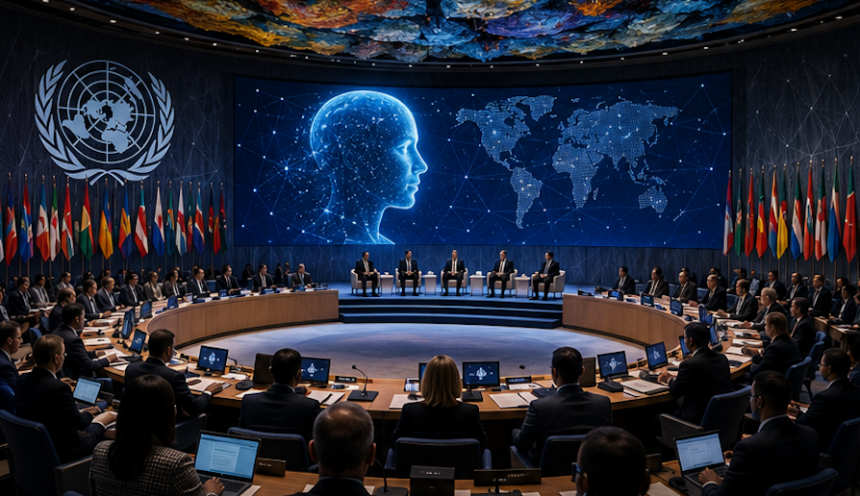
Two nations control roughly 90% of the world’s AI supercomputing capacity. The other 191 UN member states showed up in Geneva anyway. A scientific panel warned no technical guarantee of AI safety currently exists. And 118 mostly Global South countries are locked out of the most important conversations.
The UN Global Dialogue on AI Governance convened in Geneva on 6–7 July, followed immediately by the AI for Good Global Summit from 7–10 July — together drawing more than 12,000 participants from 170 countries, a new visitor record for the summit. Delegates from all 193 UN member states gathered for the first time to discuss binding international AI governance. Secretary-General António Guterres framed the stakes directly: “The question is whether we will govern [the] transformation together — or let it govern us.” By contrast, an independent UN scientific panel released its preliminary global assessment two days before the summit opened, concluding that AI capabilities are accelerating faster than any government’s ability to regulate them — and that no technical guarantee currently exists that the most advanced systems will follow the instructions they are given.
What’s Happening & Why It Matters
The Compute Concentration Problem
The UN Global Dialogue on AI Governance operates against a specific and structurally uncomfortable fact. The United States accounts for approximately 75% of global AI supercomputing capacity; China holds roughly 15%. Together, two nations control nearly all the physical infrastructure on which frontier AI systems are trained and run. That means the other 191 UN member states — the overwhelming majority of the delegates in Geneva — lack the independent compute capacity to audit, evaluate, or stress-test the world’s most capable AI systems.
By contrast, any governance framework agreed in Geneva depends, for its technical enforcement, on the cooperation of the two nations that built and operate the systems being governed. That dependency is the unstated implication shaping every session on the agenda — a UN process attempting to build consensus among 193 countries when meaningful technical leverage is almost entirely with two of them.
The Global South —118 Countries — Exclusion Problem

The UN Global Dialogue on AI Governance was explicitly designed to address a documented participation gap. According to UN Trade and Development, 118 countries — predominantly in the Global South — are not engaged in major AI governance discussions. Co-chair Egriselda López, El Salvador’s ambassador to the UN, called the summit’s purpose at a press conference: “This is not another meeting about technology. It is definitely the beginning of a global process to answer the most important questions of our time.”
Fellow co-chair Rein Tammsaar, Estonia’s UN ambassador, described the fragmentation problem the Dialogue aims to solve. “The global AI [sector] is very, very fragmented,” he said, envisioning the Geneva gathering as a “Dialogue of the dialogues.” Additionally, previous AI summits — Bletchley Park in 2023, Seoul in 2024, New Delhi’s AI Impact Summit earlier in 2026 — were each convened by individual host governments, inviting a curated group of participants. Geneva marks the first time every UN member state has a guaranteed seat at the table.
Guterres’ Environmental and Child Safety Priorities
The UN Global Dialogue on AI Governance produced two specific policy calls TF has covered in detail separately. As TF reported in its UN AI Child Safety Pledge article, Guterres called for nations to adopt an AI Child Safety Pledge, insisting “when a child is harmed, the answer must never be ‘the algorithm did it.'” He renewed his transparency demand from Guterres’ AI Environmental Transparency Initiative, warning that data centres could consume more electricity than all but five nations by 2030 — “enough water to meet the needs of all 1.3 billion people in sub-Saharan Africa for an entire year.”
By contrast, Guterres noted the accessibility gap as equally urgent to the safety questions. “We cannot allow the digital divide to harden into an AI divide and the AI divide to become a development gap, a security gap, and a sovereignty gap,” he said. The perspective links AI governance to the compute concentration problem — countries without infrastructure access face compounding disadvantage across every dimension of the technology’s rollout.
The AI for Good Global Commission

The UN Global Dialogue on AI Governance produced one concrete institutional outcome: the launch of the AI for Good Global Commission on 1 July, co-chaired by Salesforce CEO Marc Benioff and Rwandan President Paul Kagame. Members include NVIDIA’s Jensen Huang, Amazon’s Andy Jassy, Microsoft’s Brad Smith, and Anthropic co-founder Jack Clark — representing the most senior gathering of AI executives and heads of state ever assembled under a single UN governance body.
That commission structure is the summit’s core tension directly. Governments cannot deliver effective AI governance alone, López and Tammsaar both stressed — but embedding the CEOs of the companies building frontier AI directly into the governance body they are meant to be regulated by raises its own accountability questions. As TF covered in its Meta KOSA immunity article, the same tension between corporate self-regulation and binding external accountability is playing out simultaneously in US domestic legislation.
TF Summary: What’s Next
The Global Dialogue on AI Governance reconvenes for a second session in New York in May 2027. The newly launched AI for Good Global Commission begins its ongoing work following the July gathering. No binding treaty or enforcement mechanism emerged from the Geneva sessions — the process is consultative. The scientific panel’s preliminary risk assessment will be developed further ahead of the New York session.
MY FORECAST: The UN Global Dialogue on AI Governance will produce meaningful diplomatic language but no binding compute-sharing or audit mechanism by the New York session in 2027 — the structural dependency on US and Chinese cooperation for technical enforcement is not something a UN resolution can override. By contrast, the AI for Good Global Commission’s mixed CEO-head-of-state membership will generate its own accountability debate well before any governance framework matures; expect civil society groups to challenge the commission’s legitimacy directly, given how closely its private-sector members overlap with the companies any eventual framework would need to constrain. The 118-country exclusion figure is the number to watch — meaningful progress by 2027 means that figure shrinking substantially, not just more summit attendance from countries still lacking genuine technical participation.
Related Stories
- UN’s AI Child Safety Pledge — Guterres Calls for Accountability in Geneva
- 40 Mayors Demand Standards for AI Data Centres — the UN Wants Transparency Too
- China Tops Global Supercomputer Rankings and Opens the World’s First Underwater Data Centre