


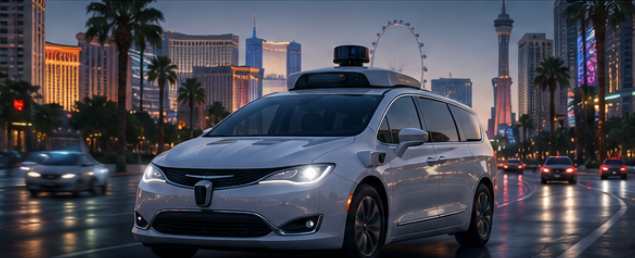
San Diego, Las Vegas, Tampa, and Denver just flipped from supervised testing to fully driverless. No safety specialist. No human backup. Waymo operates in more than 10 cities, targeting 1 million weekly rides by year-end — while Tesla’s entire Austin fleet is still at roughly 20 cars.
Waymo’s four-city driverless expansion was confirmed on 8 July 2026 — a single announcement that converts months of supervised testing into commercial autonomous service across an entire region simultaneously. Alphabet‘s robotaxi division will start offering fully autonomous rides in San Diego, Las Vegas, Tampa, and Denver, the company confirmed. The launch begins with Alphabet employees before extending to the public in the coming weeks. Waymo, which first announced these expansion plans last year, currently operates driverless cars in more than 10 cities. The company operates a fleet of roughly 3,500 robotaxis and has surpassed 20 million trips total. Waymo is targeting 1 million weekly rides by the end of 2026 — a figure co-CEO Tekedra Mawakana has called an “inflexion point” for the business.
What’s Happening & Why It Matters
Testing to Live Service
Waymo’s four-city driverless expansion represents a specific and consequential operational shift, not simply new geography. Waymo has been testing in these four markets with human safety operators behind the wheel for months. Flipping to fully driverless — what Waymo calls “autonomous mode activated” — is the milestone that converts a test programme into a genuine commercial robotaxi service. In Las Vegas specifically, vehicles began running “with no human at the wheel” the day of the announcement, with Denver, San Diego, and Tampa confirmed to follow shortly after.
By contrast, public access is staggered. Rider-only trips begin with Waymo employees, with service expected to expand to the general public in the coming months. Interested riders in all four cities can already download the Waymo app to be notified when public access opens — a graduated rollout approach that lets the company manage demand and maintain quality control before fully opening.
Four Cities’ Hurdles: Weather, Regulation, and Geography
Waymo’s four-city driverless expansion targets markets chosen for specific strategic reasons beyond simple population size. Denver occupies a particularly important role in Waymo‘s surge into colder climates. Among the vehicles slated for the city is the Ojai — a purpose-built SUV running Waymo‘s sixth-generation Driver system, engineered specifically for snowier road conditions. To prepare that software, Waymo conducted extensive training runs across the Sierra Nevada, Michigan, and New York regions.
The regulatory pattern behind Waymo‘s 2026 expansion map is notable. States and cities that have created clear legal pathways — California, Arizona, Texas, Florida, Nevada, and Colorado — are precisely where Waymo has built commercial momentum. States that have not, including Massachusetts, New York, and Washington, are notable absences from the expansion map despite having large, transit-hungry urban populations.
The Fleet: 3,500 Vehicles and a New Hyundai Deal
Waymo’s four-city driverless expansion is supported by a rapidly diversifying vehicle fleet. Alongside the city expansions, Waymo confirmed it has begun driving the Hyundai Ioniq 5 autonomously with a specialist present — a validation phase ahead of fully driverless operation on the new platform. Hyundai is reportedly planning to supply Waymo with 50,000 Ioniq 5 vehicles by 2028 in a deal valued at roughly $2.5 billion — one of the largest vehicle supply agreements in autonomous driving history.
That fleet expansion follows Waymo‘s $16 billion Series funding round earlier this year at a $126 billion valuation — the largest investment ever in an autonomous vehicle company, raised specifically to fund this kind of aggressive multi-city expansion. Additionally, Waymo launched a paid membership tier called Waymo Premier in June — a $29.99-per-month subscription offering priority pickups and fare credits to frequent riders.
Tesla, Zoox Still Counted in Dozens of Cars
Waymo’s four-city driverless expansion widens an already substantial lead over its US domestic rivals. Tesla launched its Robotaxi service in Austin in June 2025 and has since expanded to Dallas, Houston, and Miami — as TF covered in its Tesla Miami launch article — but the fleet is tiny, roughly 20 driverless vehicles covering about 245 square miles of the Austin metro, according to third-party tracking data. Tesla has tied any major fleet expansion to the release of Full Self-Driving v15, targeted for late 2026 or early 2027.
By contrast, Zoox — as TF covered in its Zoox redesign article — is in pre-commercial testing pending approval of its own NHTSA exemption. Waymo is adding entire cities to its driverless network on a near-monthly basis, while its two closest domestic competitors are measured in dozens of vehicles rather than thousands.
The Safety Data Backing the Expansion
Waymo’s four-city driverless expansion rests on a documented safety record the company cites to support its aggressive scaling. A recent safety study analysing more than 220 million fully autonomous miles found Waymo vehicles were involved in 94% fewer crashes causing serious or fatal injuries, 82% fewer crashes involving deployed airbags, and 82% fewer crashes involving any reported injury, compared with human drivers.
By contrast, operational challenges have accompanied the growth. As TF covered in its Waymo recall article, flooding incidents and a Fourth of July weekend cluster of San Francisco vehicles that sat gridlocked long enough to exhaust their batteries have both drawn scrutiny. The core economic challenge is unresolved, too — running fully driverless operations across 14-plus markets is genuinely expensive, and achieving 1 million weekly rides is a hard number to meet even with Waymo’s current momentum.
TF Summary: What’s Next
Public access in San Diego, Las Vegas, Tampa, and Denver opens on a rolling basis over the coming weeks and months. Waymo targets 1 million weekly trips across more than 20 cities by the end of 2026. London is on the 2026 calendar as Waymo‘s first international market, with test drives already underway. The Hyundai Ioniq 5 validation phase continues ahead of its own fully driverless rollout.
MY FORECAST: Waymo’s four-city driverless expansion will reach its 1 million weekly rides target by year-end, but the timeline will run close — the operational and battery-management issues TF has documented in San Francisco suggest scaling friction that compounds as fleet size grows. By contrast, the competitive gap with Tesla and Zoox will widen before either rival meaningfully closes it. Tesla’s fleet expansion depends entirely on FSD v15 shipping on schedule — a dependency that has slipped before. The Hyundai Ioniq 5 deal is the more consequential long-term story: 50,000 vehicles by 2028 give Waymo the manufacturing scale to genuinely compete with human-driven ride-hailing on price, not just novelty.
Related Stories
- Tesla Robotaxis Are Now Live in Miami — Rain Is the Real Test
- Waymo Recalls 3,871 Robotaxis — the Third Major Recall in 14 Months
- Amazon’s Zoox Redesigns Its Robotaxi for Commercial Launch