


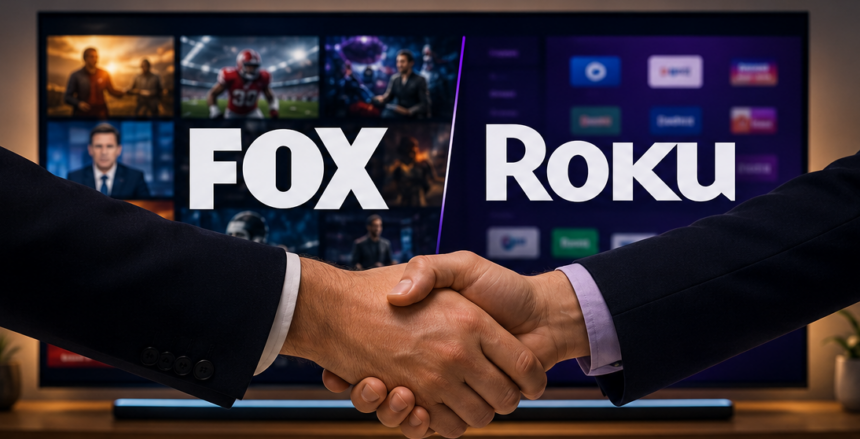
Fox is buying Roku for $160 a share — $96 in cash, the rest in Fox stock. Roku reaches 100 million households. Combined with Tubi, Fox is the third-largest player in US television. Six years ago, Fox sold its Roku shares at $58 to fund the Tubi deal. Today’s irony is not lost on anyone.
The Fox-Roku acquisition announced changes the competitive landscape of US television in a single transaction. Fox Corporation agreed to acquire Roku for $160.00 per share — a mix of $96.00 in cash and 0.9693 shares of Fox Class A common stock per Roku share. The deal values Roku at approximately $22 billion in enterprise value. Fox CEO Lachlan Murdoch called it “a defining moment” for the company. The boards of both companies approved the transaction unanimously. By contrast, the combination’s significance extends well beyond the price tag. Fox pairs its live sports and news dominance with Roku‘s connected TV platform — reaching more than 100 million households globally, including more than half of all US broadband homes.
What’s Happening & Why It Matters
The Deal Structure — and How Fox Pays for It
The Fox-Roku acquisition combines cash and stock in a structure designed to preserve Fox‘s financial position. Each Roku share converts into $96.00 cash plus 0.9693 Fox Class A shares — together valued at $160.00. Fox secured $12 billion in fully committed bridge financing from Morgan Stanley Senior Funding, funding the cash portion alongside existing cash reserves. Murdoch emphasised the company’s discipline directly. “We are executing this acquisition from a position of financial strength — maintaining our investment grade balance sheet while providing our shareholders with an uninterrupted return of capital program.”
Large acquisitions often force buyers to suspend dividends or buybacks. Fox is telling shareholders the deal does neither. Furthermore, the structure signals confidence — Fox is betting its own stock will hold value through the transaction, since Roku shareholders receive a meaningful equity stake in the combined company.
Why Roku?
The strategic logic behind the Fox-Roku acquisition is straightforward on paper. Fox owns Tubi, a free ad-supported streaming service. Roku owns The Roku Channel and — critically — the operating system running on a large share of America’s smart TVs. By contrast, Tubi has no hardware foothold. Combining the two gives Fox direct access to first-party viewer data and the device-level relationship Roku has built with over 100 million households.
LightShed Partners analyst Rich Greenfield had identified Fox as a likely Roku acquirer just days before the announcement. His status captured the strategic shift precisely. “Given how tied Fox is to the legacy TV ecosystem, a Roku acquisition would enable Fox to meaningfully reposition its narrative with investors toward a streaming future.” Additionally, Greenfield noted a striking historical detail. Fox sold its 6 million Roku shares at $58 back in 2020 — using the proceeds to help finance its acquisition of Tubi. Buying Roku back, at $160 per share, closes that loop in a way Greenfield called genuinely “ironic.”
The Roku Channel’s Position — Fifth, Not First
Roku‘s market position deserves accurate review. According to Nielsen, The Roku Channel commands 3% of all US streaming viewership — placing it fifth overall, behind YouTube, Netflix, Disney, and Amazon‘s Prime Video. By contrast, Roku’s real value lies elsewhere. The platform is a primary access point for viewers opening Netflix and YouTube on their televisions — meaning Roku captures advertising and data value from traffic flowing to competitors’ apps. That gatekeeper position, not the Roku Channel’s content library, is the asset Fox is buying.
Roku‘s advertising business reinforces that point. The company generated $613 million in advertising revenue in Q1 2026 alone — up 27% year-on-year, according to Reuters. Adding Roku‘s audience to Fox‘s targeted advertising operation is expected to boost ad revenue meaningfully across the combined company.
Third-Largest in US Television — What That Actually Means
The Fox-Roku acquisition creates what both companies describe as the third-largest player in US television by share of viewing — spanning broadcast, cable, local, and streaming combined. That ranking places the combined Fox–Roku entity behind only the largest legacy media conglomerates and Disney. Fox‘s existing portfolio includes FOX News Media, and broadcast rights to major sports including the NFL and MLB. By contrast, Roku‘s strength is entirely in streaming — making the combination a genuine bridge between legacy broadcast strength and the connected-TV future every media company is racing toward.
Roku will continue operating as a standalone platform under Fox ownership, according to the companies’ statement. That preservation strategy mirrors how successful media acquisitions typically retain a target’s brand and operational independence while integrating data, advertising, and content distribution at the corporate level.
TF Summary: What’s Next
The Fox-Roku acquisition requires shareholder approval from both companies and standard regulatory clearance. Given the scale — $22 billion in enterprise value, spanning television, streaming, and advertising markets — antitrust review will examine the combined company’s market position carefully. Both boards have already approved the transaction unanimously. No specific closing date has been announced. Roku shares fell slightly and Fox Class A shares dropped sharply on the announcement — a reaction typical of stock-and-cash acquisitions, where the acquirer’s shares often dip on dilution concerns.
MY FORECAST: The Fox-Roku acquisition will close within 9 to 12 months, pending regulatory review. The deal’s structure — preserving Roku’s brand, maintaining Fox’s dividend program, and combining first-party data with live sports content — addresses the two biggest risks in media M&A: brand dilution and balance sheet strain. By contrast, the more interesting question is competitive response. Comcast, Paramount, and Warner Bros. Discovery all face the same structural problem Fox just solved — legacy broadcast strength with no direct connected-TV hardware relationship. Expect at least one of those companies to pursue a comparable acquisition — targeting a smaller connected-TV platform — within 12 months. Fox just demonstrated the playbook. The remaining question is who has the balance sheet to follow it.