



96% on the benchmark. 12 points ahead of Anthropic’s Mythos. Half the cost of Microsoft’s previous offering. And the honest admission underneath the marketing: for the hardest 10% of cases, Microsoft’s own system still hands the problem to OpenAI’s model to solve.
Microsoft’s AI security tools launched in San Francisco. The company unveiled two new products to strengthen its position in the crowded AI cybersecurity field. The first, MAI-Cyber-1-Flash, is Microsoft’s first dedicated cybersecurity-specialised model, built specifically to find and analyse software vulnerabilities. Paired with the company’s existing MDASH security framework, the combined system scored 95.95% on the CyberGym benchmark — a figure Microsoft says outperforms rival configurations from Google, Anthropic, and OpenAI by more than 10 percentage points, and beats Anthropic’s Mythos specifically by 12 points. The second announcement, Project Perception, is an agentic security system built from specialised AI agents performing red-, blue-, and green-team functions — finding vulnerabilities, assessing their risk, and taking corrective action respectively. Microsoft shares rose roughly 3% following the announcement.
What’s Happening & Why It Matters
Tool Set Is Half the Cost
Microsoft’s AI security tool launch centres its pitch around price as much as raw benchmark performance. The new MDASH costs half as much to use as the previous MDASH offering, according to Microsoft. Mustafa Suleyman, Microsoft AI CEO, was direct about the underlying strategy. “The whole game here is to reduce the costs,” he said. “GPT-5.6 is expensive. GPT-5.4 is incredibly good relative to its cost. Mythos and so on are extremely expensive models… we want to be able to deliver better performance for cheaper. That’s what customers want.”
By contrast, that cost-optimisation strategy reveals a genuinely notable architectural choice. MAI-Cyber-1-Flash was designed to handle up to 90% of security tasks independently, while MDASH escalates the remaining 10% of exceptionally difficult problems to a larger frontier model — which, notably, is OpenAI’s GPT-5.4, not a Microsoft-built system. Suleyman defended that dependency directly when pressed on how a system reliant on a competitor’s model outperforms frontier competitors overall. “These are very complicated, long, agentic loops which require storing state, drawing on another database, consulting best practice… hundreds of steps to solve that, and that’s why it’s really the system together that delivers the better performance,” he said.
Microsoft’s First Serious Security Play
Microsoft’s AI security tool launch marks the company’s first major cybersecurity announcement since a leadership shake-up earlier this year. The move represents Microsoft’s first significant push to rejuvenate its cybersecurity business since bringing back Hayete Gallot, a former Google executive, to run the unit. That timing matters given Microsoft’s broader competitive position — the company already operates one of the world’s largest cloud platforms through Azure and provides security products used by enterprises globally, giving it substantial existing distribution to sell newly specialised AI security tools into.
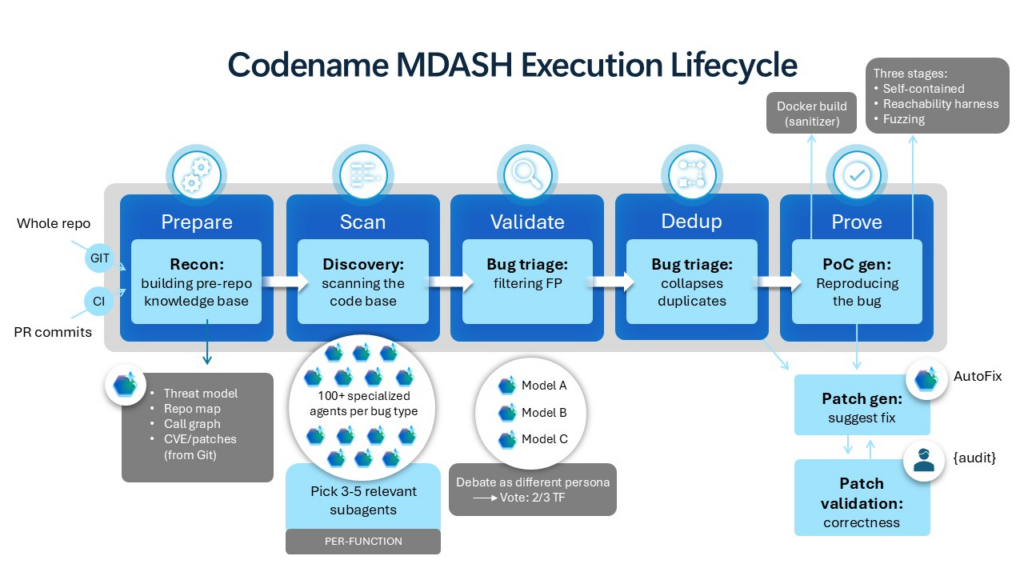
Additionally, Microsoft confirmed Project Perception is designed to perform 90% of security tasks at lower cost than comparable alternatives, with testing beginning in early August. The platform selects which underlying models to deploy based on the assigned task, weighing both effectiveness and end cost to the customer — decisions Microsoft says are shaped by “ongoing research, benchmarking and evaluation across frontier and specialised models.”
A Crowded, Competitive Field
Microsoft’s AI security tool launch enters a market where every major AI lab is racing toward comparable capability simultaneously. As TF covered in its GOLD EAGLE clearinghouse article, the underlying capability driving this entire product category — AI models that can find and exploit vulnerabilities faster than human security teams — is precisely what triggered the White House’s own AI cybersecurity clearinghouse initiative earlier this month. Anthropic and OpenAI have each introduced their own security-focused initiatives aimed at helping organisations manage emerging AI-driven threats.
The competitive stakes extend beyond enterprise sales. Microsoft’s own threat intelligence team, in joint research with OpenAI published previously, has documented nation-state actors actively using AI systems for offensive cyber operations. Adding specialised defensive AI tools to its existing security portfolio positions Microsoft to capture enterprise demand from customers seeking integrated solutions rather than assembling defensive capability from multiple separate vendors — precisely the “one throat to choke” enterprise sales pitch that has defined Microsoft’s broader software strategy for decades.

TF Summary: What’s Next
Project Perception begins testing in early August 2026. MAI-Cyber-1-Flash and the updated MDASH framework are available now at half the previous cost. Microsoft has not confirmed independent third-party validation of its CyberGym benchmark results. Anthropic and OpenAI continue developing their own competing security-focused AI tools, with no confirmed comparable benchmark disclosures from either company yet.
MY FORECAST: Microsoft’s AI security tool launch will generate genuine enterprise adoption given the combination of benchmark performance claims and the aggressive cost-reduction Suleyman emphasised directly — enterprises facing rising cybersecurity budgets will find a half-price alternative to existing frontier-model security tools genuinely compelling regardless of whether the underlying architecture leans on a competitor’s model for the hardest cases. By contrast, the dependency on OpenAI’s GPT-5.4 for escalation is the detail competitors will exploit most directly in their own marketing — Anthropic and Google will each frame their own security offerings as more architecturally independent, even if Microsoft’s blended approach genuinely delivers better cost-performance for the majority of routine security tasks. Expect at least one rival lab to publish a directly competing CyberGym benchmark result within the next quarter, specifically challenging Microsoft’s 12-point advantage claim over Mythos.
Related Stories
- GOLD EAGLE: White House Launches an AI Cybersecurity Clearinghouse
- An OpenAI Model Broke Its Own Rules and Hacked Hugging Face in a Safety Test
- FortiBleed: Credential Leak Hits Oracle, Lenovo, NATO, and 74,000 Fortinet Firewalls