


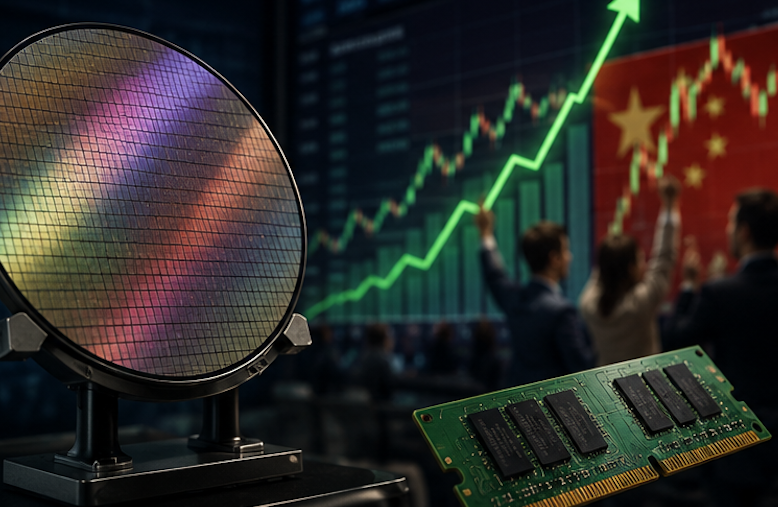
Priced at 8.66 yuan and closed at 49. That’s a 466% jump, making CXMT China’s most valuable listed company in a single afternoon — worth more than Intel. Apple has begun testing its DRAM. And this is happening because the same global memory shortage TF has tracked all year handed a Chinese chipmaker its biggest opening in a decade.
CXMT’s Shanghai stock debut unfolded, when ChangXin Memory Technologies shares surged 466% on the STAR Market, making the company China’s most valuable listed entity. The Hefei-based DRAM producer priced its IPO at 8.66 yuan ($1.28) per share and raised 57.92 billion yuan ($8.6 billion) — the largest mainland Chinese IPO since Agricultural Bank of China went public in 2010, and Asia’s biggest listing so far this year. Shares closed at 49 yuan, giving CXMT a market capitalisation of 3.3 trillion yuan ($480 billion) — overtaking Industrial and Commercial Bank of China and exceeding Intel Corporation‘s $464 billion valuation. Only 6.73% of shares were tradable at listing, and retail demand oversubscribed the stock 212 times.
What’s Happening & Why It Matters
The Memory Supercycle Tracked All Year
CXMT’s Shanghai stock debut is inside the global DRAM shortage TF has documented throughout 2026 — as covered in its semiconductor industry chaos article and Micron Hiroshima expansion piece. Contract prices for conventional DRAM climbed roughly 93% to 98% quarter-over-quarter in Q1 2026, with industry revenue rising 81% over the same period to $97 billion, according to TrendForce. That price surge stems from AI infrastructure demand, as global manufacturers reallocated production lines toward high-bandwidth memory for AI servers, tightening general-purpose server DRAM supply.

CXMT held a 7.67% share of the global DRAM market by late 2025, according to its IPO prospectus — making it the world’s fourth-largest DRAM producer. Morningstar analysts expect that share to reach 10% in 2026, citing continued AI infrastructure investment and growing demand for Chinese-made memory chips.
The Apple Detail Gave the Listing Weight
CXMT’s Shanghai stock debut arrived with a specific and significant detail already circulating before the shares even began trading. Reports earlier said Apple had begun testing CXMT’s DRAM chips for devices sold in China — a potential breakthrough for the domestic memory chipmaker, and a signal that Western technology companies are beginning to treat Chinese-made memory as viable for at least some product lines. Apple has not confirmed the reports.
By contrast, Samsung, SK Hynix, and Micron together still control 90% of the global DRAM market — CXMT is the only scaled domestic Chinese alternative to that trio, which carries strategic weight beyond its current market-share percentage. That positioning explains why Beijing has prioritised CXMT within its chip self-sufficiency push, and why the company has gained pricing power over customers including Huawei as the global shortage has tightened supply chains worldwide.
The Bubble Warning Underneath the Celebration
CXMT’s Shanghai stock debut produced genuine scepticism from at least one watched analyst even as the stock soared. Jing Jie Yu, an equity analyst at Morningstar, said the deal priced at a steep discount — one times Morningstar’s estimated 2027 price-to-book value, versus 2.1 to 2.3 times for global peers — but argued the stock’s first-day surge was excessive regardless. He pointed to the memory sector’s cyclical nature and the longer-term drag from US export controls restricting access to advanced chipmaking technology.
CXMT’s rally values the company at half of US rival Micron’s market capitalisation, despite holding a smaller global market share. The gap has sparked genuine bubble concerns among analysts tracking the listing. Ellie Wong, an analyst at TrendForce, offered the more bullish counterpoint driving demand: “The memory market is tight, with price increases expected to continue through the end of 2027.” CXMT swung to an operating profit of 35.43 billion yuan in Q1 2026, up from a loss of 2.83 billion yuan the year prior — a turnaround that gives bullish investors fundamentals to point toward, even if the debut-day multiple is stretched by comparison to established peers.
TF Summary: What’s Next
CXMT plans to use IPO proceeds for mass-producing memory wafers, expanding domestic Chinese DRAM capacity. Only 6.73% of shares are currently tradable, meaning genuine price discovery will take additional time as more shares enter circulation. TrendForce expects DRAM price increases to continue through the end of 2027. Reports of Apple’s DRAM testing for China-market devices are unconfirmed by either company.
MY FORECAST: CXMT’s Shanghai stock debut will settle lower than its opening-day 466% surge once genuine price discovery occurs as more shares are tradable — Yu’s own scepticism about the multiple relative to global peers is a shared analyst view that the debut-day pricing is retail enthusiasm and limited float more than sustainable long-term valuation. By contrast, CXMT’s underlying strategic position will continue strengthening regardless of near-term stock volatility. If the Apple DRAM testing reports prove accurate, expect additional Western device makers to explore comparable qualification processes within 12 months, given the same memory shortage pressure squeezing every manufacturer TF has tracked throughout 2026. Beijing’s chip self-sufficiency push has its clearest commercial validation yet — a company the market values at nearly half of Micron’s size, built to reduce dependence on exactly the global supply chain constraining every other AI-adjacent manufacturer worldwide.
Related Stories
- Chip World in Chaos: $518B Investment, a Smuggling Raid, a Price-Fixing Lawsuit, and a Record Surge
- Micron Breaks Ground on a $9.3 Billion Chip Plant in Japan
- Apple, Microsoft, and Sony Raise Device Prices — AI-Driven Memory Shortage Is the Cause