


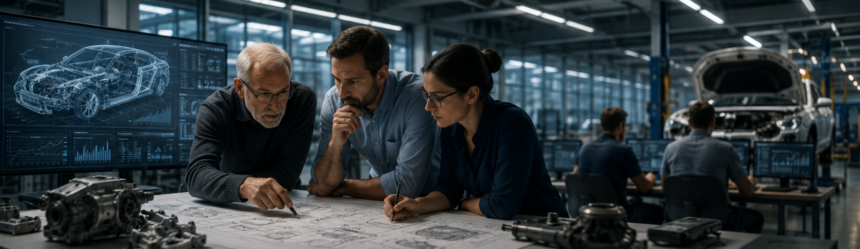
Ford fired veteran engineers to make room for AI. The AI got worse, not better, because the experienced people who could have trained it had already left. So Ford spent three years hiring 350 of them back. The payoff: Ford just topped JD Power’s quality study for the first time in 16 years.
Ford’s veteran-engineer rehiring programme has kicked off — confirming what Bloomberg first reported: a quiet three-year correction at America’s second-largest automaker. Ford executives said they have hired 350 veteran engineers — some former employees, others previously employed by suppliers — after artificial intelligence and automated systems failed to deliver the desired level of quality.
Chief Operating Officer Kumar Galhotra told reporters Ford had been “relying more and more on automated quality systems” with disappointing results. So the company “brought back technical specialists,” who “hunt for failure points before a part ever reaches the plant floor.”
Vice President of Vehicle Hardware Engineering Charles Poon explained the root cause directly. “Mistakenly, we thought that by just introducing artificial intelligence and ingesting the design requirements that we had, that would produce a high quality product.” The strategy failed for a specific reason. Many of Ford ‘s veteran technicians had already left before their knowledge could be transferred into the AI systems meant to replace them.
What’s Happening & Why It Matters
Why the AI Got Worse Without Human Experts — Not Better
Ford’s veteran engineer rehiring programme reveals a specific and instructive failure mode in AI deployment. Poon explained that the problem was not that the AI itself was fundamentally broken. By contrast, experienced workers left before they could transfer their institutional knowledge into the systems meant to replace them. Without decades of engineering judgment encoded in the training data, Ford‘s automated tools amplified weak inputs rather than catching design flaws. AI quality systems require accurate, expert-validated data to identify genuine defects. When the people who could validate that data left the company, the AI had no mechanism to distinguish a real failure point from noise.
“Over prior years, we didn’t pay as much attention as we should have to the experience of our most knowledgeable engineers that have been with us through many product cycles,” Poon told reporters. That admission is specific and significant. Ford did not simply under-invest in AI tooling. It actively reduced the headcount of the people whose expertise the AI tooling needed to function correctly — creating a structural gap that automation alone could not fill.
What the 350 Engineers Do
Ford’s veteran engineer rehiring programme assigns its rehired engineers a specific and distinct function from their previous roles. Free from daily production schedules, the engineers act as internal auditors, running mandatory weekly design reviews to hunt for and eliminate potential quality issues. Those engineers were “at the heart” of Ford‘s turnaround effort, according to Galhotra. They run mandatory meetings that rigorously troubleshoot quality problems and have reprogrammed AI tools to head off glitches before they happen.
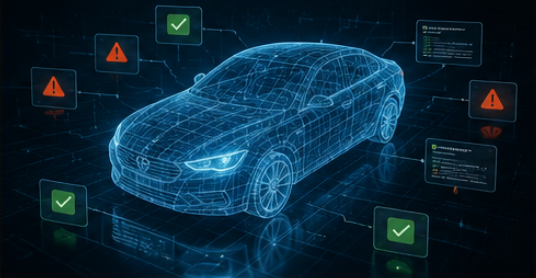
Additionally, the role is explicitly structured to combine institutional memory with AI oversight — not to replace AI with manual processes. Ford still uses heavy automation and added more than 100,000 AI-powered tests to its quality assurance pipeline. The veterans rebuilt the quality process, mentored younger staff, and retrained the automated tools — rather than discarding them. The lesson Ford learned is not that AI fails. It is that AI fails without the specific human expertise that validates and corrects its outputs continuously.
The JD Power Result — and the Recall Caveat
Ford’s veteran engineer rehiring programme produced a measurable result. Ford topped JD Power ‘s 2026 US Initial Quality Study among mainstream automakers — its best result in 16 years, since 2010. Ford scored 152 problems per 100 vehicles, ahead of Nissan and Buick. The F-150, Mustang, and Super Duty each won best-in-segment for the second consecutive year. Seven of Ford‘s top 10 models ranked in the top three of their respective categories.
By contrast, the quality win does not erase a rougher concurrent record. Ford has led US automakers in recalls in 2026, issuing 51 recalls covering more than 11 million vehicles — more than double the next-closest manufacturer. That gap is significant. Initial quality scores measure problems reported by owners in the first 90 days of ownership — a narrower window than the design and engineering issues that drive recalls, which often surface years after a vehicle’s launch. The 350 rehired engineers are improving the metric JD Power measures. Whether they resolve the deeper design issues behind 2026’s recall total is to be seen.
The Lesson for Every Company Replacing Workers With A
Ford’s veteran engineer rehiring programme is at a moment when companies across multiple industries are running the same experiment. As TF covered in its Oracle layoffs article, Oracle cut 21,000 jobs in fiscal 2026, explicitly citing AI adoption as a driver. As TF covered in its GM Factory Zero robots article, GM installed cobots in Detroit while workers remained laid off. Ford‘s experience offers a specific counterpoint. AI replacing human judgment without preserving the institutional knowledge that AI needs to function correctly produces worse outcomes, not better ones — and the cost of correcting that mistake is measured in years, not quarters.
The episode is the same week that OpenAI, Anthropic, Amazon, and Microsoft backed RAISE US — a $500 million nonprofit led by former Commerce Secretary Gina Raimondo to retrain American workers for AI-era jobs. Ford‘s case study is precisely the kind of evidence that effort will need to address: AI deployment that displaces expertise too quickly produces measurably worse outcomes than AI deployment paired with sustained human oversight.
TF Summary: What’s Next
Ford‘s rehiring programme has run for approximately three years and is largely complete, with 350 engineers rehired. The company continues expanding its automated testing infrastructure alongside the human oversight layer. JD Power‘s next quality study arrives in 2027 — the first full test of whether Ford‘s 2026 result is a durable improvement or a single-year correction. Ford‘s 2026 recall total is under review by NHTSA.
MY FORECAST: Ford’s veteran engineer rehiring programme is the most-cited corporate case study in the 2026 conversation about AI labour displacement — specifically because it documents reversal, not just risk. Most AI displacement stories describe job losses without resolution. Ford‘s story describes a company that displaced expertise, watched quality fail, and spent three years and real capital correcting the mistake. By contrast, every company currently replacing experienced staff with AI tooling — Oracle, and the long list TF has covered throughout 2026 — will face the same question Ford eventually had to answer: did the institutional knowledge leave before the AI could learn from it? Companies that ask that question proactively will avoid Ford‘s three-year correction. Companies that do not will discover the same answer Ford discovered — at a similar cost, on a similar timeline.
Related Stories
- Oracle Cuts 21,000 Jobs as AI Replaces Human Roles
- GM Installed 50 Robots at Its Flagship EV Factory — While 1,300 Workers Remain Laid Off
- Anthropic Pledges $350 Million to Study AI’s Effect on Jobs