


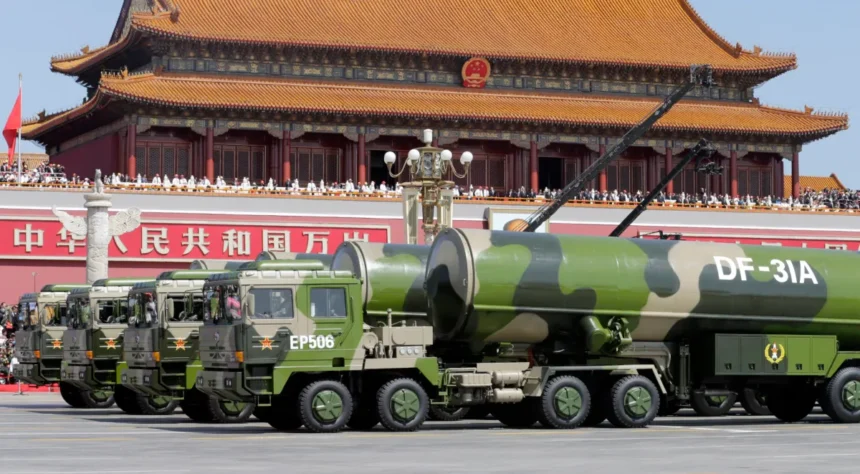
China added 20 warheads in 2025 — bringing its total to 620. It is expanding faster than any other nuclear power. By 2030, it could match the US and Russia for ICBMs. The disarmament era is over, says SIPRI. What has begun instead is considerably more concerning.
China’s nuclear arsenal expansion reached 620 warheads as of January 2026 — up from 600 the previous year — according to the SIPRI Yearbook 2026, released on 8 June. The Stockholm International Peace Research Institute confirmed China as the fastest-expanding nuclear power among the world’s nine nuclear-armed states. The total global inventory stands at 12,187 warheads — with approximately 9,745 in military stockpiles considered operationally available. The nine nuclear states are the United States, Russia, the United Kingdom, France, China, India, Pakistan, North Korea, and Israel. All nine continued modernisation programmes in 2025. All nine deployed new nuclear-armed or nuclear-capable weapons systems during the year. The disarmament narrative that shaped international arms control policy for three decades has ended. In its place, SIPRI describes a world in which nuclear weapons are returning to the centre of great-power strategy.
What’s Happening & Why It Matters
China’s 620 Warheads — and the ICBM Race Ahead
China’s nuclear arsenal expansion extended across both deployed and stored categories. By January 2026, China had 34 deployed warheads — up from 24 in 2025. Stored warheads rose from 576 to 586. Those numbers look modest compared to Russia and the United States. By contrast, the trajectory is the story. SIPRI identified three large ICBM silo fields under construction in northern China, plus 30 additional silos under completion in mountainous eastern regions. The institute’s assessment carries a stark projection. “Depending on how it decides to structure its forces, China could potentially have at least as many ICBMs as either Russia or the USA by the turn of the decade.”
That projection changes the US-China strategic calculus fundamentally. A China with ICBM parity redefines deterrence assumptions built since the 1970s. Additionally, SIPRI noted that China may now deploy warheads on missiles in peacetime — a shift from its traditional launch-on-warning posture.
The Global Inventory: 12,187 Warheads, Nine Countries
The full global picture from the SIPRI Yearbook 2026 is sobering. The United States maintains 1,770 deployed warheads — the world’s largest deployed arsenal. Russia holds a similar deployed figure and the world’s largest total stockpile. The UK maintains its arsenal at current levels. France announced in March 2026 that President Macron had ordered a warhead increase — and simultaneously stated the government would no longer publicly communicate the size of its arsenal. India’s arsenal grew to approximately 190 warheads and expanded its long-range missile systems targeting China. Pakistan continued accumulating fissile material throughout 2025. Israel maintains its policy of nuclear ambiguity at approximately 90 warheads. North Korea’s arsenal size remains the most uncertain estimate in the report.
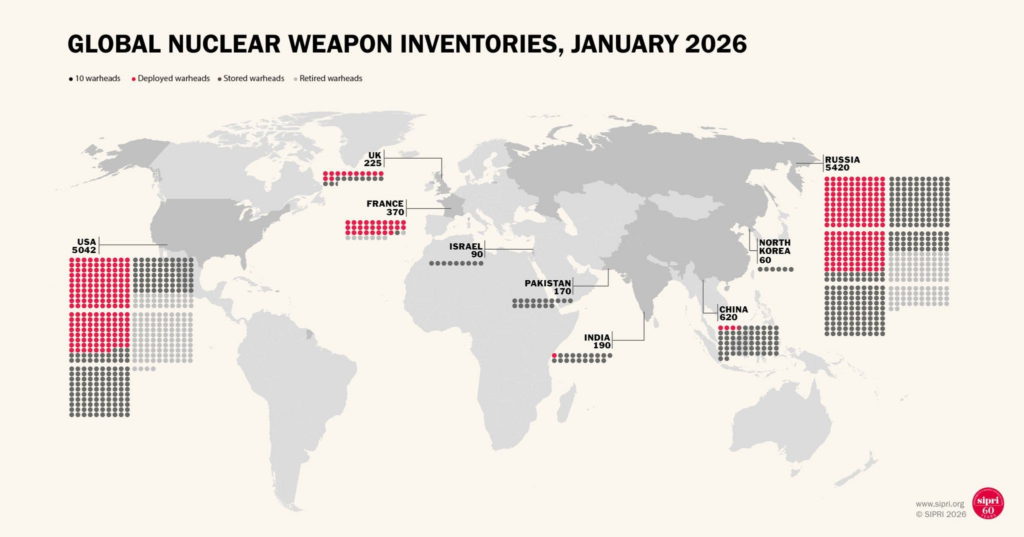
Furthermore, approximately 2,100 to 2,200 warheads globally remain on high operational alert — mounted on ballistic missiles and ready for rapid launch. Most belong to Russia and the United States. A smaller number belong to France, the UK, China, and India.
The End of Disarmament — and What Replaces It
The SIPRI Yearbook 2026 marks the formal end of the post-Cold War disarmament era. For three decades after the Soviet Union’s collapse, Russia and the United States steadily reduced their arsenals through successive arms control treaties. SIPRI researchers note that for the first time since that era began, the pace of gradual dismantlement of retired warheads could slow — leading to a situation in which the global total inventory begins rising.
Nuclear advocates in Washington are pushing for additional warhead deployments specifically in response to China’s new silo fields. That reactive cycle — China builds, the US responds, China expands further — is the mechanism SIPRI identifies as creating “new risks amid heightened escalation.” The same AI systems that Anthropic warned could enable catastrophic cyberattacks — as TF covered in its Anthropic brake pedal article — are simultaneously being integrated into military command and control systems. That integration adds a new failure mode to a nuclear posture already under renewed strategic pressure.
India, Pakistan, and the South Asian Dynamic
The SIPRI Yearbook 2026 identifies South Asia as one of the most acute nuclear risk environments globally. India’s arsenal reached approximately 190 warheads. For the first time, India deployed 12 warheads on operational missiles — a shift from purely stored status. Those weapons are targeted at Chinese strategic infrastructure. Pakistan continued developing new delivery systems and accumulating fissile material throughout 2025. SIPRI warns that Pakistan’s fissile material accumulation suggests a possible arsenal expansion over the coming decade. A severe India-Pakistan crisis in May 2025 — involving cyber operations — demonstrated that regional tensions remain acute. Additionally, both countries continue developing new missile systems that extend their mutual deterrence reach.
TF Summary: What’s Next
The SIPRI Yearbook 2026 is available in full at sipri.org. The institute will present its findings to the UN General Assembly in September 2026. No new US-Russia arms control treaty is currently under negotiation. China has not responded to SIPRI‘s deployment projections. The Treaty on the Non-Proliferation of Nuclear Weapons (NPT) review conference meets in 2026 — its findings will reflect the deteriorating arms control environment the yearbook documents.
MY FORECAST: China’s nuclear arsenal expansion will reach 700 warheads before 2028 — and the first ICBM silo field will be fully operational before the end of 2027. That operational milestone will trigger a formal US Nuclear Posture Review updating response options to Chinese ICBM parity. By contrast, the most consequential near-term risk is not the warhead count itself. It is the integration of AI decision-support tools into Chinese military command structures as warhead numbers grow. A larger, faster-deploying arsenal combined with AI-assisted targeting reduces the decision windows that traditional deterrence doctrine assumes. SIPRI will document that integration in next year’s yearbook. By then, the policy window for managing it may have narrowed considerably.