



The EU just declared its age verification app ready. But between the technology, the politics, and the platforms, “ready” is doing a lot of work.
Europe has had enough of waiting for tech platforms to protect children. On 15 April 2026, European Commission President Ursula von der Leyen announced that the EU’s new age verification app is technically ready. Furthermore, it will soon be available for platforms across all EU member states. The app promises something the tech industry has long claimed was impossible: a way to verify a user’s age online without sharing their sensitive personal data with every platform they visit.
Consequently, the announcement carries significant weight. Von der Leyen was direct: “Online platforms can easily rely on our age verification app. So there are no more excuses.” The message to Meta, Snap, TikTok, and others was clear. However, the real test — whether the app works in practice, whether platforms adopt it, and whether children are actually safer as a result — is still to come.
What’s Happening & Why It Matters
What the App Actually Does
The EU’s age verification app is technically elegant. Furthermore, it solves a problem that has paralysed the online safety debate for years. The dilemma has always been this: verifying a user’s age requires collecting personal data. Collecting personal data creates privacy risks. Therefore, privacy advocates and child safety campaigners have been in a perpetual standoff.

The EU’s solution is zero-knowledge proof cryptography. This is the app’s defining feature. Users upload a passport or national ID card to the app to verify their age. The app then generates a verifiable age credential. Crucially, when a platform requests age confirmation, it receives only a binary response — for example, “yes, this user is above 16” or “yes, this user is above 18.” The platform never sees the ID document. It never sees the user’s birthdate. It receives no personally identifiable information whatsoever. EU Executive Vice-President Henna Virkkunen described the approach: “Our solution builds on zero-knowledge proof: this means that when users want to access an age-restricted service, you remain in full control of your data. We do not want platforms to scan our passports or faces.”
The app is fully open-source. Furthermore, publishers can customise it — including translating it into national languages — but cannot modify its privacy-preserving features. The technical specifications and source code are already publicly available. Additionally, the solution is compatible with the European Digital Identity Wallets currently being rolled out across member states, with full wallet deployment expected by the end of 2026.
Why This Moment Matters
The context behind this announcement is not subtle. Courts, regulators, and parents have spent years demanding that platforms do more to protect children. Consequently, the pressure has finally produced action from the top of European governance.

In March 2026, a California jury found Meta and YouTube liable for harming a young woman through addictive platform features. Furthermore, a separate New Mexico jury found Meta liable for enabling child sexual abuse on its platforms. Australia passed a world-first law banning children under 16 from social media in December 2025. Additionally, a handful of European countries are pursuing similar bans of their own.
Meanwhile, TikTok, Facebook, Instagram, Snapchat, and Shein have all faced EU enforcement action over failures to protect minors, including addictive design features and insufficient age verification. Furthermore, the European Commission reached preliminary findings in 2026 that four major pornographic platforms — Pornhub, Stripchat, XNXX, and XVideos — are in breach of the Digital Services Act (DSA) for allowing minors to access their services. Additionally, formal proceedings are underway to investigate whether Snapchat is complying with child protection rules. The Commission signed a Memorandum of Understanding with the Dutch Digital Services Coordinator specifically to support that investigation.
Therefore, the age verification app arrives not as a standalone product, but as the centrepiece of a coordinated, simultaneous crackdown.
Seven Countries Leading the Way

The app is not starting from scratch. Seven EU member states — France, Denmark, Greece, Italy, Spain, Cyprus, and Ireland — are already preparing integration of the app into their national digital identity wallets. The countries represent Europe’s “front-runner” cohort. Furthermore, they provide early evidence that the cross-border deployment model is viable.
The architecture itself draws on a proven precedent. The EU’s COVID digital certificate — which allowed citizens to prove vaccination status across member states without sharing personal medical records — used the same type of cross-border digital credential infrastructure. Consequently, Europe already has experience building and deploying privacy-preserving identity systems at a continental scale. That track record strengthens the case that this app can work technically. However, technical readiness and real-world adoption are not the same thing.
How the DSA Fits In
The Digital Services Act is the regulatory backbone behind all of this. Under the DSA, large platforms accessible to minors must implement “appropriate and proportionate measures” to ensure a high level of privacy, safety, and security for young users. However, the DSA does not require platforms to use the EU’s specific app. Platforms can use alternative age verification tools — provided those tools are equally effective.
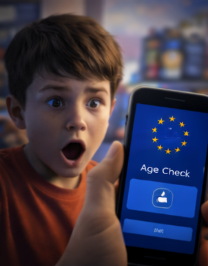
This is a critical nuance. EU technology spokesperson Thomas Regnier confirmed to CNN that sites required to restrict access to minors under the DSA are not obligated to use the new app. Nevertheless, Regnier added that platforms using alternatives must prove equal effectiveness or face sanctions. Furthermore, the Commission has made clear it will apply zero tolerance for non-compliance. As von der Leyen and Virkkunen stated jointly: “We will have zero tolerance for companies that do not respect our children’s rights.”
Therefore, the app functions as both a practical tool and a regulatory benchmark. Platforms that adopt it are compliant. Platforms that use alternatives carry the burden of proving equivalence. Consequently, the Commission has made non-adoption a risky choice, even without a legal mandate.
The Questions That Remain
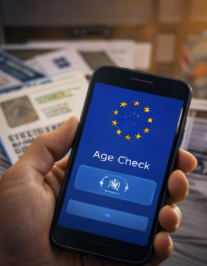
The app is ready. The enforcement framework is tightening. However, several legitimate challenges exist.
First, uptake is voluntary at the platform level. The app provides a free, privacy-preserving solution. However, adoption depends on commercial actors choosing to integrate it or facing regulatory consequences severe enough to compel them to do so. The DSA’s maximum penalty is a fine of up to 6% of global annual turnover for very large platforms. Consequently, that threat carries real weight. Nevertheless, enforcement moves slowly compared to product development cycles.
Second, the EU does not yet have a single minimum age threshold across member states. Individual countries set their own age requirements. Therefore, one user in France may need to prove they are over 16, while another in a country with different rules may need to prove they are over 13 or 18. The EU coordination mechanism, which is still being established, must resolve the inconsistencies before the app delivers a truly harmonised experience.

Third, the digital divide is vital. Not every EU citizen has a smartphone with an up-to-date operating system that supports the Digital Credentials API, on which the app relies. Furthermore, older or lower-income users may face barriers to onboarding. The Commission acknowledges the gaps but has not yet detailed specific inclusion strategies.
Fourth, critics rightly note that centralised verification systems — however well designed — create single points of failure. These include potential phishing attacks targeting the credential issuance process, service disruptions, and the risk of government visibility into online activity patterns over time. Zero-knowledge proofs protect data in transit. However, they do not eliminate all systemic risks in a centralised infrastructure.
TF Summary: What’s Next
The EU’s age verification app represents the most technically sophisticated and privacy-conscious attempt to solve age gating online that any major jurisdiction has produced. Furthermore, its open-source design, zero-knowledge proof architecture, and compatibility with the European Digital Identity Wallet position it as a potential global reference standard. An expert panel on children’s online safety is expected to deliver recommendations by summer 2026. Additionally, DSA enforcement actions against Snapchat and the four pornographic platforms are ongoing. Consequently, the regulatory environment surrounding the app will only intensify in the months ahead.
Nevertheless, technical readiness is a milestone, not a destination. The app now enters a pilot phase with member states, platforms, users, and third-party software providers. Voluntary adoption by the largest platforms is the central challenge. Furthermore, resolving the fragmented minimum age landscape across EU member states will determine whether the app delivers a genuinely unified experience or yet another patchwork of national solutions. Europe has built the tool. The question is whether the platforms — and the regulators enforcing the rules — will ensure it actually gets used.
— Text-to-Speech (TTS) provided by gspeech | TechFyle