


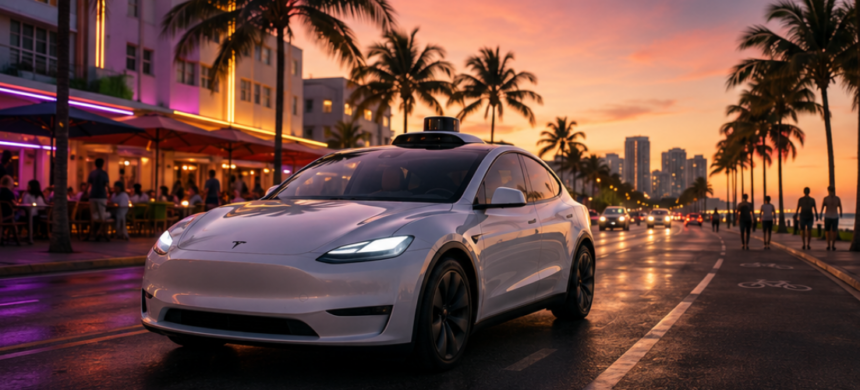
Miami is Tesla’s third state and its first true weather stress test. No safety driver. No LiDAR. Just eight cameras navigating South Florida’s sudden tropical downpours and blinding sun glare — the exact conditions federal regulators are already investigating for causing crashes elsewhere.
Tesla’s Miami robotaxi launch went live — making Florida the third US state to host the company’s driverless ride-hailing service. Tesla launched its Robotaxi service in Miami on 3 July, the first driverless ride-hailing operation outside Texas and California. The rides are fully unsupervised from day one — no safety driver, no human in the front seat — a detail confirmed within hours of the announcement by Ashok Elluswamy, Tesla‘s VP of AI Software. The geofenced launch zone covers 10 to 14 square miles in western and central Miami-Dade, including Miami International Airport and portions of the Palmetto Expressway and Tamiami Trail. By contrast, the service excludes downtown Miami and Miami Beach entirely at launch. The expansion arrives immediately behind Tesla‘s record 480,126 Q2 vehicle deliveries — and directly into the middle of an active federal safety investigation that centres on exactly the weather conditions Miami is known for.
What’s Happening & Why It Matters
Why Miami Is a Genuine Technical Test
Tesla’s Miami robotaxi launch is not simply geographic expansion. Miami’s launch is the first time Tesla’s Full Self-Driving system will operate commercially in a climate defined by sudden, intense tropical downpours, sun glare, and high humidity — conditions are at the centre of an active federal investigation. Federal regulators opened an engineering analysis in March 2026 — the final step before a potential recall — finding that Tesla’s camera-only FSD “fails to detect and/or warn the driver appropriately under degraded visibility conditions such as glare and airborne obscurants.”
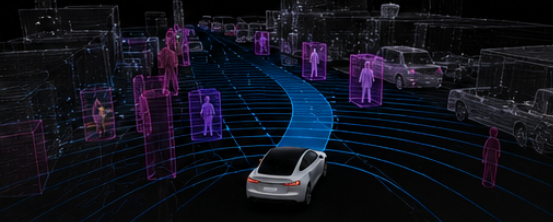
As TF covered in its Tesla FSD federal investigation article, that engineering analysis — designated EA26002 — already covers more than 3.2 million vehicles following a fatal Texas crash. Unlike Waymo, which uses LiDAR sensors that generate usable three-dimensional data in rain and glare, Tesla‘s system relies entirely on cameras. South Florida’s frequent intense downpours and sun glare make Miami a real-world test of the exact performance gap NHTSA is investigating — playing out commercially, with paying customers, while the federal inquiry is open.
Waymo Already Beat Tesla to Miami
Tesla’s Miami robotaxi launch arrives into a market where a rival is already established. Waymo has already established operations in Miami, opening fully autonomous rides in the city earlier and building a larger operating area. Waymo has four times the coverage and a far larger fleet than Tesla’s initial Miami deployment. Tesla‘s current Miami fleet uses modified Model Y vehicles, not the purpose-built two-seat Cybercab — which is expected to join the fleet once volume production scales later in 2026.
That competitive gap is commercially significant. Availability will be limited — in Austin, early riders documented waits of 15 minutes or longer, and in more than a quarter of availability checks, no cars were found at all. Riders must download the dedicated Robotaxi app and join a waitlist, with access historically staggered and invite-only. For Miamians, Tesla‘s robotaxi is currently early access rather than everyday utility — a genuine alternative to Waymo for adventurous early adopters, not yet a reliable daily transportation option.
Dallas and Houston Live in the Same Week
Tesla’s Miami robotaxi launch did not happen in isolation. Unsupervised Model Y rides are simultaneously live in Dallas and Houston as well. Austin offers a hybrid mix of unsupervised and safety-monitor rides, while the Bay Area currently runs safety-monitor rides only. That distinction is significant — Tesla is expanding unsupervised operation fastest in Texas and Florida, while maintaining more cautious human-monitored operation in California, a state with historically stricter autonomous vehicle regulatory oversight.
CEO Elon Musk stated plans in January to expand to seven additional cities in the first half of 2026, including Orlando and Tampa alongside Phoenix and Las Vegas. By contrast, the company softened that first-half target for those additional cities to “preparations underway” — with large-scale expansion tied to FSD v15, a planned major software rewrite carrying no confirmed release date, and to ramping Cybercab production.
TF Summary: What’s Next
The Miami geofence is expected to expand gradually beyond its initial 10-to-14-square-mile footprint, prioritising high-traffic, airport-linked routes first. The Cybercab is expected to join the Miami fleet once volume production scales later in 2026. NHTSA‘s Engineering Analysis EA26002 continues independently of the Miami launch — with a Congressional response deadline of 7 July 2026, as TF covered in its Tesla FSD investigation article. Orlando and Tampa are in “preparations underway” status with no confirmed launch date.
MY FORECAST: Tesla’s Miami robotaxi launch will generate the first meaningful real-world safety data point on how camera-only FSD performs in genuinely adverse tropical weather — data that NHTSA‘s active engineering analysis will absorb directly. By contrast, Tesla launching commercially into precisely the visibility conditions its own federal investigators have flagged as a documented failure mode is either supreme confidence in recent software improvements or a significant unforced risk. The first heavy Miami thunderstorm during active robotaxi operations is the story every outlet covers next. If the system performs reliably through South Florida’s summer storm season, Tesla gains genuine evidence to counter NHTSA‘s concerns. If it does not, Miami is Exhibit A in whatever recall demand EA26002 eventually produces.
Related Stories
- NHTSA Probes Tesla FSD After Drivers Crashed Into Homes and Pools
- Amazon’s Zoox Redesigns Its Robotaxi for Commercial Launch
- Waymo Recalls 3,871 Robotaxis — the Third Major Recall in 14 Months