


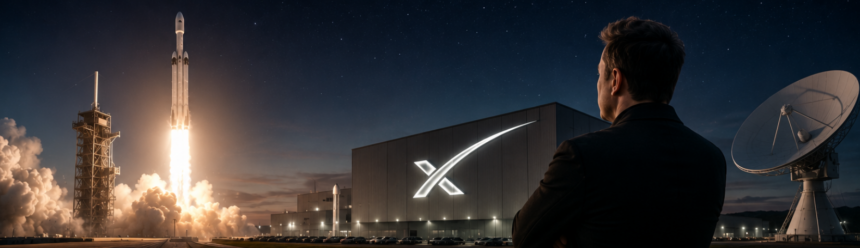
SpaceX priced at $135 per share on 11 June. It raised $75 billion. The offering smashed Saudi Aramco’s 2019 record by nearly three times. Opening indications pointed to $169 or higher — a 25% first-day pop. And Elon Musk is likely to be the world’s first trillionaire.
SpaceX’s $75 billion IPO priced at $135 per share — officially making it the largest initial public offering in stock market history, eclipsing Saudi Aramco’s $24.9 billion record from 2019. SpaceX sold 555.6 million shares at that price. The company trades on the Nasdaq under the ticker SPCX. Gwynne Shotwell — SpaceX‘s president and COO — rang the opening bell at the Nasdaq MarketSite in New York. Elon Musk joined remotely from Texas. Meanwhile, opening indications pointed to a first trade around $169 per share — approximately 25% above the IPO price. At those levels, Musk is poised to reach the status of the world’s first trillionaire. By any measure, today is one of the most consequential days in financial history.
What’s Happening & Why It Matters
$75 Billion Raised: How SpaceX Shattered Every Record

SpaceX’s $75 billion IPO obliterates prior records without ambiguity. Saudi Aramco raised $24.9 billion in its 2019 listing — holding the previous record for seven years. SpaceX raises three times that figure in a single offering. Additionally, the company allocated approximately 30% of its issue — around $22.5 billion — to retail investors. That is triple the industry norm of roughly 10%. In practice, anyone with a brokerage account at Robinhood, Fidelity, Charles Schwab, SoFi, or E*TRADE could request an allocation at the $135 price. Furthermore, prediction markets estimated the offering would create approximately 4,000 new millionaires — from senior executives down to engineers who received equity over years of employment.
The Three Businesses Inside SPCX
SpaceX’s $75 billion IPO reveals a company structured around three segments with radically different unit economics. The connectivity segment — Starlink — is the only profitable division. Starlink generated $11.4 billion in 2025 revenue and $4.4 billion in operating profit, with an adjusted EBITDA margin of 63%. By contrast, the xAI division — added through SpaceX‘s February 2026 acquisition — incurred a $6.36 billion operating loss in 2025. The space launch segment — Falcon 9, Starship, and Starshield — has been profitable since 2025 but generates lower margins than Starlink.

According to its prospectus, SpaceX has accumulated a total deficit of $41.3 billion since its founding in 2002. That figure will surprise retail investors who see only the Starlink growth story. In practice, the deficit is two decades of extraordinary infrastructure investment — reusable rockets, the Starlink constellation, and Starship development — none of which a competitor could easily replicate today.
Musk’s Stake — and the Trillionaire Moment
Musk — who joined the opening bell remotely from Texas — is poised to become the world’s first trillionaire based on his combined stakes in SpaceX and Tesla. His stake includes 85.1% of combined voting power through a dual-class share structure — the same structure TF analysed in its SpaceX IPO filing article. At the $135 IPO price, Musk‘s SpaceX holdings alone approach the trillion-dollar threshold. At the $169 opening indication, they cross it. Additionally, Antonio Gracias — founder of Valor Management and a SpaceX board member — holds 503.4 million shares worth nearly $68 billion at the IPO price. COO Gwynne Shotwell holds nearly 12.6 million shares. Board member Luke Nosek owns 33 million shares.
The Retail Investor Opportunity — and Its Limits
SpaceX’s $75 billion IPO is deliberately structured to give ordinary investors access. Despite the retail allocation, the deal is heavily oversubscribed. Most retail requests through brokerage platforms received only partial allocations — or none at all. By contrast, investors who did not receive an IPO allocation can still buy SPCX on the open market. The catch is price. The opening trade could be well above the $135 offer price, meaning later buyers pay a premium that early IPO buyers did not. Furthermore, trading start time was delayed by 30 minutes to 9:50 a.m. ET due to intense pre-market positioning activity.
Senator Elizabeth Warren asked the SEC to delay the offering over governance concerns. A letter like that does not stop an IPO, and the debut proceeded on schedule. Warren’s objections — focused on the dual-class share structure and mandatory arbitration clauses — will not disappear after today’s opening bell. They will resurface in the first shareholder meeting.
Falcon 9 Launches on IPO Morning
SpaceX launched its flagship Falcon 9 rocket from Cape Canaveral Space Force Station in Florida just hours before the stock debuted. The mission sent 29 Starlink satellites into low Earth orbit. That launch — routine in SpaceX’s operating cadence — made a specific point to the market. The company goes public on a Friday and launches a rocket on the same morning. By contrast, most companies spend their IPO day in carefully controlled media appearances. SpaceX spent part of it deploying broadband satellites.
The Nasdaq-100 Fast-Entry Clock Starts Today
One technical detail will drive sustained post-IPO buying pressure. As TF covered in its SpaceX IPO filing article, under Nasdaq‘s fast-entry rule, SpaceX automatically joins the Nasdaq-100 after just 15 days of trading — triggering an estimated $22 to $27 billion in forced mechanical buying from every QQQ index fund in the world. That rebalancing, expected in early July 2026, represents structural buying demand entirely independent of individual investor sentiment. Additionally, MSCI inclusion begins as early as 13 June 2026 — creating index fund buying pressure from day two of trading.
TF Summary: What’s Next
SPCX trades on Nasdaq from today. The offering closes on 15 June 2026. Underwriters hold a 30-day option to purchase an additional 83.3 million shares at the IPO price. The Nasdaq-100 forced-buying event is expected around early July 2026. SpaceX‘s first quarterly public earnings call is expected in November 2026 — the first time the market sees actual public-company financial reporting from the world’s most valuable aerospace company.
MY FORECAST: SpaceX’s $75 billion IPO will close its first day of trading at between $155 and $175 per share — a significant premium over the $135 IPO price, but below the crypto derivatives peak of $220+ from May 2026. The Nasdaq-100 fast-entry buying event in early July will drive the price above $180 briefly. By contrast, the first real test arrives in November with the inaugural earnings call. At that point, public investors will see the xAI division’s loss trajectory — running at $6.36 billion for 2025 — alongside Starlink’s 63% EBITDA margin for the first time in a structured quarterly disclosure. The market’s reaction to that earnings call will define SPCX‘s trading range for the rest of 2026. Musk’s voting control ensures no external pressure can alter SpaceX‘s strategy. The question investors will answer is whether they trust that control to produce the outcomes the $1.77 trillion valuation requires.