


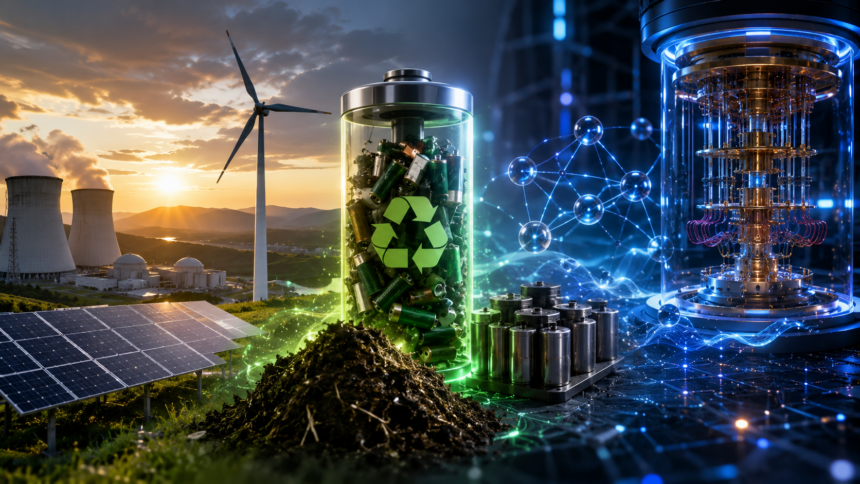
Energy technology breakthroughs dominated three separate research and industry announcements this week — and each one points toward a different part of the same future. The US Department of Energy (DOE) is accelerating the deployment of advanced reactors under its new UPRISE Initiative, aiming to add 5 gigawatts of additional nuclear capacity by 2029. Meanwhile, researchers in China demonstrated a method for converting discarded Nokia phone batteries and industrial lignin waste into a functional sodium-ion battery anode — a circular energy storage approach with real-world potential. At the same time, CAS Cold Atom Technology, a Wuhan-based startup linked to the Chinese Academy of Sciences, unveiled Hanyuan-2 — the world’s first dual-core neutral atom quantum computer, running on under 7 kilowatts of power. Together, these three energy technology breakthroughs cover nuclear, storage, and computing — the three pillars every advanced energy system needs.
What’s Happening & Why It Matters
US Nuclear Deployment: UPRISE, Pilot Programs, and Military Microreactors
The United States is deploying advanced nuclear reactors faster than at any point in the last 40 years. The DOE launched the Utility Power Reactor Incremental Scaling Effort (UPRISE) in March 2026. UPRISE targets 2.5 GW of additional nuclear capacity by 2027 and 5 GW by 2029. Deputy Energy Secretary Rian Bahran described it plainly: “This will be a resurgence for America’s nuclear fleet.”
UPRISE works on three fronts simultaneously. First, it extends the lifespans of existing reactors through license renewals. Second, it boosts output through power uprates — adding capacity without building new plants. Third, it restarts dormant facilities. Two restarts are already underway: the Palisades Nuclear Plant in Michigan and the Crane Clean Energy Center. Holtec is rebuilding its SMR-300 at Palisades, targeting early 2030s operation.
New Reactors and the Independence Day Target
Beyond UPRISE, the DOE launched its Nuclear Reactor Pilot Program — selecting 11 advanced reactor projects and pushing them toward achieving criticality by 4 July 2026. The companies selected include Oklo, Radiant Industries, Last Energy, and eight others. Each company funds its own reactor testing, from design through decommissioning.
By contrast, commercial big-technology deployments are following a different timeline. TerraPower, the Bill Gates-backed company, began construction of its Natrium sodium-cooled reactor in Kemmerer, Wyoming, in early 2026 — after the NRC granted final construction approval in March. TerraPower CEO Chris Levesque described the milestone as evidence that advanced nuclear is real. “Milestones like this really show people that, yeah, this is a new technology, but we’re doing it,” he said. The plant targets commercial operation by 2031, with the capacity to power roughly half a million homes near Salt Lake City.
Military Microreactors: The DOD Joins the Push
The military dimension of energy technology breakthroughs extends the story further. In October 2025, the US Army launched the Janus Program — a microreactor initiative building on Project Pele, a transportable nuclear design. The Army selected nine military bases as potential microreactor sites, including Fort Bragg, Fort Campbell, and Fort Hood. The US Air Force selected two additional sites — Buckley Space Force Base in Colorado and Malmstrom Air Force Base in Montana — for microreactor deployment in partnership with Oklo.
Meta signed agreements with TerraPower for up to eight Natrium reactor plants — potentially delivering 2.8 GW of carbon-free baseload power for data centres. GE Vernova Hitachi‘s BWRX-300 will go to the Tennessee Valley Authority‘s Clinch River site. Six New England governors pledged in March 2026 to direct state energy agencies to explore advanced nuclear options. The buildout is genuinely nationwide.
Waste Into Watts: The Nokia Battery Anode Discovery
Across the Pacific, researchers at Henan Normal University and Qilu University of Technology published a study in the journal Biochar X demonstrating a breakthrough in circular battery chemistry. The approach transforms two categories of industrial waste — discarded mobile phone batteries and lignin from paper and biofuel manufacturing — into a high-performance electrode material for sodium-ion batteries.
The process uses hydrothermal synthesis. Researchers extracted nickel and cobalt compounds from spent Nokia phone batteries. They then combined those compounds with carbon derived from lignin — the natural polymer found abundantly in wood and crop waste. The resulting composite material — called NiCo₂S₄/Co₉S₈@LC50 — produces a honeycomb-like structure at the nanoscale. That structure improves electrical conductivity, stabilises the electrode during charging and discharging, and accelerates sodium-ion transport between electrode surfaces.
Why Sodium-Ion Batteries Matter Right Now
Sodium-ion batteries are gaining commercial momentum as a viable alternative to lithium-ion systems for grid storage, electric vehicles, and consumer electronics. Sodium is approximately 20,000 times more abundant in Earth’s crust than lithium. It is extractable from seawater, salt deposits, and industrial waste streams at a stable, low cost. In 2026, sodium-ion cells cost between $55 and $70 per kilowatt-hour — roughly 35 to 40% cheaper than equivalent lithium-iron-phosphate cells.
The composite material in this new research retains its capacity across more than 300 charge cycles — a meaningful step toward grid-scale durability. The researchers noted: “Sodium-ion batteries are attractive because sodium is abundant, low-cost, and environmentally friendly. However, the development of efficient electrode materials remains a major challenge.” The waste-to-waste approach addresses both the electrode performance problem and the e-waste disposal problem simultaneously. Old Nokia phones and paper-mill lignin become next-generation battery components. That is a genuine circular economy win.
China’s Hanyuan-2: Quantum Power in a Cabinet
The third energy technology breakthrough is the most unconventional. On 8 May 2026, CAS Cold Atom Technology unveiled Hanyuan-2 — a 200-qubit neutral atom quantum computer that runs on under 7 kilowatts of total power. For context, a typical home air conditioner draws between 3 and 6 kilowatts. A commercial superconducting quantum computer — like those operated by IBM and Google — requires dilution refrigerators that consume hundreds of kilowatts while cooling hardware to near absolute zero.
Hanyuan-2 avoids that requirement entirely. Instead of superconducting circuits or ion traps, it uses neutral atoms — specifically 100 rubidium-85 atoms and 100 rubidium-87 atoms in two separate arrays. Neutral atoms carry no electrical charge. They can be controlled with laser fields at temperatures far above absolute zero. A relatively compact laser cooling system that fits inside a standard cabinet handles all operational requirements.
The Dual-Core Architecture That Makes It Different
Hanyuan-2’s most distinctive feature is its dual-core design. CAS Cold Atom Technology senior expert Ge Guiguo described it as the first time a quantum processor has moved from single-core to dual-core architecture — comparable to the evolution of classical CPUs. The two cores operate either in parallel — splitting computational workloads — or in a “main core plus auxiliary core” mode. In the second mode, the auxiliary core handles real-time error correction while the primary core executes computations. That cooperative error correction reduces the qubit interference problem that has plagued large single-core neutral atom arrays.
Company general manager Tang Biao described the practical implications. “The Hanyuan-2 adopts a standard cabinet-style integrated design and only requires a small laser cooling system to operate.” The machine fits in an ordinary room. It needs no specialised facility. By contrast, 200 qubits place Hanyuan-2 significantly behind Western leaders. Atom Computing demonstrated a 1,180-qubit neutral atom array in 2023 and has partnered with Microsoft since. QuEra Computing and Pasqal are both pursuing comparable architectures in the West. No independent performance benchmarks for Hanyuan-2 have been released.
TF Summary: What’s Next
The US nuclear deployment acceleration reaches its next milestone on 4 July 2026 — the DOE‘s target date for at least three pilot reactors to achieve criticality. TerraPower’s Natrium plant in Wyoming continues construction toward the 2031 commercial target. UPRISE‘s 5 GW capacity goal reaches its 2029 deadline with significant commercial, military, and technology-sector support already secured. The waste-to-anode battery research will advance through further electrochemical testing. Potential commercial interest from sodium-ion manufacturers in China and South Korea is likely to follow if the 300-cycle durability holds at larger scales.
MY FORECAST: All three energy technology breakthroughs carry momentum toward commercial relevance, but at very different speeds. US nuclear is the fastest-moving — the combination of AI data centre demand, DOE funding authority of $289 billion, and accelerated licensing will produce operating reactors years sooner than the previous regulatory cycle would have allowed. The waste battery chemistry is promising, but years from production scale — electrode materials research typically takes a decade from publication to commercial deployment. Hanyuan-2 is the most cautious call. China’s neutral-atom approach is legitimate, but the 200-qubit ceiling and the absence of independent benchmarks make it difficult to assess against Western leaders. The dual-core architecture is genuinely innovative. Whether it translates into computational advantage at practical problem scales remains unverified. Expect Western-verified performance data to emerge within 12 months as international customers evaluate the Hanyuan-1 commercial deployments already underway.