


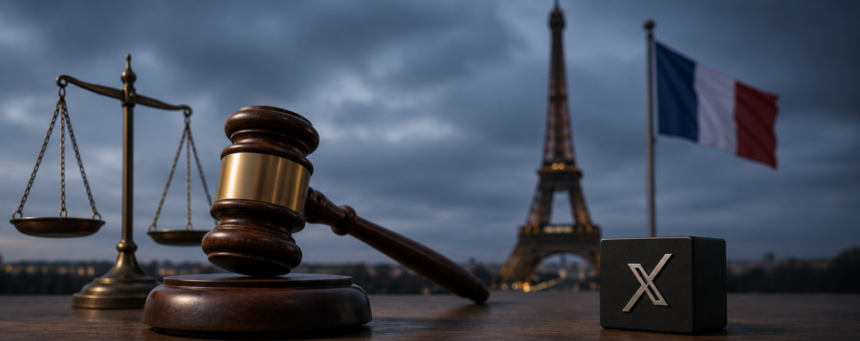
France’s criminal probe into xAI and SpaceXAI is the most serious legal threat Musk has faced in Europe — and it arrived the same day he restructured the very company under investigation. On 7 May 2026, the Paris public prosecutor’s office escalated its probe of Elon Musk, X, and xAI into a full criminal investigation. The charges include complicity in possessing and distributing child sexual abuse material, spreading sexually explicit deepfakes, Holocaust denial, and unlawfully collecting personal data. On the same day, Musk announced that xAI no longer exists as a standalone company. It is now SpaceXAI — a division inside SpaceX. The AI company facing criminal charges in France just changed its name and its corporate parent overnight.
What’s Happening & Why It Matters
France’s Criminal Investigation: A Year in the Making
France’s criminal probe into xAI and SpaceXAI did not arrive suddenly. The Paris cybercrime unit opened its initial investigation in January 2025. At that point, it focused on two specific concerns. The first was whether X‘s algorithm was deliberately biased to interfere in French politics. The second was whether Grok — xAI’s AI chatbot — generated and spread posts denying the Holocaust, which is a criminal offence under French law.
The investigation expanded through 2025. French authorities discovered additional evidence related to deepfake pornography and child sexual abuse images on the platform. French MP Éric Bothorel had first requested the probe after reporting algorithmic bias in X’s content distribution. By February 2026, investigators had seen enough to act. French cybercrime police raided X‘s Paris offices that month. Musk called it “a political attack.” He ignored the summons.
The Summons Musk and Yaccarino Refused
French authorities summoned both Musk and former X CEO Linda Yaccarino for voluntary interviews on 20 April 2026. Neither appeared. Under French law, that refusal gave prosecutors grounds to escalate. On 7 May, the Paris public prosecutor formally opened a judicial investigation — placing investigating judges in charge rather than cybercrime police.
That procedural shift matters enormously. A judicial investigation is a formal criminal proceeding. The judges have the authority to forcibly summon Musk and Yaccarino. If they refuse again, judges can issue warrants that are legally equivalent to formal charges. The prosecutor named four corporate entities in the request: X Corp, X.AI Holdings Corp, xAI, and individual defendants Musk and Yaccarino. Notably, xAI no longer exists — Musk dissolved it the same day the investigation went criminal.
Four Criminal Charges on the Table
The scope of France’s criminal probe into xAI and SpaceXAI covers four distinct areas. First, investigators allege complicity in the possession and distribution of child sexual abuse material (CSAM) on the X platform. Second, they allege the spread of non-consensual sexually explicit deepfake imagery — a category that other jurisdictions are criminalizing rapidly. Third, they allege denial of crimes against humanity — specifically referencing Grok posts that denied the Holocaust. Fourth, they allege unlawful collection of personal data through X‘s systems.
All four categories are serious under French criminal law. The Holocaust denial charge is particularly significant. France is one of several European countries where denial of Nazi genocide carries criminal penalties — not just civil or regulatory ones. Grok’s generation of Holocaust-denial content is not treated as a platform moderation failure. It is treated as corporate complicity in a crime.
The US Department of Justice Said No
France requested cooperation from the US Department of Justice as part of its investigation. The DOJ declined. That refusal intensified the transatlantic friction around the case. Musk described France’s investigation as politically motivated. Meanwhile, X itself condemned the February office raid as “an abusive act of law enforcement theater designed to achieve illegitimate political objectives.” The US government’s refusal to cooperate gives that framing institutional backing. At the same time, French prosecutors are proceeding regardless. They have investigating judges, a formal criminal file, and the authority to issue warrants. The DOJ’s non-cooperation delays but does not block the process.
xAI Is Gone: Musk Dissolves the Company Under Investigation
The SpaceXAI news landed hours before the criminal investigation went public. On 6 May, Musk posted on X: “xAI will be dissolved as a separate company, so it will just be SpaceXAI, the AI products from SpaceX.” SpaceX filed two trademark applications with the USPTO covering the SpaceXAI name. One targets “satellite-based data center services and orbital computing infrastructure.” The other covers SaaS AI, cloud storage, internet services, and social networking — meaning X itself is now technically a product of a rocket company.
Musk was explicit about why xAI is being dissolved. “xAI was not built right first time around, so is being rebuilt from the foundations up,” he said. By March 2026, all 11 original xAI co-founders had left the company. Musk is the sole founder remaining. The Memphis Colossus 1 supercomputer — xAI’s flagship asset — is now leased to Anthropic. Colossus 2, where SpaceXAI runs its own training workloads, is more capable. The old infrastructure is now a commercial rental property for a competitor.
What’s in a Name? What SpaceXAI Covers

The two USPTO trademark filings define the scope of the SpaceXAI brand. The first covers AI products and services tied to space infrastructure — orbital data centres, satellite-based computing, and SaaS AI for data processing. The second is broader. It covers GPS services, internet servers, cloud storage, telecom hardware, and social networking — placing X, Grok, Starlink, and future orbital AI under one brand.
SpaceXAI’s own communications framed the ambition plainly. “SpaceX is the organization with the launch cadence, mass-to-orbit economics, and constellation operations experience to make orbital compute a near-term engineering program rather than a research concept.” That claim is accurate. No other company has the Starship production cadence, the Starlink constellation, and the AI infrastructure to execute orbital data centres as a near-term product rather than a concept. By contrast, the question of whether that same company can manage a criminal investigation, an IPO roadshow, and a Grok rebuild simultaneously is less obvious.
Other Jurisdictions Observing French Probe
France is not the only jurisdiction examining Musk‘s platforms over AI-generated harmful content. The California Attorney General’s office is also investigating X and Grok. Multiple international regulators are examining the platform’s deepfake generation and child safety violations. France’s escalation to criminal charges gives other jurisdictions a template. A criminal proceeding in a major G7 democracy against a named individual and three corporate entities carries a different weight than a civil regulatory investigation.
At the same time, the EU’s Digital Services Act (DSA) gives the European Commission its own parallel enforcement track. The Commission has an active DSA investigation into X over content moderation and recommender system transparency. France’s criminal probe runs alongside that regulatory process — not instead of it.
TF Summary: What’s Next
The Paris investigating judges will now attempt to summon Musk, Yaccarino, and the corporate entities for formal examination. If they do not appear, warrants follow. The US DOJ’s refusal to cooperate limits France’s ability to enforce those warrants across the Atlantic — but investigating judges have tools available through international legal assistance treaties that bypass bilateral executive cooperation. The SpaceXAI trademark filings will complete their USPTO review process in the coming months. SpaceX‘s IPO documentation must now reflect SpaceXAI as a product line — meaning investors evaluating the June listing will price the French criminal investigation into their risk assessment.
MY FORECAST: France’s criminal investigation will not result in Musk’s extradition or arrest. The transatlantic legal framework makes that outcome practically implausible in the near term. However, the investigation will produce concrete consequences. Investigating judges will issue formal requests to X‘s Paris legal entity. Fines against the French corporate subsidiary are the most likely near-term outcome — potentially substantial ones under French criminal law. More importantly, the SpaceXAI rebrand does not erase xAI’s legal liability. French prosecutors named X.AI Holdings Corp separately from xAI and X Corp. Corporate restructuring during a criminal investigation is a well-documented strategy to complicate enforcement. It rarely eliminates exposure. French judges know this — and the investigation will follow the corporate structure wherever it leads.