


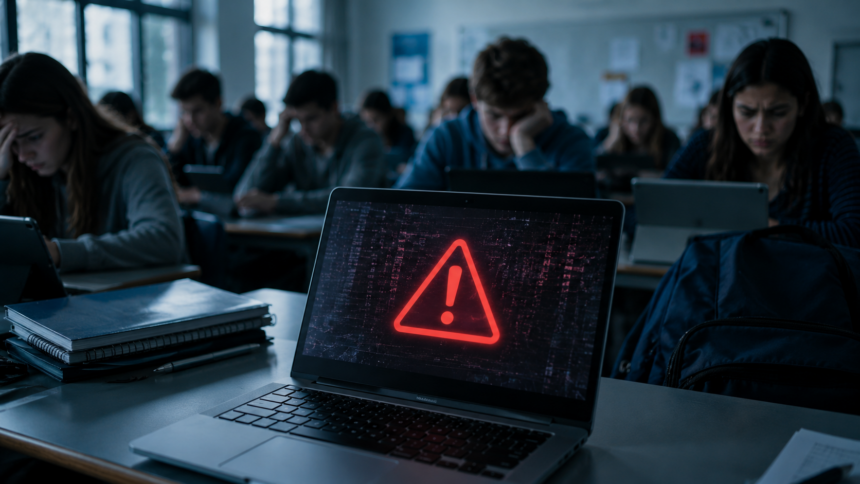
The Canvas LMS cyberattack struck at the worst possible moment. On 7 May 2026, criminal hacking group ShinyHunters breached Instructure, the parent company of Canvas — the most widely used learning management system in North American higher education. The attack took the platform offline for approximately nine hours. Students at Harvard, Princeton, Columbia, Georgetown, MIT, Duke, the University of Illinois, James Madison University, and thousands more institutions suddenly lost access to course materials, exam submissions, grades, and communications with faculty. The timing was deliberate. Millions of students were in the middle of final exams. Millions more were preparing for them. ShinyHunters replaced Canvas login pages with a ransom note. The message demanded payment to prevent the release of data from 275 million students and teachers. The deadline: 12 May 2026.
What’s Happening & Why It Matters
What Canvas Is — and Why Losing It Hurt So Much
Canvas is the dominant learning management system in North American education. It serves more than 30 million active users globally. More than 8,000 institutions — K-12 schools and universities — depend on it daily. Instructure describes Canvas as used by approximately 41% of higher education institutions in North America.
The platform is not merely a file storage system. Teachers upload course materials, communicate with students, and grade assignments through Canvas. Students submit work, view grades, take online exams, and receive course announcements — all in one place. When Canvas goes offline, the entire instructional infrastructure disappears simultaneously. That dependency is precisely what made this attack so damaging.
ShinyHunters: A Well-Known Criminal Group
ShinyHunters is not an unfamiliar name to cybersecurity professionals. The group has previously breached Ticketmaster, AT&T, and several other major US corporations. Its attacks follow a consistent pattern: gain access to a system, extract data, threaten to publish unless paid, and set a tight deadline. The Canvas LMS cyberattack follows that exact playbook.
Instructure discovered unauthorised activity in Canvas on 29 April — more than a week before the public attack. The company states it immediately revoked the unauthorised party’s access, began an investigation, and engaged outside forensic experts. Despite those steps, ShinyHunters returned on 7 May and replaced login pages across affected institutions with its ransom note. That escalation suggests the group had maintained access — or retained extracted data — despite the April revocation.
How the Hackers Got In: Free Teacher Accounts
Crucially, PCMag reported on 8 May that investigators traced the breach to Canvas’s free teacher accounts. Canvas offers free accounts to educators who want to use the platform independently — outside their institution’s paid licence. Those free accounts carry fewer security controls than institutional ones. ShinyHunters reportedly used free teacher accounts as the initial entry point into Instructure’s systems.
That finding is significant. It means the breach did not begin with a sophisticated zero-day exploit or a nation-state-level attack. It began with a category of user accounts that Instructure offered specifically to grow adoption. The same product decision that expanded Canvas’s reach created a lower-security access pathway that attackers exploited at scale.
What Data Was Taken — and What Was Not
Instructure confirmed the breach involved certain identifying information of users — including names, email addresses, student ID numbers, and messages among users. The company stated it found no evidence that passwords, dates of birth, government identifiers, or financial information were accessed. Exposure of personal financial and identity data would pose an immediate fraud risk. Name, email, and student ID data represent a longer-term risk.
Retired FBI special agent Richard Kolko described the future danger directly. “You need to follow up — because they have this information on these students now and a couple of years from now, they may use some of that information to attack them,” he told CNN. The FBI issued guidance advising anyone affected to avoid engaging with anyone claiming to have their data, including refusing to pay ransoms or respond to threats.
What Happened on Campus During the Nine Hours
The human cost was immediate and widespread. At the University of Iowa, political science professor Sara Mitchell lost the ability to grade papers for nine hours — directly during final exam week. At MIT, students reported that faculty scrambled to find students’ email addresses because Canvas’s announcement feature was unavailable. Junior Allison Park summarised the dependency clearly. “The fact that this one website was the link between teaching staff and students outside of class — I didn’t realise how big a dependency we had on it until they were scrambling to find our emails,” she said.
At the same time, James Madison University moved exams scheduled for Friday to Wednesday. Kent State University described ongoing concerns about disruptions to final exams. Kent State confirmed the outage affected tuition billing and financial aid systems — widening the disruption well beyond classroom access. The attack hit during what is arguably the single most high-stakes week in the academic calendar.
The Irony Mitchell Noticed

Sara Mitchell‘s observation from Iowa deserves its own moment. She had been teaching students about US and Israeli cyberattacks on Iran’s infrastructure as part of an international relations module. When Canvas went offline mid-lecture, her students experienced a live demonstration of exactly what she had been explaining. “Yeah, I guess this was good timing, we had just talked about this,” she said. “When you talk about all of these terminologies like ‘degrade’ or ‘denial of service,’ it’s hard for them to really wrap their minds around what it is.” By the end of the outage, they understood. “Our entire financial system is vulnerable, our electrical grid is vulnerable, especially when these cyberattacks get more sophisticated,” Mitchell said.
The Structural Problem: K-12 Cybersecurity Is Underfunded
The Canvas LMS cyberattack came in a specific policy context. A 2026 US State of EdTech report from the Consortium for School Networking found that 65% of K-12 technology leaders cite insufficient staffing and lack of dedicated cybersecurity budget as their top barriers. Meanwhile, the Trump administration cut its investment in K-12 cybersecurity earlier in 2026. Many state and local governments face their own budget shortfalls. Cybersecurity expert Doug Levin, cited in Education Week, put it plainly. ShinyHunters is “prolific, and they go after lots of targets in and out of education, including successfully compromising some of the largest companies in the US.” The capacity to defend against this calibre of attacker does not exist across most school districts. “We have to do a lot of work before we could have some assurance that we could keep these kinds of threat actors out,” Levin said.
Australia, The Netherlands Also Affected

The Canvas LMS cyberattack was not limited to the United States. ABC News Australia reported that universities, vocational education providers, and some state schools across Australia experienced disruption. Australia’s National Office of Cyber Security coordinated a federal response. In the Netherlands, 44 educational institutions were affected. The umbrella body for the Universities of the Netherlands confirmed that no Dutch university had yet been approached to make a ransom payment. The global scope reinforces the scale of ShinyHunters‘ operation — and the structural vulnerability of centralised EdTech platforms to the type of targeted attack.
TF Summary: What’s Next
Canvas restored full service on the morning of 8 May 2026. Multiple universities confirmed their platforms returned to normal by Friday. Instructure engaged outside forensic experts and notified law enforcement. The FBI is investigating alongside Instructure. The 12 May ransom deadline is active at the time of writing. ShinyHunters has threatened to release data from 275 million users if payment does not arrive. Instructure has not commented publicly on whether it will pay. Several universities announced extended deadlines and rescheduled finals as a result of the disruption.
MY FORECAST: Instructure will not pay the ransom — and ShinyHunters will publish at least a sample of the stolen data on or after 12 May to demonstrate the credibility of its threat. That publication will trigger a wave of notifications to affected students and staff at individual institutions. The more consequential outcome of the attack will be policy — specifically, the removal of free teacher accounts with reduced security controls from Canvas’s public product offering, and renewed Congressional pressure to restore federal K-12 cybersecurity funding. The vulnerability in the free account is the clearest, correctable systemic failure in the incident. Instructure will close it. Whether the 8,000 institutions that depend on Canvas to diversify their digital infrastructure dependency — rather than simply waiting for the next breach — is a harder question. Most will not. The cost of transition is higher than the cost of trust, until the next attack.